


Design
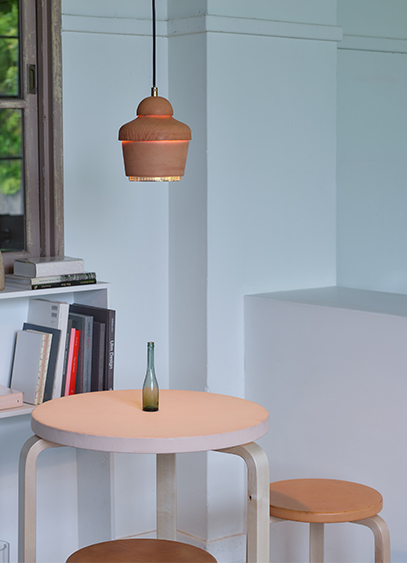
Le finlandais Artek et le japonais Hender Scheme présentent une première collaboration autour du vieillissement naturel des matériaux et du pouvoir esthétique du temps.
Notre attachement à certains objets ne s’explique pas par leur valeur intrinsèque, mais par leur histoire. Celle qui cause l’usure et attaque parfois la forme, voire la fonction. C’est avec cette question du temps qui passe en toile de fond qu’Artek et Hender Scheme se sont associés. Spécialiste du mobilier en bois cintré depuis 1935, la marque finlandaise avait amorcé en 2024 un nouveau tournant en tolérant, à l’occasion d’une collection avec le studio Formafantasma, les défauts du bouleau dans ses assises. Un rapport au naturel que la société, fondée par Aino et Alvar Aalto, interroge cette fois-ci avec un fabricant de chaussures et d’accessoires en cuir, le japonais Hender Scheme.
La valeur du temps
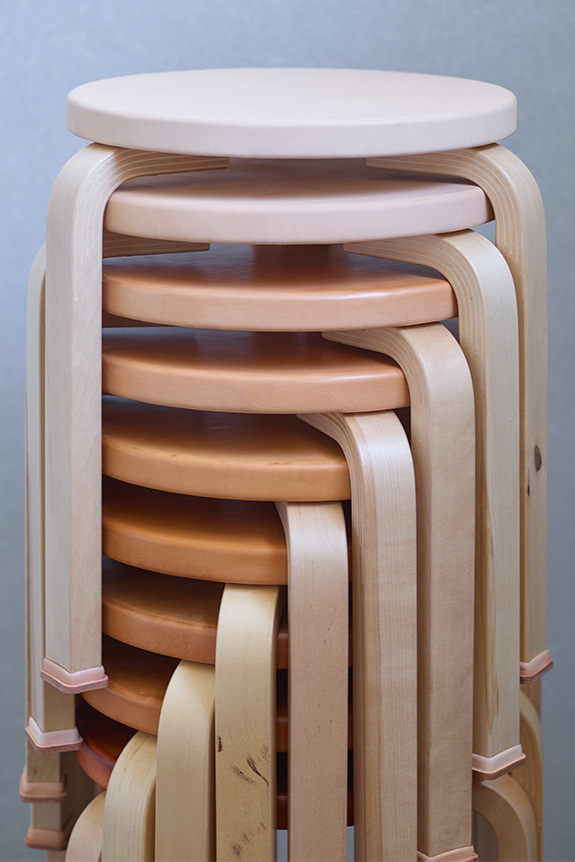
Si les objets sont façonnés par l’industrie qui les fait naître, cette collection entend montrer qu’ils continuent de vivre entre les mains de leurs utilisateurs. En faisant du cuir tanné végétal l’élément central de cette collaboration, les marques proposent un nouveau revêtement qui se patine naturellement avec le temps. Un rapport sensible à la vie des meubles qui confère aux pièces leur unicité. De ce choix naît aussi un échange entre les deux entreprises. La première introduit le langage stylistique du couple Aalto dans un univers codé et japonisant, lorsque l’autre importe son savoir-faire en dotant le célèbre Stool 60 de souliers de cuir. Un clin d’œil qui met en valeur le piètement en L caractéristique de la célèbre assise.
« New Craft » ou le concept d’un artisanat technologique
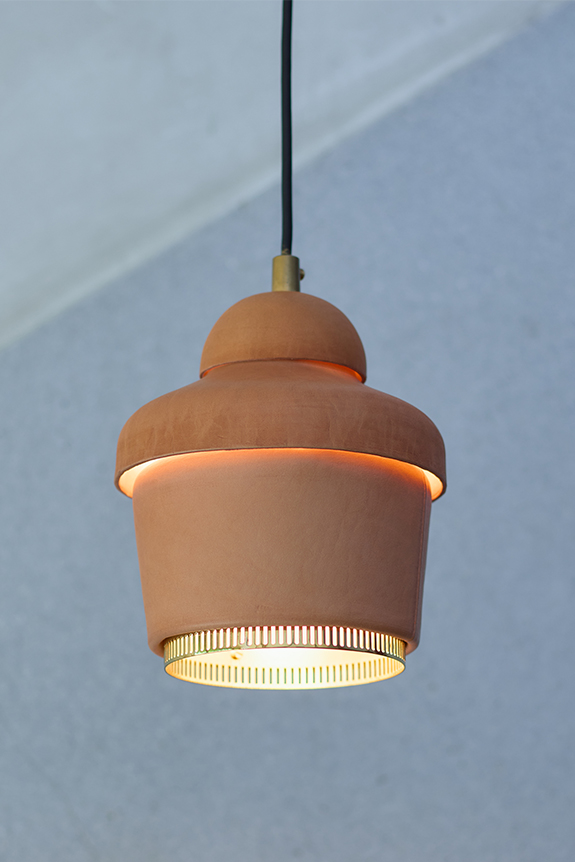
Cette nouvelle connexion est également l’occasion pour Hender Scheme de développer son concept de « New Craft ». Une idée selon laquelle l’artisanat et la technologie moderne se rencontrent et fusionnent au service de nouvelles réalisations. Parmi elles, la suspension A330 Golden Bell, dessinée par les Aalto. L’abat-jour en laiton est pour l’occasion réinterprété en cuir moulé. La technique traditionnelle du moulage humide est associée à l’impression 3D pour offrir de nouvelles qualités visuelles et tactiles sans altérer la forme initiale. Une proposition forte en écho au traitement plus classique du cuir valorisé sur différentes typologies dont une horloge, un porte-clés et des dessous de verre reprenant la forme courbe « Riihitie », imaginée par Aino Aalto. Dévoilés au London Design Festival, ces objets seront disponibles à la vente à partir du 10 octobre.
Ci-dessous de gauche à droite : dessous de verre et horloge
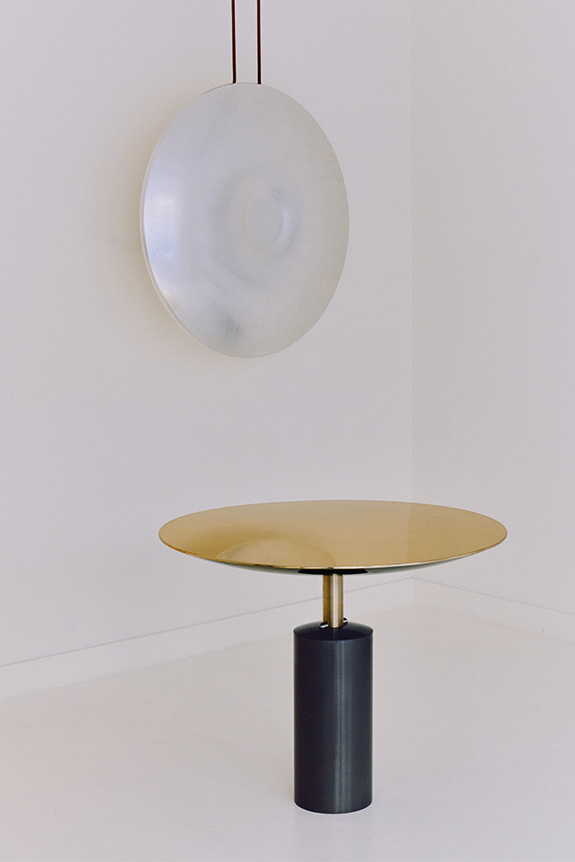
Jusqu’au 10 octobre, le duo Marie et Alexandre présente à la galerie signé l’exposition « Under Pressure », dans laquelle la pression est explorée sous plusieurs aspects : dans les techniques et les matières employées, mais aussi, plus largement, dans leur rapport à la création.
« L’idée derrière cette exposition était de travailler la pression un peu différemment, en utilisant des techniques diverses, avec cette idée d’explosion rapide, et de réussir à les allier toutes ensemble. » Pour cette exposition, le duo de designers formé en 2018 a choisi de faire de la pression son point de départ. Le titre, « Under Pressure », fait notamment référence à l’hydroformage, un procédé industriel dans lequel la pression de l’eau permet de donner forme au métal. Au sein de la galerie, Marie et Alexandre présentent ainsi des pièces façonnées par différentes forces et contraintes, réalisées en collaboration avec plusieurs artisans spécialisés. Mais la pression ne désigne pas seulement ici une technique de façonnage. Elle devient également une condition de création, exercée par la matière, par le temps, le doute, les choix parfois irréversibles ou encore la volonté de faire apparaître quelque chose qui n’existe pas encore.
Allier techniques et savoir-faire
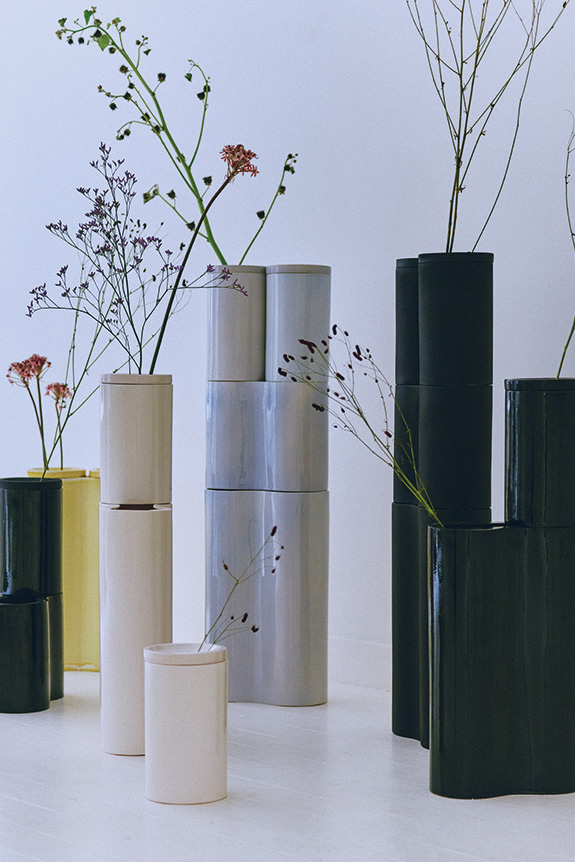
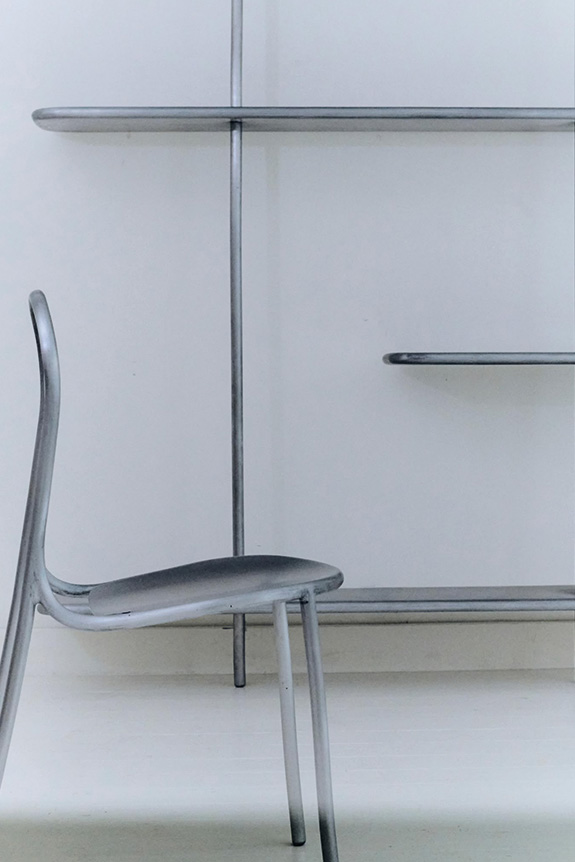
Au sein de l’exposition, qui réunit une dizaine de pièces, les designers se sont associés à différents artisans pour explorer la pression sous toutes ses formes. Avec Antoine Giret, ils présentent ainsi une console, un système d’étagères et une chaise autour d’un travail de l'aluminium fondé notamment sur la vibration de la matière et la création de systèmes. Accompagnés par Jean-Marie Foubert, ils ont imaginé une collection de vases en céramique, déclinés en versions simple et double ainsi qu’en différents formats. Avec le verrier Simon Rio, ils sont allés vers un autre registre en imaginant une table basse dont le plateau est en verre thermoformé. Enfin, avec l’atelier Blam - notamment connu pour avoir participé à la réalisation du cheval mécanique apparu lors de la cérémonie d’ouverture des Jeux olympiques de Paris 2024 -, ils ont imaginé une table sur piston ainsi qu’un médaillon en métal et feuille d'argent dont la forme naît directement de la contrainte exercée sur la matière. Ce dernier sera ensuite destiné à rejoindre la Cité du design de Saint-Etienne, récemment inaugurée.
À travers cette exposition, Marie et Alexandre semblent faire évoluer leur langage formel vers davantage de retenue. Les formes se resserrent et les moyens se réduisent, sans pour autant perdre leur fonction et leur intensité. Un moyen finalement pour le duo de questionner son propre processus créatif.
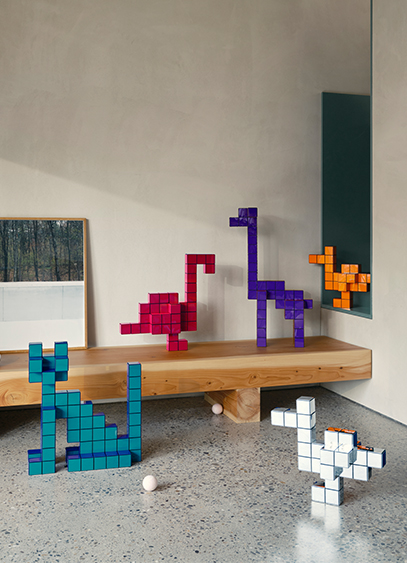
Imaginé par Verner Panton dans les années 1970, le système modulaire Panton Cubes est aujourd’hui réédité par Vitra sous la forme de quatre kits représentant des figures animales.
Imaginés par Verner Panton en 1974, les Panton Cubes associent jeu et design. Constitués de structures cubiques pouvant être assemblées entre elles à l’aide de clips, les cubes sont ensuite habillés de panneaux colorés ou chromés. Ce système permet de composer des volumes et des motifs variés, allant de sculptures figuratives à des constructions plus abstraites.
Développée par Vitra en collaboration avec Verner Panton Design AG à l’occasion du centenaire de la naissance du designer, cette réédition propose quatre modèles : un canard, un flamant rose, un chat et une girafe. Chacune des versions est proposée dans une combinaison de deux couleurs ou avec une finition chromée. Les modèles bicolores reprennent la palette vive caractéristique du travail du créateur danois. En laissant à chacun une grande liberté de construction, le concept des Panton Cubes illustre de manière ludique les possibilités offertes par un système modulaire.
Ci-dessous : ©Panton Cubes - Vitra
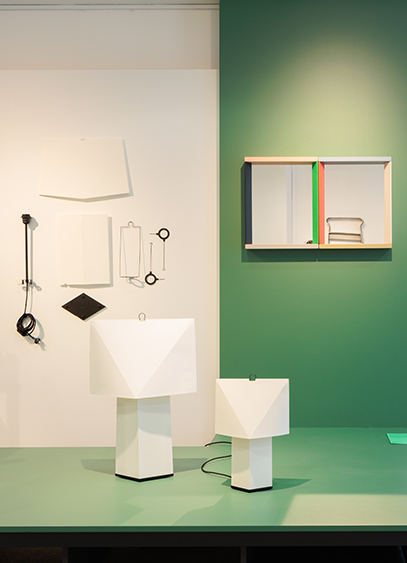
Through October 3, the Bureau de la Mode, des Métiers d’Art et du Design (BDMMA) is presenting the "Multiples" exhibition. A range of projects celebrating industrial design and the new relationships between designers and industry.
As we reflect on September's Paris Design Week, one thing is clear: collectible design seems to reign supreme. Yet, the less "Instagrammable" world of industrial design has not disappeared. To reaffirm its presence and offer a counterpoint to the current trend, the Bureau de la Mode, des Métiers d’Art et du Design (BDMMA) presents "Multiples." Conceived as a return to basics, the exhibition is not "a status report on the sector", but rather aims to "provide an overview of research and textures centered on mass production", explains Frédéric Bouchet, deputy director of the institution. This diversity is reaffirmed through thirteen studios whose utilitarian and aesthetic objects celebrate production. Through this, the focus is not on creating for the sake of creating, but on the intelligence of replicable and viable systems.
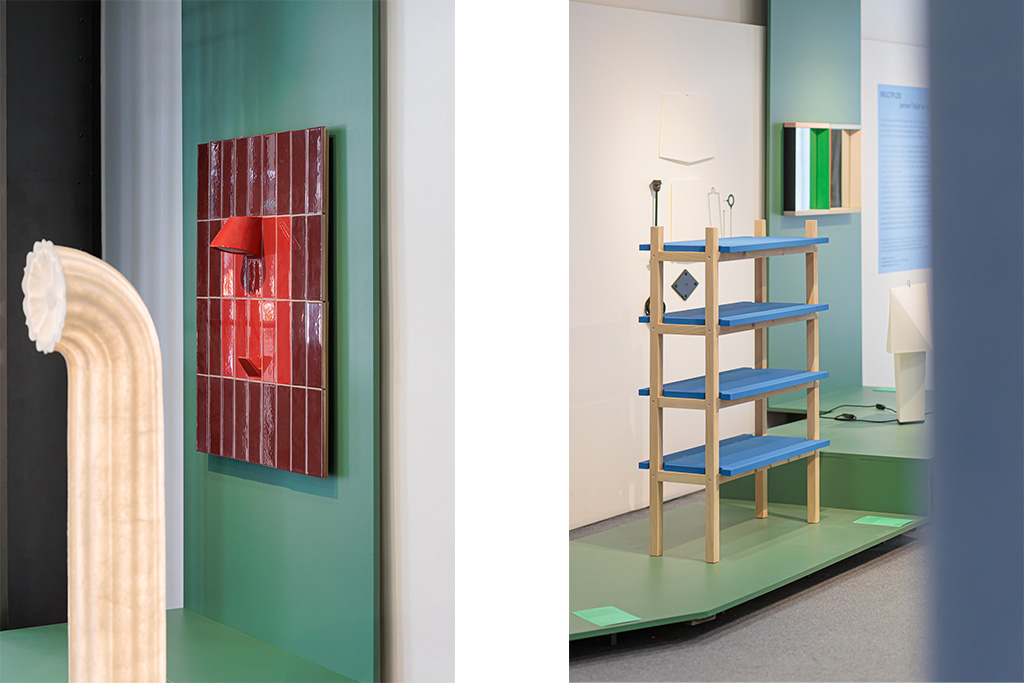
A new relationship with industry, but the same idea of design
If the sector is experiencing "a change of state", it is partly due to the upheaval that has occurred in industrial production. "The relationship with industry has changed completely, requiring designers to shift their stance and be less passive regarding production. They are now encouraged to take hold of processes themselves or repurpose production methods to engage in self-publishing", analyzes Frédéric Bouchet. These new alternative paths are prompting some designers to question the challenges related to resources and how the materials used serve their intended purpose. "It seems to me that this concern is increasingly rooted in the local fabric, as seen in the work of Jules Levasseur. He convinced a company in Burgundy, where he is based, to take an interest in his project, and together they developed 'Projet S,' made from corrugated metal sheets. His challenge today is to channel production at his own scale to produce just the right number of furniture pieces." Beyond the challenge of economic adaptability, there is the issue of formal and technical reinterpretation. "How can one avoid being beholden to traditional publishing? How can I bring local industry into my own territory while generating value? These are the two major questions that emerge in the exhibition, notably through the work of Lila Guédin, who used industrial assembly techniques to create chairs, and Nicolas Verschaeve, who uses tool handles to create small interior objects like hooks and coat racks." These captures and reinterpretations of pre-existing industrial matrices open up new aesthetic and technical doors. Whether published or not, the projects selected by curators and exhibitors Lucien Icard and Kevin Lebouvier shed different lights on these new relationships with industry, favoring "a certain stylistic purity based primarily on assembly".
An exhibition to discover at the Bureau de la Mode, des Métiers d’Art et du Design, 30 rue du Faubourg Saint-Antoine, in the 12th arrondissement of Paris, until October 3rd.
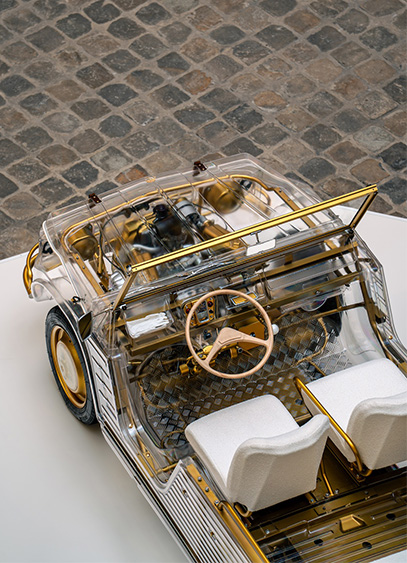
For Paris Design Week, and running until October 4, the Hôtel de la Marine is hosting a Méhari. This lunar-inspired hybrid vehicle was reimagined by Maison Lacmé as a tribute to fine craftsmanship.
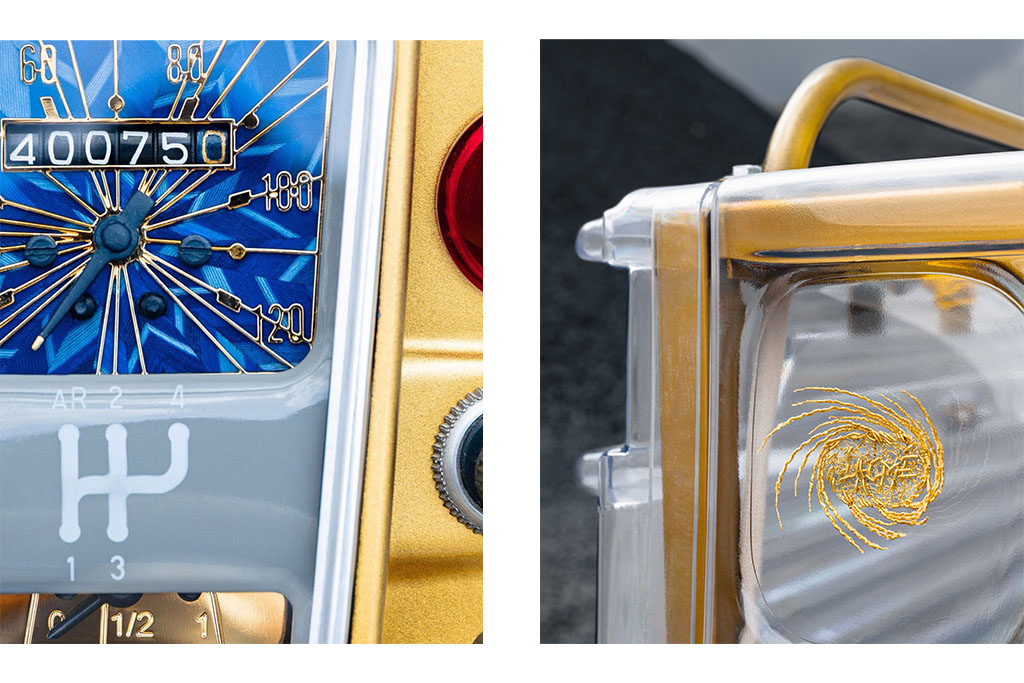
While the Hôtel de la Marine has established itself as a key venue for Paris Design Week, this year’s bold choice is sure to surprise. A curious car is parked right in the center of the courtyard, its odometer—fresh from the workshop—seemingly stuck at 40,075 kilometers. A malfunction? No, a clue. Because behind this familiar silhouette, that of the Citroën-produced Méhari, lies a true design manifesto and a tribute to the decorative arts.
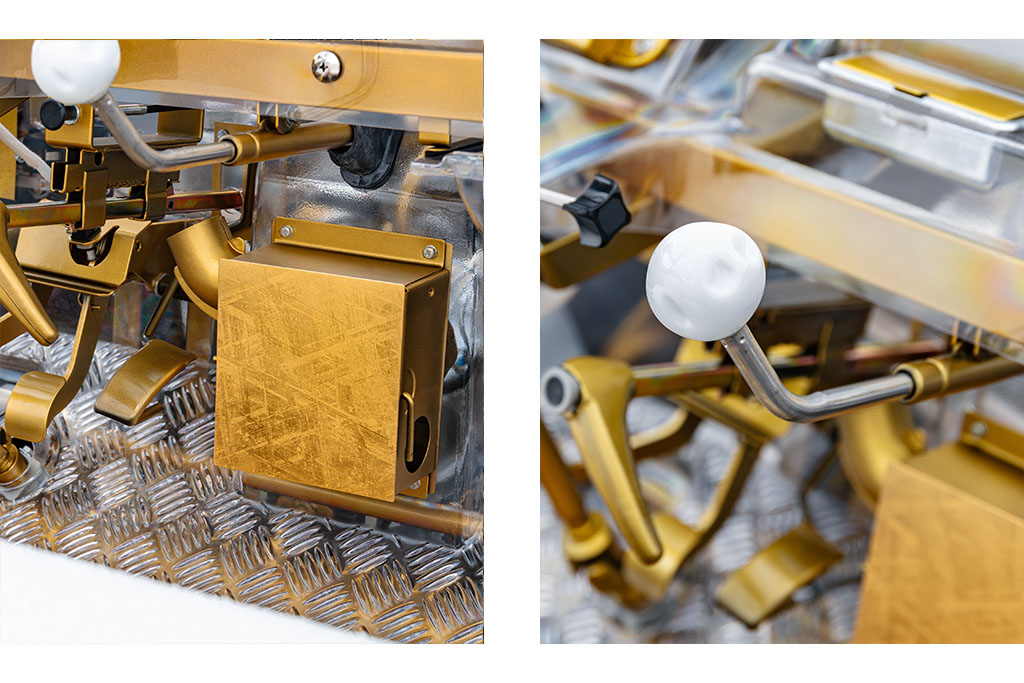
A collision between industry and craftsmanship
Behind this project are Cécile and Antoine Tauvel, the founders of Maison Lacmé, established two years ago. Their goal: to create functional works of art from everyday objects. This ambition led the two vintage car enthusiasts to explore the potential of the Méhari. "For many French people, it evokes the 60s or memories of seaside vacations. But for me, it was also the lunar aspect that spoke to me, reminding me of the covers of certain Tintin albums. So our role was to reveal the symbolism and the sense of wonder that were already there," explains Antoine Tauvel. The couple then designed the frame. It would be gold, echoing French decorative arts and art history, applied in touches to a transparent chassis. "What we found interesting was creating a certain balance between industry and fine craftsmanship by playing with contrasts." This aesthetic research was conducted with a French manufacturer to rethink the polymer composition and prevent the chassis from yellowing, after which a layer of transparent ceramic was applied. "The challenge was to transform this purely industrial typology into an art object without giving it the status of a luxury item. We first had to spark formal curiosity to then draw the eye to the smaller elements," details Cécile Tauvel. A quest for storytelling where the automobile conveys the imagination.
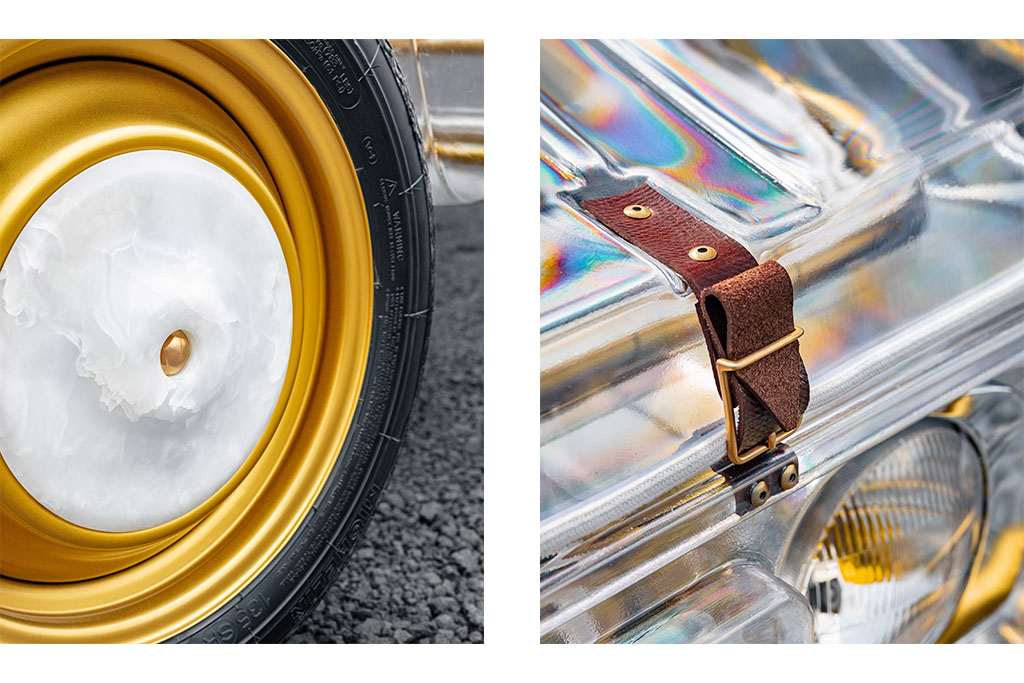
A concentration of expertise
Who said a hubcap and a lamp, or an automotive logo and a brooch, don't belong to the same world? Certainly not Maison Lacmé, whose project is centered on the ambivalence of objects. Each of the twelve elements created by master artisans has a practical function. "This car is a Trojan horse, a mobile cabinet of curiosities that hides things within itself," summarizes Antoine Tauvel, who originated these dual functions. "This idea is central. We did all the preparatory drawings and aesthetic choices in-house, then presented them to the artisans." From then on, the project became collaborative, and the sketches were adjusted for aesthetic coherence. The steering wheel, crafted from driftwood, and the seashell-embroidered upholstery open up a maritime horizon, while the feather-marquetry odometer—stuck at the Earth's circumference—can be removed and used as a desk clock. Beyond their utility, the techniques used recall those of the golden age of French decorative arts. Among them is the trompe-l’œil technique, used to replace the stone hubcaps with painted versions when the vehicle is in motion.
A true "poetic travel tool," the Maison Lacmé Méhari will be on display in the courtyard of the Hôtel de la Marine until Sunday, October 4.
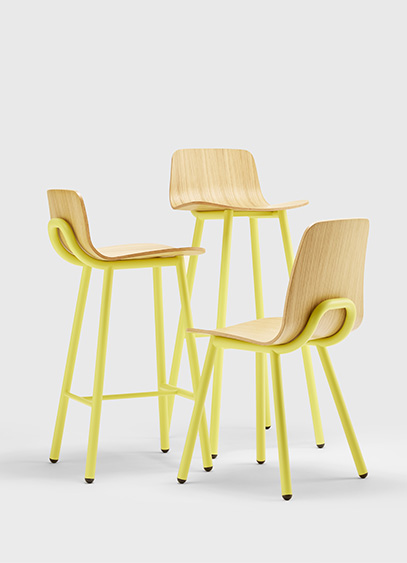
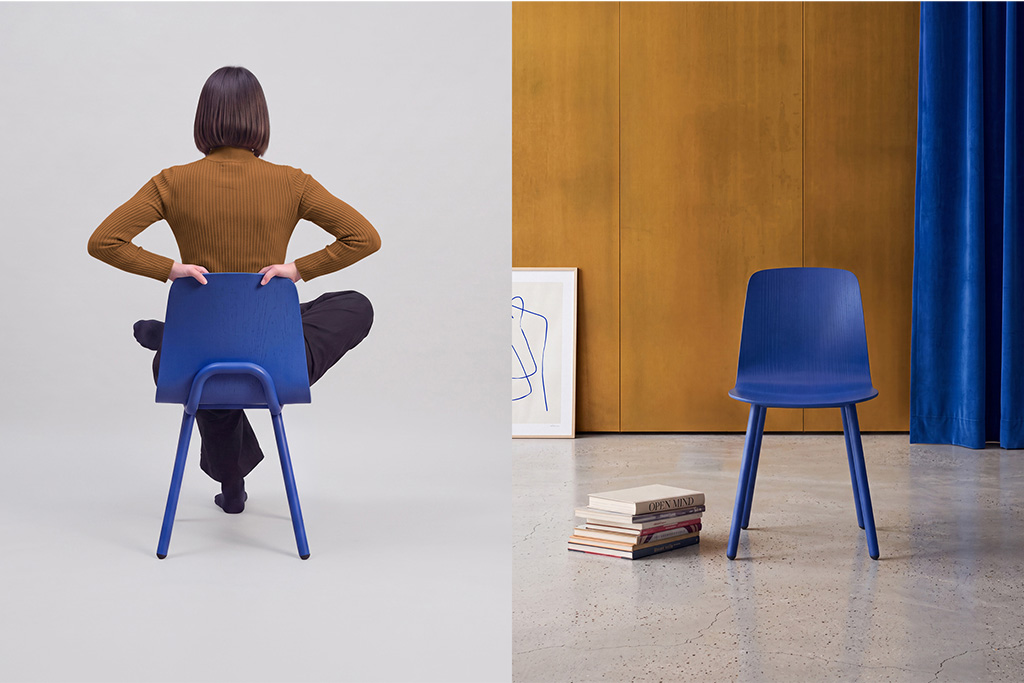
Fifteen years after the launch of Kuskoa, Alki and Iratzoki Studio are evolving this iconic collection with Kuskoa M.
Created by Iratzoki Studio in 2011, Kuskoa established itself as one of Alki’s best-sellers with its oak shell design set on a solid wood trestle. During Paris Design Week, the brand unveiled Kuskoa M. Comprising a chair, two stools of different heights, and a bench, the collection was designed for restaurants, bars, canteens, and kitchens alike. With its various heights and typologies, this set can offer multiple configurations within a single space.
Featuring a powder-coated tubular steel frame, the seat develops a new graphic expression. Available in several finishes, it offers everyone the opportunity to compose their own piece, celebrating monochrome or, conversely, contrasts between metal, wood, and textile. Note that the shell can be upholstered in its entirety or only on the front.
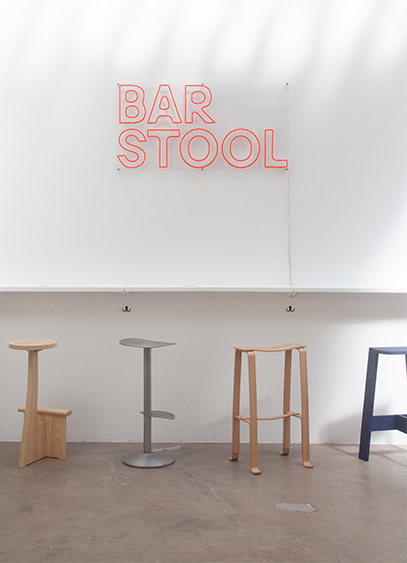
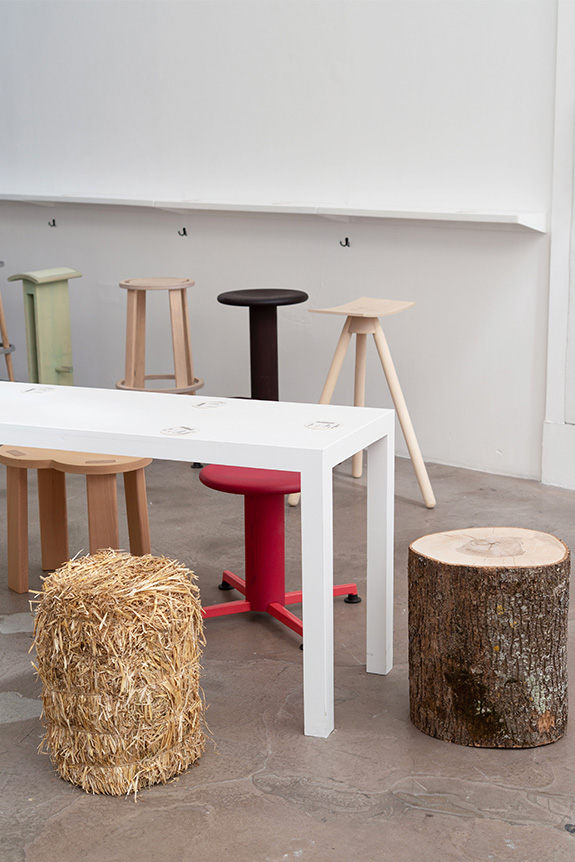
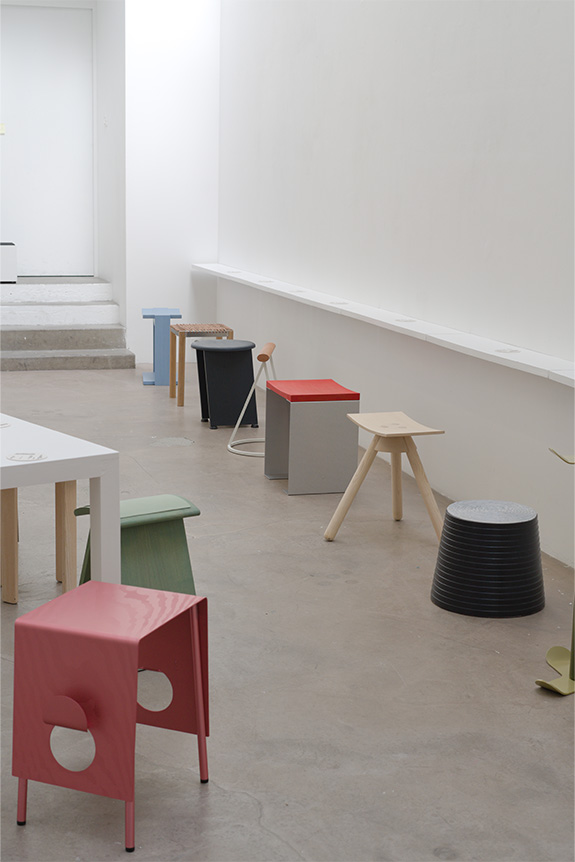
For their first joint exhibition, Athime de Crécy and Quentin Frichet have invited 35 designers to each create a stool. This free-spirited and convivial initiative, centered on utilitarian design, is on view at Espace Brownstone in Paris until September 19.
It is a sentiment some might find overused, but design, beyond its commercial and aesthetic dimensions, must be utilitarian. This philosophy, often challenged in the context of collectible design and shifting trends, is shared by Athime de Crécy and Quentin Frichet. Both ECAL graduates, having trained under Philippe Starck and Erwan Bouroullec respectively, the two young designers have taken over Espace Brownstone in Paris until September 19. It is a white-box space where 35 stools are displayed—not for visitors to look at, but for users to experience. "We had wanted to create a self-service exhibition for a long time. We initially thought about doing it in a bar, but in the end, the typology of the object took precedence over the venue," explains Athime de Crécy. Here, behavior is not dictated by the decor—which is nonexistent, save for a central table and drink storage at the entrance—but by the very nature of the pieces themselves. Presented without pedestals or labels, the seats invite everyone to pick them up, move them around, and sit down, effectively transforming the gallery into a living space. "We believe that a design exhibition that separates objects from the public invariably loses an essential aspect of what makes the discipline so powerful." The social dimension is an imperative here, carried by the stool and its characteristically lighthearted tone.
A shared idea expressed in every form
If a single object can spark different visions from one mind to another, *Bar stool* is the perfect illustration. A true synthesis of forms and materials, the exhibition is an ode to creativity. From the technical mastery of molded wood by Arthur Desmet to the high-tech 3D-printed stainless steel by the German studio Wint, the exhibition reveals a paradoxical coherence driven by the balance of diverse ambitions. "We didn't have to look far to find the designers. They are friends with whom we share a common sensibility for utilitarian and expressive design. We simply gave them total creative freedom, without even imagining that the projects might end up looking alike." A curation that gives this ephemeral refreshment bar its unique character and connects the aesthetic experience with everyday life. "It’s an approach that, in our view, draws the maximum amount of meaning from the minimum amount of resources."
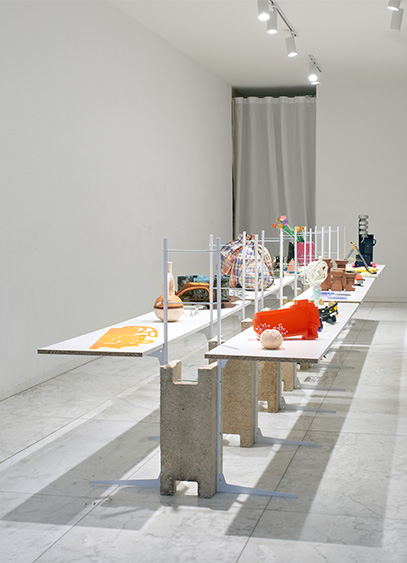
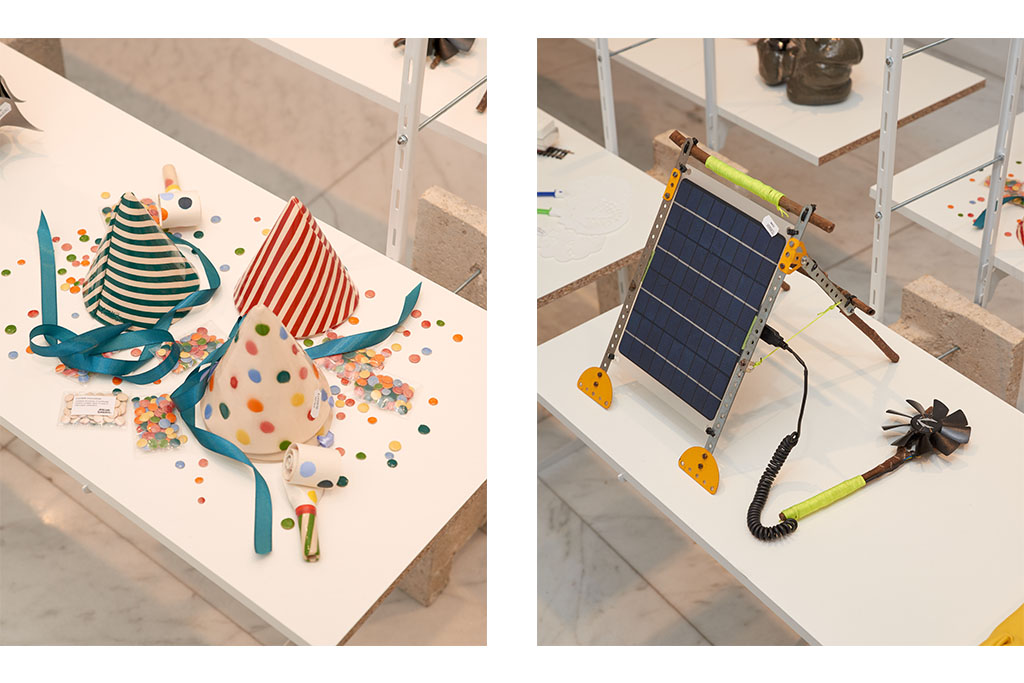
For Paris Design Week, Pierre Castignola and Alexandre Delasalle have brought together the work of 27 designers for the exhibition "take one just in case." It is a tribute to forgotten, sometimes incongruous typologies and unexpected styles.
While Paris Design Week is keen to celebrate design in all its diversity, the field remains a relatively closed concept. It was based on this observation that Alexandre Delasalle and Pierre Castignola conceived an exhibition for this September edition to celebrate alternative typologies. "Over the years and editions, we were frustrated to see that the pieces presented were generally the same, ranging from chairs to tables to mirrors. Yet, my pop-culture aesthetic and Pierre’s very classic, everyday objects don’t fit into the codes of postmodern design.", analyzes Alexandre Delasalle. Convinced that the sector is more abundant than it lets on, the duo created an exhibition celebrating neglected objects.
A heterogeneous gathering
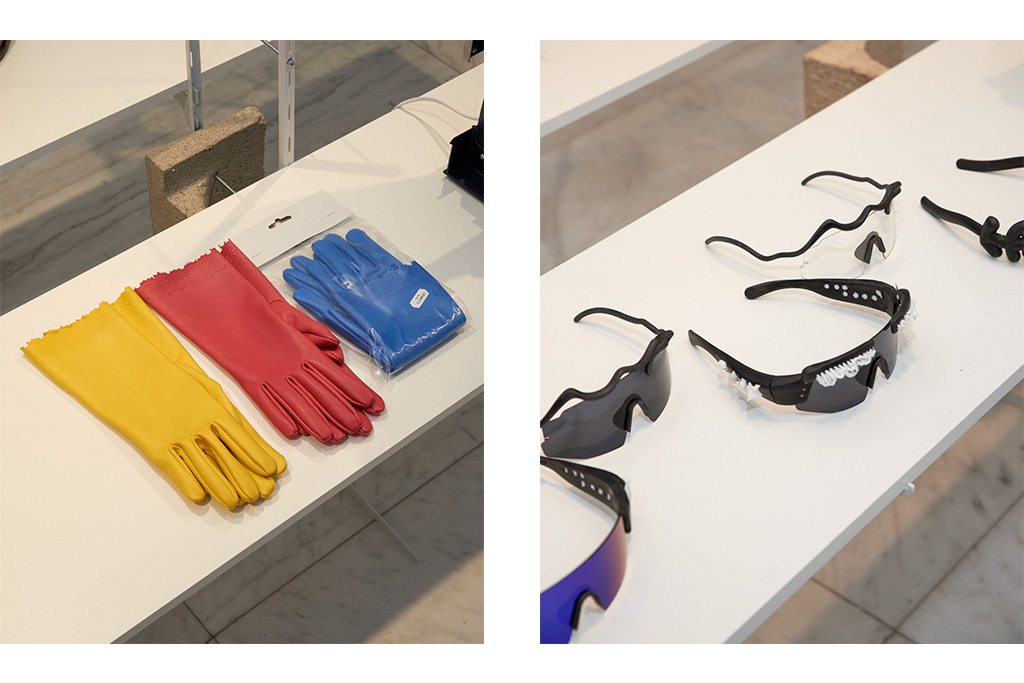
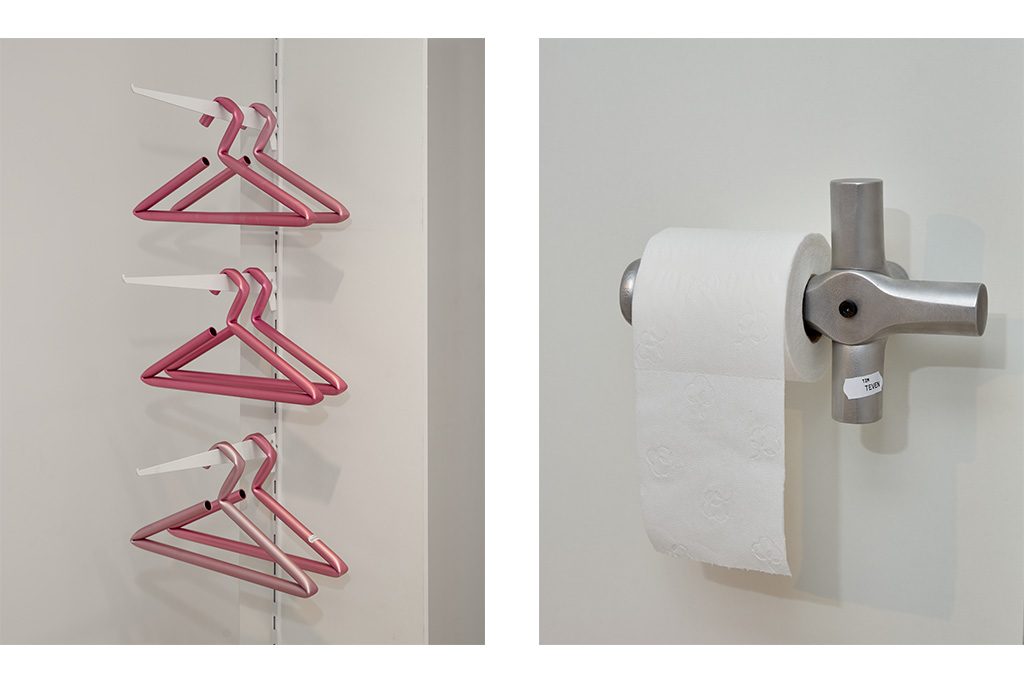
To help illustrate this diversity, the two friends invited 27 different profiles—designers and artists alike—to rework object archetypes. "Originally, Pierre and I thought of objects like a pizza cutter or a bucket, because these are objects that don't have a name in design. The former is usually inhabited by something else, like a superhero shape or an offbeat color, while the latter is so forgotten it becomes the zero degree of writing." Two opposing approaches—one loud and one silent—quickly expanded by the unique visions of the other creators. From the leather dishwashing gloves by Alice Clermont to the industrial toilet paper dispenser by Tim Teven, and the ceramic box topped with a spiked collar by visual artist Sacha Lefèvre, the approaches, sometimes very literal or more embodied, intertwine within the exhibition. "What seemed most important to us was to establish a corpus capable of surprising us. Overall, we knew all the profiles to varying degrees, but our discussions and reflections now allow us to exhibit very different objects, whether they were designed specifically for the event or not."
A creative bazaar
Inspired by the multitude of invisible objects that inhabit our storage spaces, Alexandre Delasalle and Pierre Castignola took an interest in bazaars. "These are spaces that bring together very contradictory elements, ranging from classics that can last a lifetime, like a frying pan, to very striking but sometimes very ephemeral things, like slippers." Drawing on the idea of these markets, the exhibition space, formerly a garage, has been shaped into a long, narrow layout. "What was interesting is that the notion of a bazaar isn't the same from one country to another. I have the one in Belleville in mind, but for other creators, it might be chain stores like Action. However, the idea of a small storefront with longitudinal aisles is common. We wanted to capture that feeling of entering the space.", explains Alexandre Delasalle. In keeping with this vision, the exhibition space features a long central shelf where a neo-futuristic hand brush and a baroque mini-fan straight out of a Disney movie engage in dialogue. "The scenography is DIY, using cinder blocks and storage racks, but it serves the concept. It’s the accumulation of a certain number of objects that gives the bazaar its spirit, not the other way around. And it’s this idea that gives 'take one just in case' a polyphonic quality," concludes the designer.
For the new season, Monoprix has invited Hall Haus to design a collection of furniture and decorative objects with an industrial aesthetic. We sat down with Sammy Bernoussi, co-founder of the Parisian studio, to discuss the collaboration.
Drawing on a world of hip-hop and sports influences, Hall Haus presents its collaboration with Monoprix. As the studio's first large-scale project, the collection brings a trendy industrial style to a wide range of home furniture and accessories. We spoke with Sammy Bernoussi, one of the collective's four co-founders, about this contemporary approach.
Hall Haus is often associated with an industrial aesthetic featuring perforated steel plates. Why did you choose to maintain this signature look for this collection?
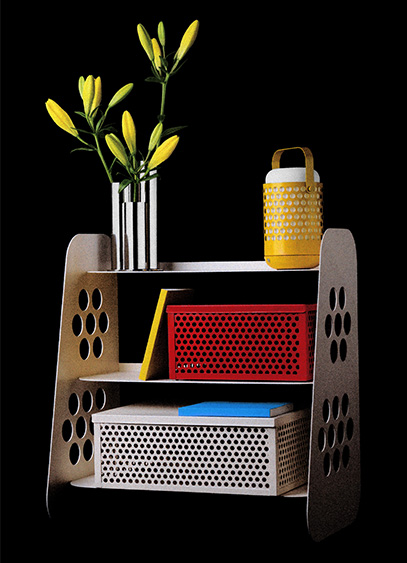
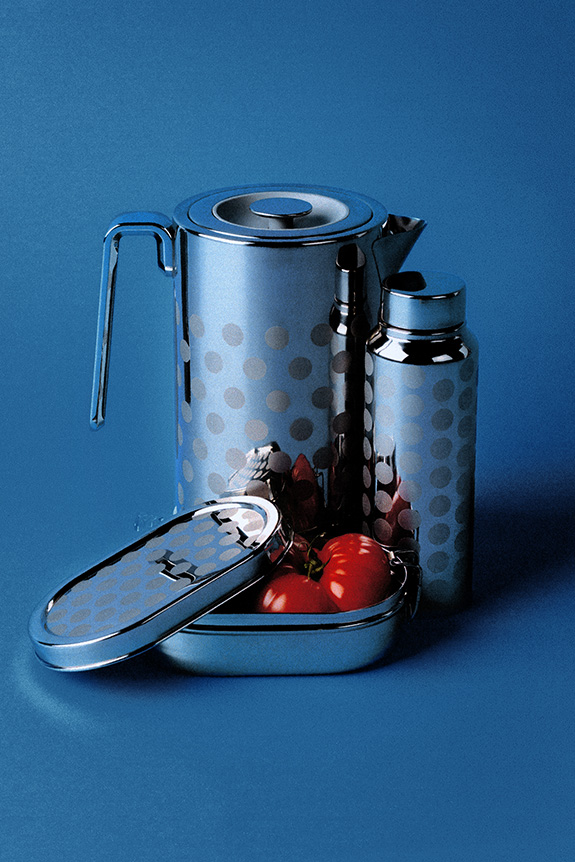
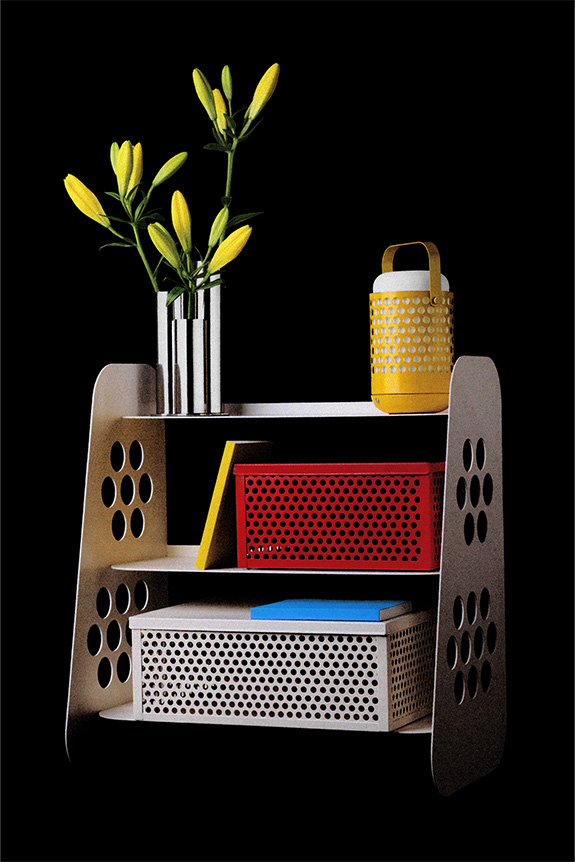
While you do see plates with holes, I think we’ve moved away from that slightly by building a bridge to Prisunic, specifically through the use of bent tubing. We had experimented with this technique before, but it was difficult for us due to our small production volumes. The collaboration with Monoprix opened new doors in terms of form and materials—like chrome, which is prohibitively expensive for small runs. Furthermore, working with Monoprix gave us the opportunity to create a truly comprehensive range. Aesthetically, we wanted it to reflect our past work while also realizing ideas we hadn't had the chance to bring to life yet. There’s a lot of talk about Bauhaus these days, so we had fun blending Breuer’s tubular structures with our own DNA. This collection is a mix of history and our own language, particularly when it comes to color. As a reminder, "Hall" comes from apartment building lobbies and the sense of community those spaces evoke, while the second part of our name is a nod to our affinity for the modernist Bauhaus movement.
The collection stands out for its wide variety of typologies. Why is that?
We were given total creative freedom. The initial idea was to offer back-to-school essentials since we were launching in early September. We wanted a student to be able to furnish their new apartment with something beautiful and affordable—maybe spending just 10 euros more to get a customized piece. We started by designing over 45 objects and ended up manufacturing 27. We selected accessible typologies, but we also decided to hybridize others. For example, we removed the dryer, but added bars to the room divider to give it a new function as a drying rack. It resulted in a really interesting piece for small apartments. I’m convinced that everyone can find something useful for their home in this collection.
Collectors are used to seeing color in your previous work. Yet, the collection you’re offering now seems to favor sobriety.
It’s true that the studio’s creations are often customizable in bright colors, but for our collaboration with Monoprix, we had to rationalize. We removed the pink, kept blue only for the shopping cart, and opted for yellow and beige—a neutral tone that remains in high demand. Then, we simply accented the collection with a touch of red as a nod to Monoprix. With the modernist chrome base, we had a lot of freedom in our color choices, so it all felt very natural.
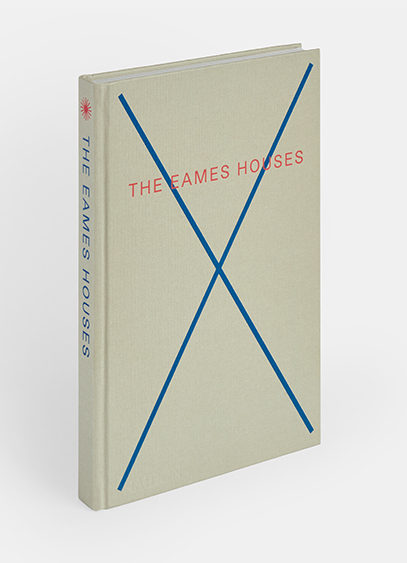
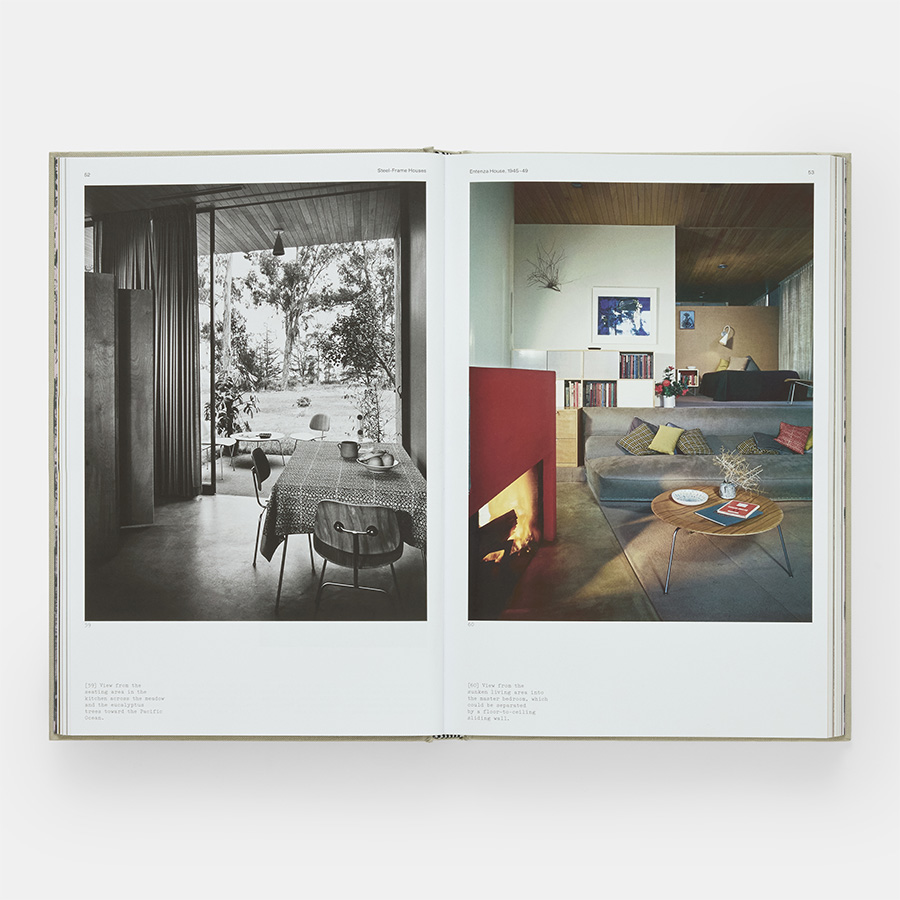
To mark the release of the book The Eames Houses, author Eckart Maise and Kettal creative director Antonio Navarro reflect on the pioneering, creative vision of the famous American architect couple.
As a legendary architectural duo, Charles and Ray Eames helped bring modernism into the residential sector. Nearly a century after their most famous projects, publisher Phaidon is releasing "The Eames Houses." More than just a monograph, the book—developed over two years—revisits eight projects that explore prefabrication, flexibility, and industrial materials. Here, architecture is not a stylistic exercise, but a generous system designed to serve daily life. To delve into this philosophy, we asked a few questions to Eckart Maise, former creative director at Vitra and a long-time collaborator of the Eames family, and to Antonio Navarro, artistic director of the Spanish company Kettal, which launched the Eames Pavilion last April.
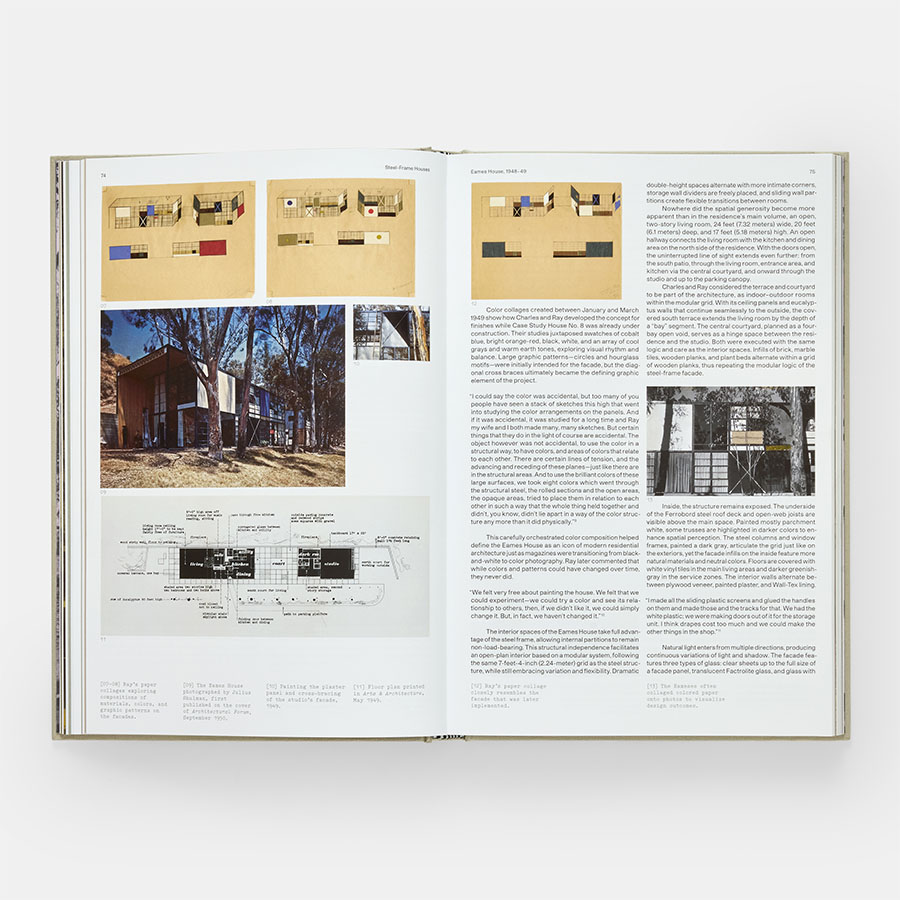
To start, could you provide some context on how the Eames houses came to be?
Eckart Maise: These houses emerged in the United States after World War II. At the time, a severe housing shortage coincided with an industrial model that was finally capable of producing standardized components on a massive scale. In California, the population was growing rapidly, and changing work and family life patterns called for new forms of domestic architecture. Consequently, the Case Study House program was launched in 1945 by John Entenza’s magazine, Arts & Architecture. The goal was to ask architects to apply advancements in materials to modern, affordable housing. Charles and Ray Eames conceived the house as a system rather than an object in the traditional sense. They favored a lightweight structure assembled from readily available components, capable of adapting to different sites, occupants, and lifestyles.
So, was the fundamental idea behind the Eames approach to create industrialized, modular design?
Antonio Navarro: Absolutely. Charles and Ray demonstrated that this idea was viable through the Eames House. However, its transformation into an industrial system that could be produced and distributed on a larger scale did not succeed. The concept was likely just too far ahead of its time. In the late 1940s, many of the materials, components, and technologies required to efficiently produce this type of architecture did not yet exist or were not sufficiently accessible. The Eames House itself was built using industrial components originally manufactured for other purposes. In fact, Charles and Ray developed a prefabricated house for Kwikset intended for mass production, but the company changed ownership and went bankrupt before the prototype could be built.
Architecture is much harder to industrialize than furniture. Each project must respond to its climate, location, foundations, local regulations, utilities, and logistics. So, the idea was sound, but the technical and industrial ecosystem needed to make it possible was missing. Today, many of those conditions are finally in place.
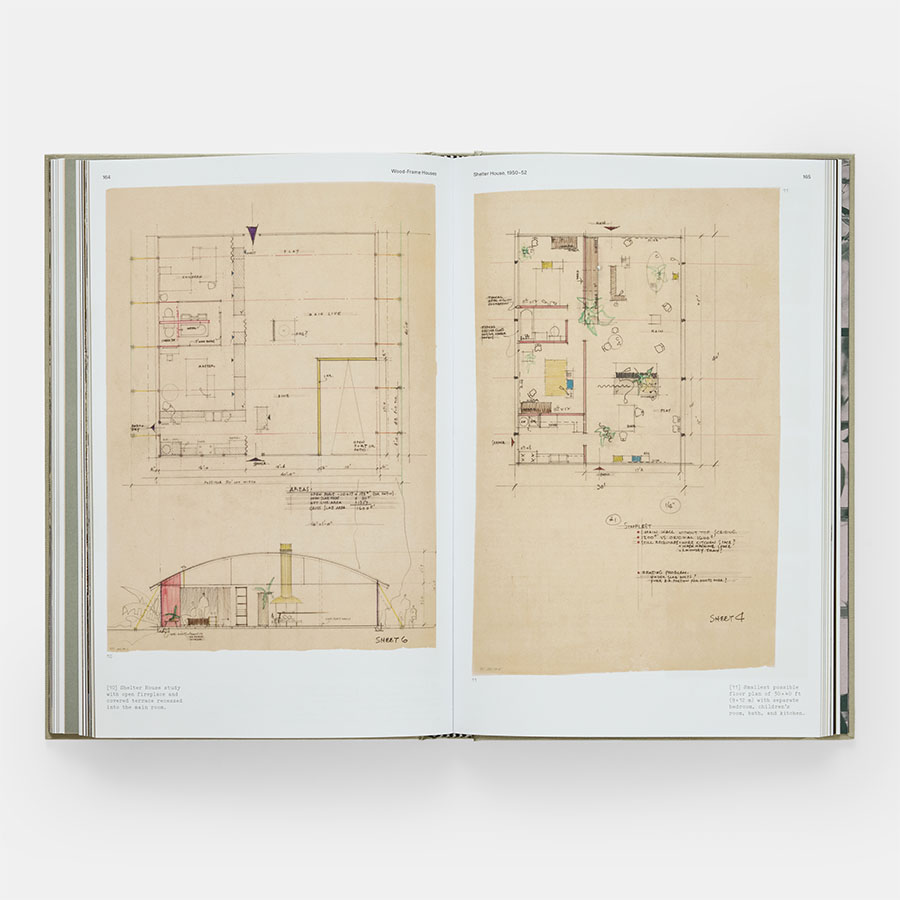
This was demonstrated in April at the Milan Triennale with the launch of an Eames Pavilion. How did Kettal and the Eames Office collaborate to design this 2026 version, which is not a replica of a blueprint, but an extension of a vision?
EM: The pavilion was born from archival research into the experimental houses and construction systems developed by Charles and Ray between 1945 and 1955. The Eames Office and Kettal translated their recurring principles—a structural grid, prefabricated components, and interchangeable infill panels—into a contemporary kit of parts. For Kettal, the brand was a natural fit because it already had experience in aluminum construction, particularly with modular pavilions. Its engineering and manufacturing capabilities allowed the Eames' ideas to move beyond the prototype stage. The goal was not to reproduce a single historical project, but to develop an adaptable system that could be manufactured, configured, and expanded to meet current requirements.
And those requirements have surely led to some changes?
AN: I wouldn’t say we changed the architecture. Our intention was to translate the original system into a contemporary production while preserving its logic, proportions, and visual character. From the start, we wanted the technical work carried out by Kettal to be almost imperceptible in the final result.
We therefore studied the Eames House as a built prototype, measuring and analyzing its components, profiles, surfaces, colors, and construction details. This study was combined with research conducted by the Eames Office on their other built and unbuilt architectural projects.
But moving from an unbuilt project to a product available for sale requires standardization, particularly regarding technical elements?
AN: Indeed. We reduced the number of elements, streamlined the assemblies, and established clear configuration rules. Paradoxically, simplifying the system increases its possibilities, because the same components can create many different structures.
So, it is the technical aspect that we primarily modified by introducing high-precision extruded aluminum profiles, improving thermal and acoustic insulation, and taking into account contemporary requirements regarding waterproofing, tolerances, weather resistance, durability, and local regulations. We also integrated lighting, ventilation, climate control, and connectivity. There is novelty, then, but the underlying architectural intelligence remains that of Charles and Ray Eames.
How do you explain that this intelligence, nearly a century old, still meets contemporary needs and aspirations?
AN: Perhaps the most surprising thing is that many of the questions Charles and Ray sought to answer have become even more urgent today. In any case, there are multiple factors.
From a technical standpoint, they conceived of architecture as an adaptable system rather than a fixed object. A rational grid and a limited number of interchangeable components allow a structure to be configured for different uses, expanded, reduced, dismantled, or moved. Elements can be repaired or replaced individually, and components that are no longer needed can be reused elsewhere. This is a much smarter use of materials than when every building is considered a permanent and inseparable whole.
From a sociological perspective, our lives have become increasingly mobile and fluid. Families grow or shrink; businesses expand, contract, or relocate; and the boundaries between home, work, and hospitality continue to blur. A space that is suitable today may need to function very differently in five or ten years. The Eameses understood that architecture should support these changes rather than resist them.
There is also an environmental dimension. In certain contexts, architecture should be reversible, allowing a structure to be removed and the landscape restored rather than permanently transformed.
What must be remembered is that they were not designing architecture to fit a particular image of modern life. They were thinking of a structure capable of responding to life as it evolves.
Beyond their functionality as living spaces, the Eames buildings were also visual. What role did the Eameses and their wireframe architecture play in modernist aesthetics and the famous Case Study Houses program?
EM: Of the 36 Case Study Houses proposed, Charles and Ray Eames developed the original design for the Bridge House as well as the Entenza House with Eero Saarinen, followed by the Eames House, which was the one actually built. Although all 36 projects followed the same brief for affordable, contemporary housing, their architectural approaches differed significantly.
The Eameses' unique contribution was to treat exposed steel structures, standardized industrial components, glass, and colored panels as both a construction system and a visual composition. Their importance lay not in defining a single aesthetic for the Case Study Houses, but in demonstrating that industrial standardization could foster architectural freedom and highly individualized ways of living.
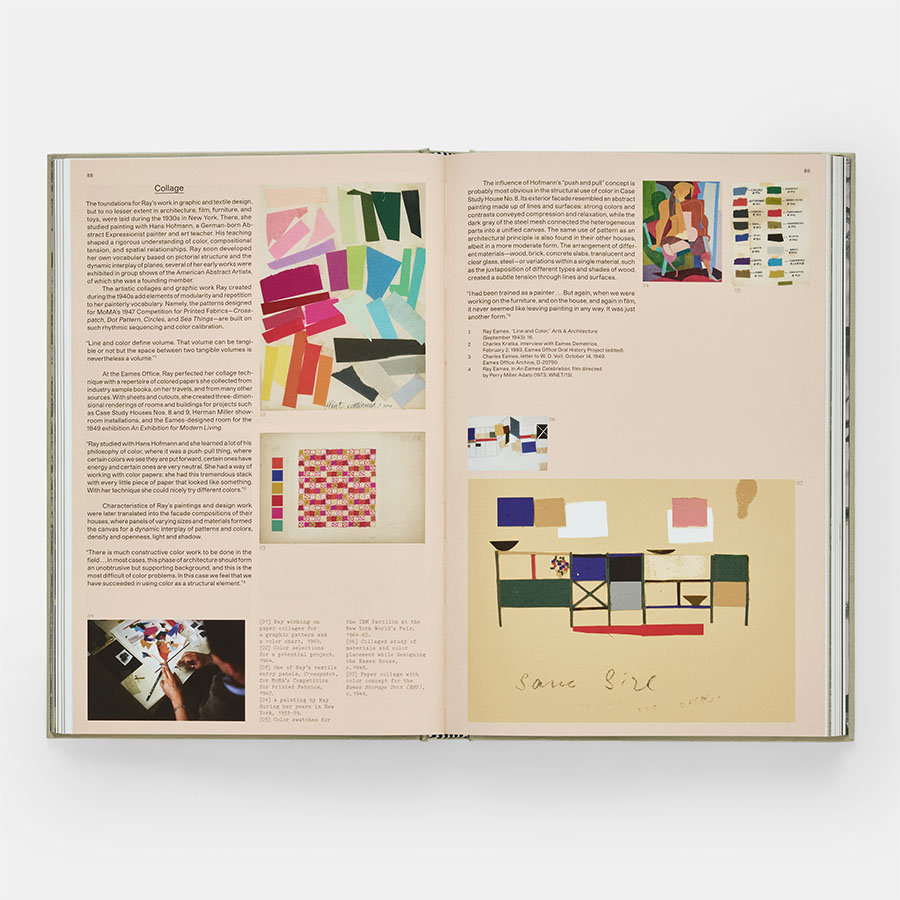
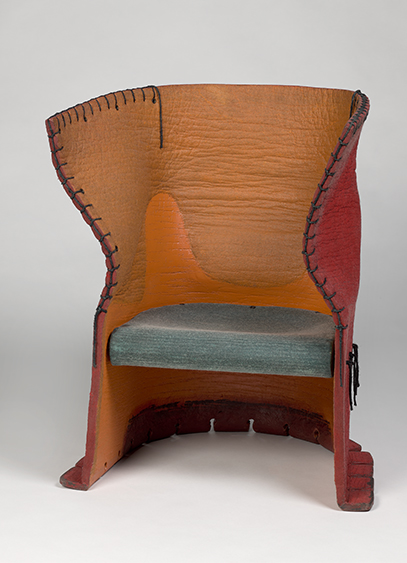
Textiles, now a matrix for space, are being celebrated at the Hôtel des Arts in Toulon. Through a hundred works, the exhibition "Follow the Thread! Design & Textile" weaves a history of creation driven by innovative designers.
Long relegated to the status of domestic ornament, textiles have now established themselves as a medium of the moment. A key player in structural and aesthetic revolutions, the medium is being showcased at the Hôtel des Arts in Toulon until October 31. The exhibition "Follow the Thread! Design & Textile" offers a historical deep dive through a hundred works from prestigious collections such as those of the Centre Pompidou and the Mobilier National. Opening with pioneering figures like Sonia Delaunay and Élise Djo-Bourgeois, the exhibition highlights the dialogue initiated between different sectors such as furniture, fashion, and architecture. It is an opportunity to recall not only the role women have played in the history of textiles but also the beginnings of a modernity where pattern and weave become one with space.
An intimate history is followed by the more impersonal yet universal story of synthetic fibers. The 1960s saw the birth of jersey, and stretch fabrics broke free from their frames to embrace the shapes of the body as well as structural armatures, driven by designers like Pierre Paulin and Olivier Mourgue. From then on, textiles became a tool for industrial innovation. At the same time, artists and creators like Sheila Hicks and Simone Prouvé explored the porous boundaries between art, structure, and habitat.
Textiles: A Flexible Universe
The exhibition also highlights the creative repurposing of materials. From the radical proposals of Gaetano Pesce or the Droog Design collective in the 1990s, to the sculptural metal meshes of Dominique Perrault, Gaëlle Lauriot-Prévost, or Muller Van Severen, the thread sheds its flexibility to become a rigid architectural language. This evolution opens new horizons for a new generation embracing these fibers in an era of high technology and environmental responsibility. From the hybrid pieces of Hella Jongerius and Jeanne Goutelle, which blend digital weaving with ancestral craftsmanship, to the modular acoustic walls of Ronan and Erwan Bouroullec, this exhibition invites you to trace the thread of a sector that is omnipresent in our lives.
Left: Pauline Esparon Arso Armchair, 2024 ©Adagp, Paris, 2026 © Les Arts Décoratifs / Christophe Dellière
Right: Marcel Wanders Knotted Chair, 1996 © Gaetano Pesce © Centre Pompidou, MNAM-CCI/Bertrand Prévost/Dist. GrandPalaisRmn
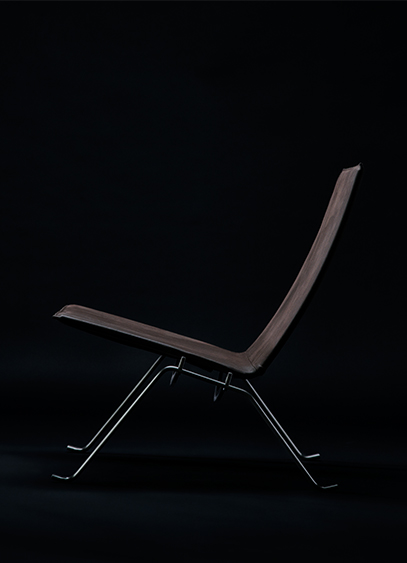
Designed by Danish designer Poul Kjærholm, the PK22 lounge chair celebrates its 70th anniversary this year. As a gift, Fritz Hansen is launching a new leather option and expanding its collection by releasing another piece by the designer.
"We are celebrating one of the most precocious designers of the 20th century this year" says Stéphane Legue, Sales Director for France at Fritz Hansen. A central and iconic figure for the brand, Poul Kjærholm is being honored on the 70th anniversary of his PK22 chair. It is an iconic piece of the Scandinavian modernist movement so dear to the creator, whose collaboration with the Danish manufacturer began with The Element—since renamed the PK25—an innovative graduation project he completed at age 21.
Structure in the service of thought
A Danish cousin to Mies van der Rohe’s Barcelona chair, the PK22, designed in 1956, embodies a vision of design that was resolutely modern for its time. "Poul Kjærholm’s approach to design was stripped back. He didn't want upholstery, the metal wasn't supposed to reflect light, and because he believed that even perfect welds would always be imperfect, he incorporated Allen screws into his pieces—fasteners previously reserved for the aeronautics industry." The designer also distinguished this ingenious design through the use of flat metal. "Kjærholm was a socialist at heart, and for him, metal was a way to ensure consistency in the industrial process. But unlike Breuer, who had imagined a tubular structure inspired by a bicycle frame, he favored flat uprights that offered different structural possibilities." This attention to detail meant the PK22 would never become a mass-market chair due to its production costs. Regardless, the model was awarded the Grand Prix at the Milan Triennale in 1957, bringing its creator international acclaim.
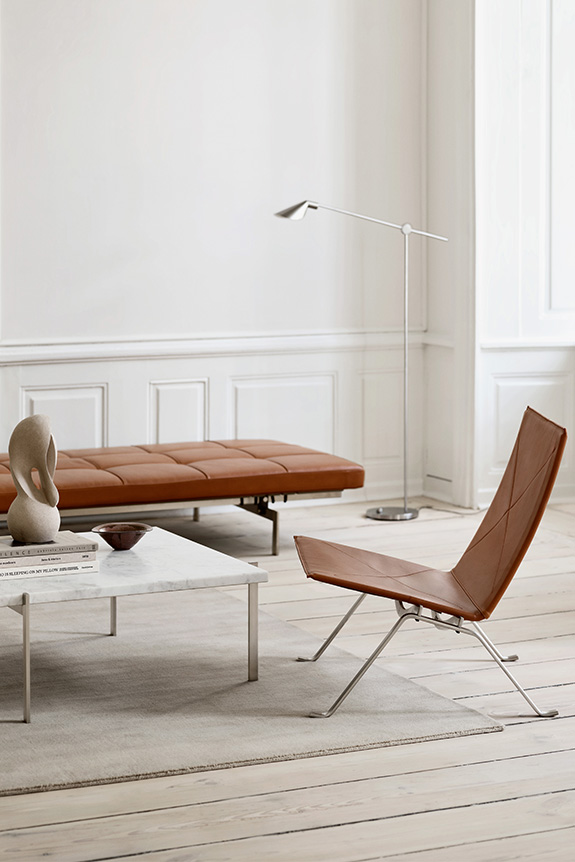
Simplicity as a collection aesthetic
Over the course of his sixteen-year collaboration with Fritz Hansen, Poul Kjærholm developed a particularly rich body of work. Showcasing a wide variety of materials (steel, leather, canvas, granite, wood, rope, etc.), the collection champions a discreet and balanced aesthetic, favoring pieces that use no more than three different mediums. " He was very inspired by what he saw outdoors and often said, 'There are no blue or red cows in the fields, so I only want natural colors.' This approach is still evident today", says Stephen Legue.
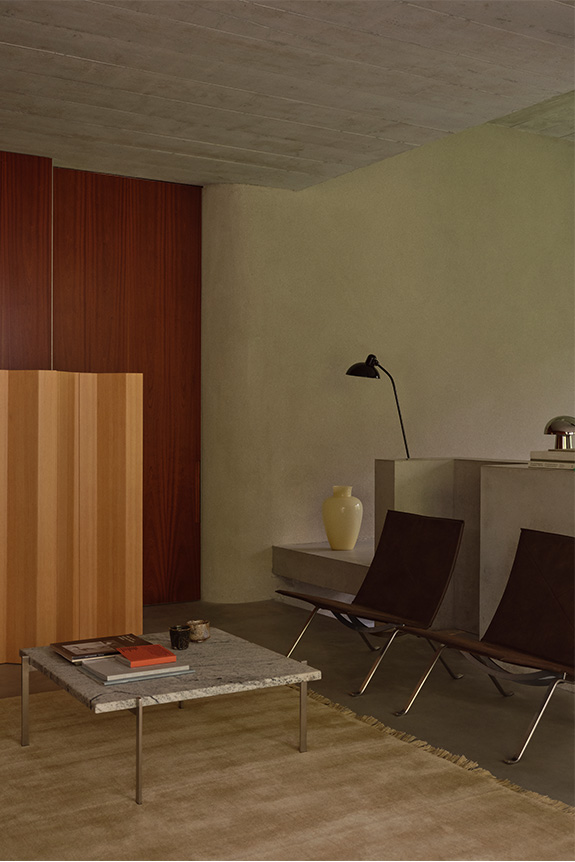
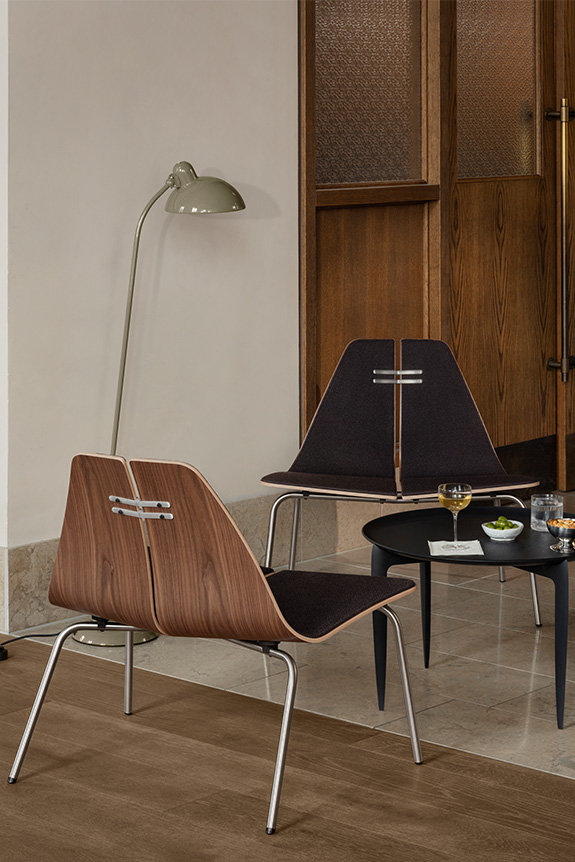
Unchanged for over half a century—with the exception of the steel, originally nickel-plated chrome, which became stainless steel in the early 2000s—the furniture designed by the designer has nonetheless evolved with the times. For its anniversary, the PK22 is enhanced with a new, exceptional leather called Haze, with a lightly sanded surface. At the same time, Fritz Hansen is introducing a new grey-white polished granite for the top of the PK61 table, whose geometry echoes the work of Piet Mondrian, and is producing the PK111 screen for the first time. Composed of clip-on Douglas fir plywood panels, this new 140 cm high typology was designed to provide a sense of privacy while seated at a table, while offering an unobstructed view of the room when standing; a design directly linked to Poul Kjærholm’s home, which opens onto the outdoors. Both pieces testify, each in their own way, to his interest in the principles of modernism and his search for a balance between functionality, architecture, and space. A lineage extended by the PK3 chair, reissued since late 2025, and the PK23 lounge chair, unveiled during 3daysofdesign 2026. Recognizable by their split backrests, the seats were cut to achieve a 3D backrest at a time when only two-dimensional bending was possible. More than just an anniversary, it is above all a tribute to the ingenuity of a mind that the Danish brand honors.
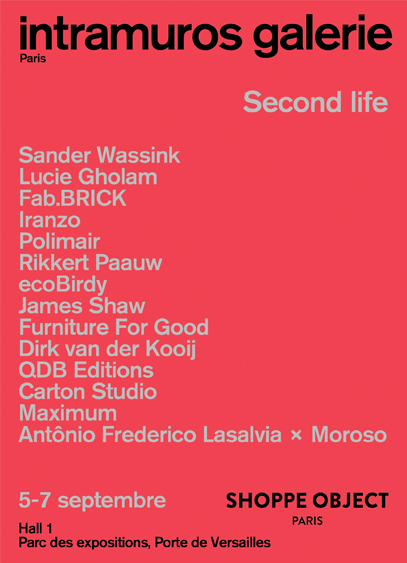
For this second edition of Shoppe Object Paris, Intramuros invites you to discover the "Second Life" exhibition and the work of the designers featured in the pages of our latest issue, now available on newsstands.
For its second French edition, Shoppe Object Paris returns to the Porte de Versailles from September 5 to 7, 2026. Dedicated to the home, design, and lifestyle sectors, this year's fair aligns with the overarching theme of Who's Next: The Dinner. Designed in harmony with this concept, the scenography will center around a large display table featuring over 80 brands, including Michie Studio, Tiptoe, and Rikke Falkow.
Intramuros at the heart of the event
Echoing the fair's curatorial focus, Intramuros will take part in the event by unveiling the "Second Life" exhibition, showcasing the work of designers featured in our September issue. More than just a timely topic, we wanted to highlight concrete and innovative perspectives. Convinced that current challenges should not lead us to stop producing, but rather to open up new creative horizons by revealing the potential of materials, this theme aims to celebrate the ingenuity of a sector that is reinventing its processes and methods. These are the practices that repair, transform, reuse, recondition, and repurpose what we, as consumers, would otherwise discard. Certain that circularity should not come at the expense of desirability, our selection brings together fourteen stories that the editorial team invites you to discover through Monday at Shoppe Object Paris:
- Sander Wassink
- Lucie Gholam
- Fab.BRICK
- Iranzo
- Polimair
- Rikkert Paauw
- ecoBirdy
- James Shaw
- Furniture For Good
- Dirk van der Kooij
- QDB Editions
- Carton Studio
- Maximum
- Antônio Frederico Lasalvia × Moroso
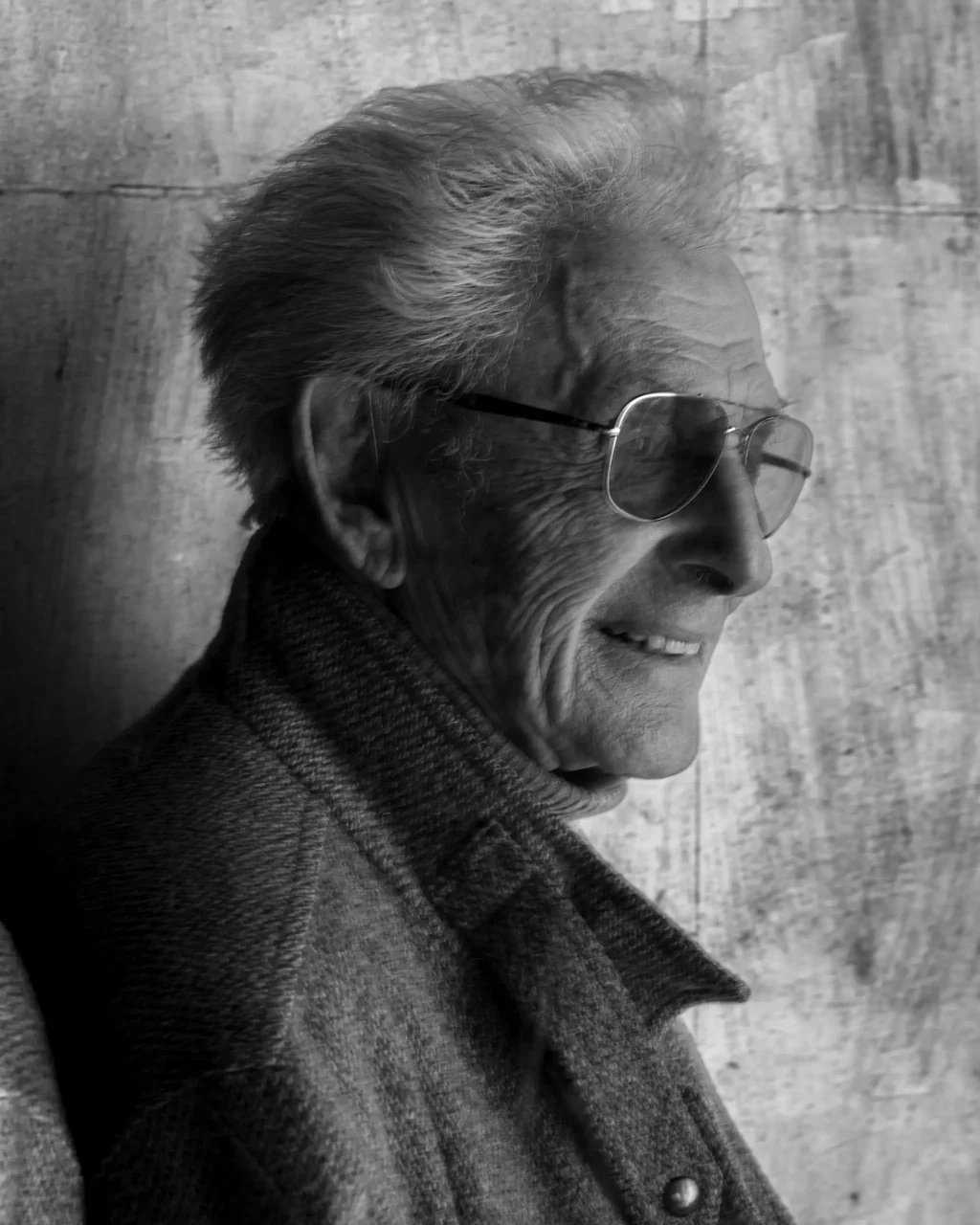
Designer, architect, and photographer Marc Held passed away on July 27 at the age of 93. His passing marks the loss of one of the most unique figures in post-war French design—a creator whose work, long kept out of the spotlight, has steadily gained recognition over the decades.
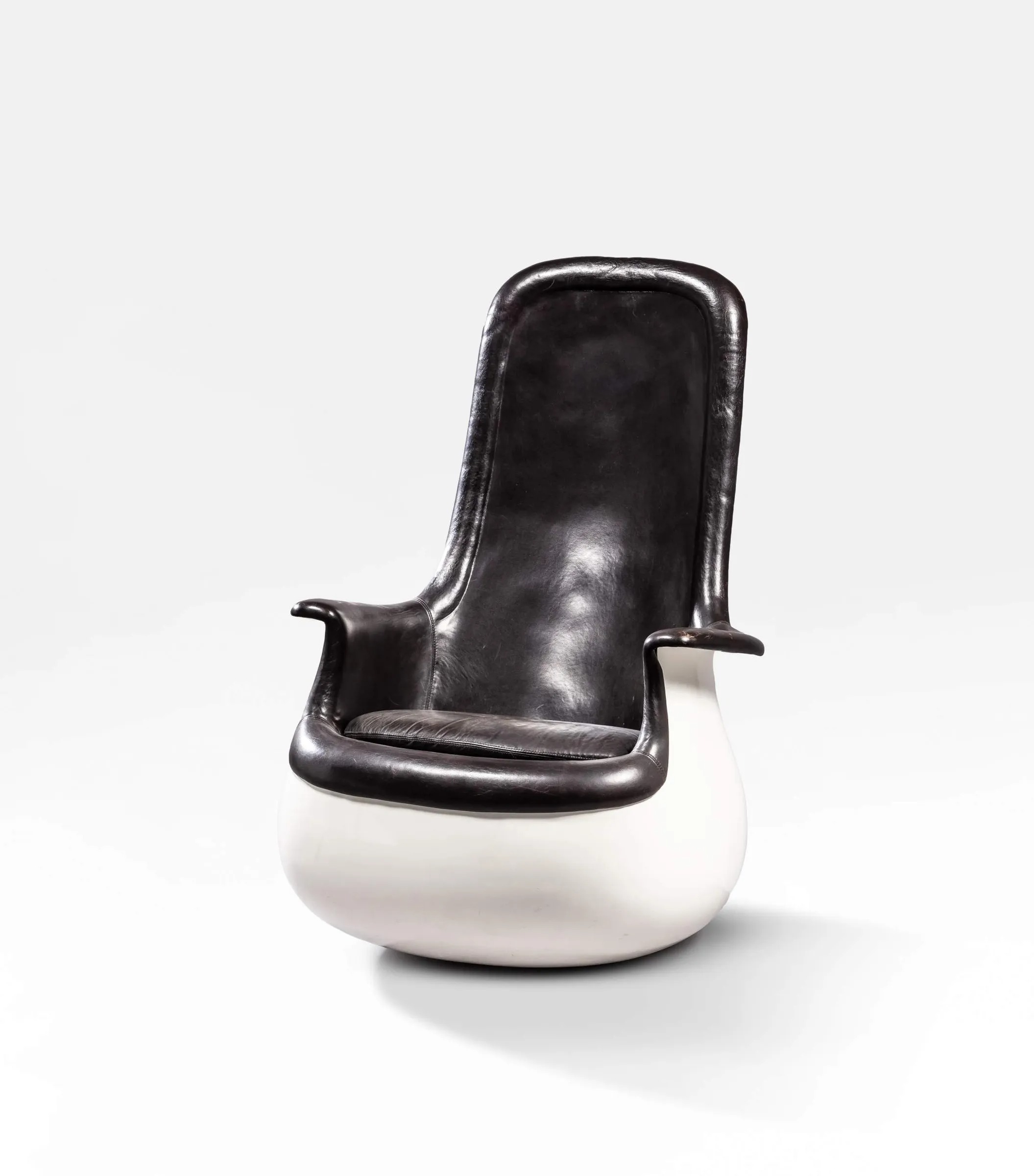
A self-taught talent, Marc Held never sought to align himself with any specific school or movement. His perspective was shaped at the intersection of photography, architecture, and industrial design, driven by a singular standard: to harmonize functional intelligence, formal freedom, and the poetry of everyday life. This approach gave rise to several iconic pieces, most notably the famous Culbuto chair (1967), whose playful silhouette and rocking motion continue to inspire generations of designers.
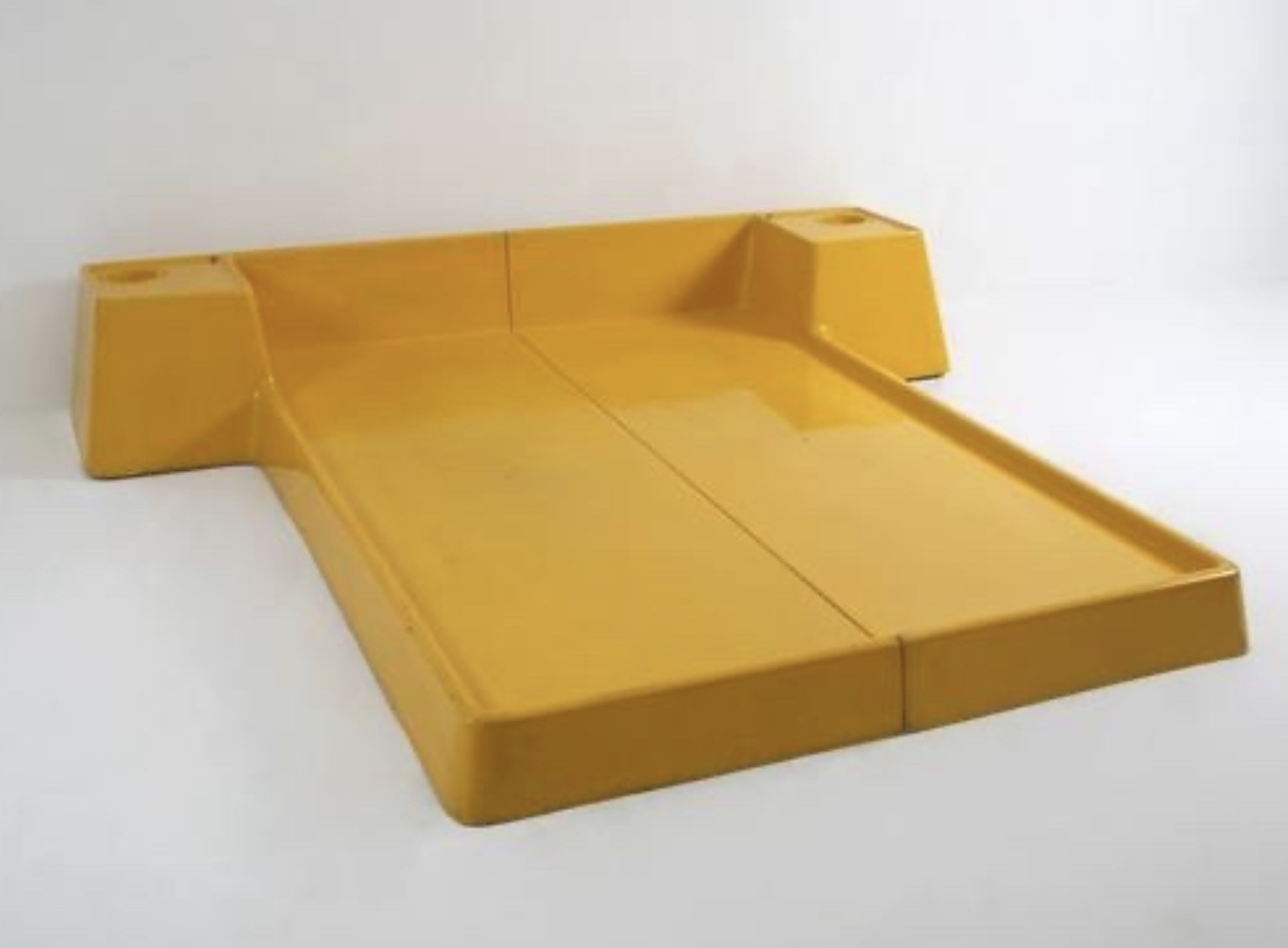
This desire to bring modernity into daily life found one of its most powerful expressions in his 1966 collaboration with Prisunic. For the retailer, Marc Held designed a collection of fiberglass furniture—beds, tables, desks, and chairs—featuring enveloping and strikingly new forms. Beyond their aesthetic, which is now emblematic of the 1960s, these pieces carried a deeply political ambition: to make contemporary furniture, previously reserved for a select few, accessible to the masses. Marc Held himself summarized this promise with a famous phrase: offering "beauty at the price of the ugly." It was an industrial utopia that did not achieve the widespread distribution hoped for, but it remains a major chapter in the story of Prisunic and the democratization of design in France.
However, to reduce Marc Held to the Culbuto and his Prisunic creations would be to overlook the breadth of his career. Spanning furniture, architecture, photography, and urban planning, his work reflects a rare curiosity and a constant drive to rethink lifestyles as much as forms. This intellectual freedom was likely rooted in his extraordinary personal journey: a hidden child during the Second World War who joined the Resistance at a very young age, he maintained an uncommon independence of thought throughout his life.

Long celebrated more by connoisseurs than the general public, Marc Held ultimately saw his work reclaim its rightful place. Reissues, exhibitions, publications, and renewed interest from collectors have confirmed the relevance of a body of work that never chased trends, preferring the intelligence of utility over stylistic posturing.
The editorial team at Intramuros extends its deepest sympathies to his family, friends, and all those whose paths he crossed.
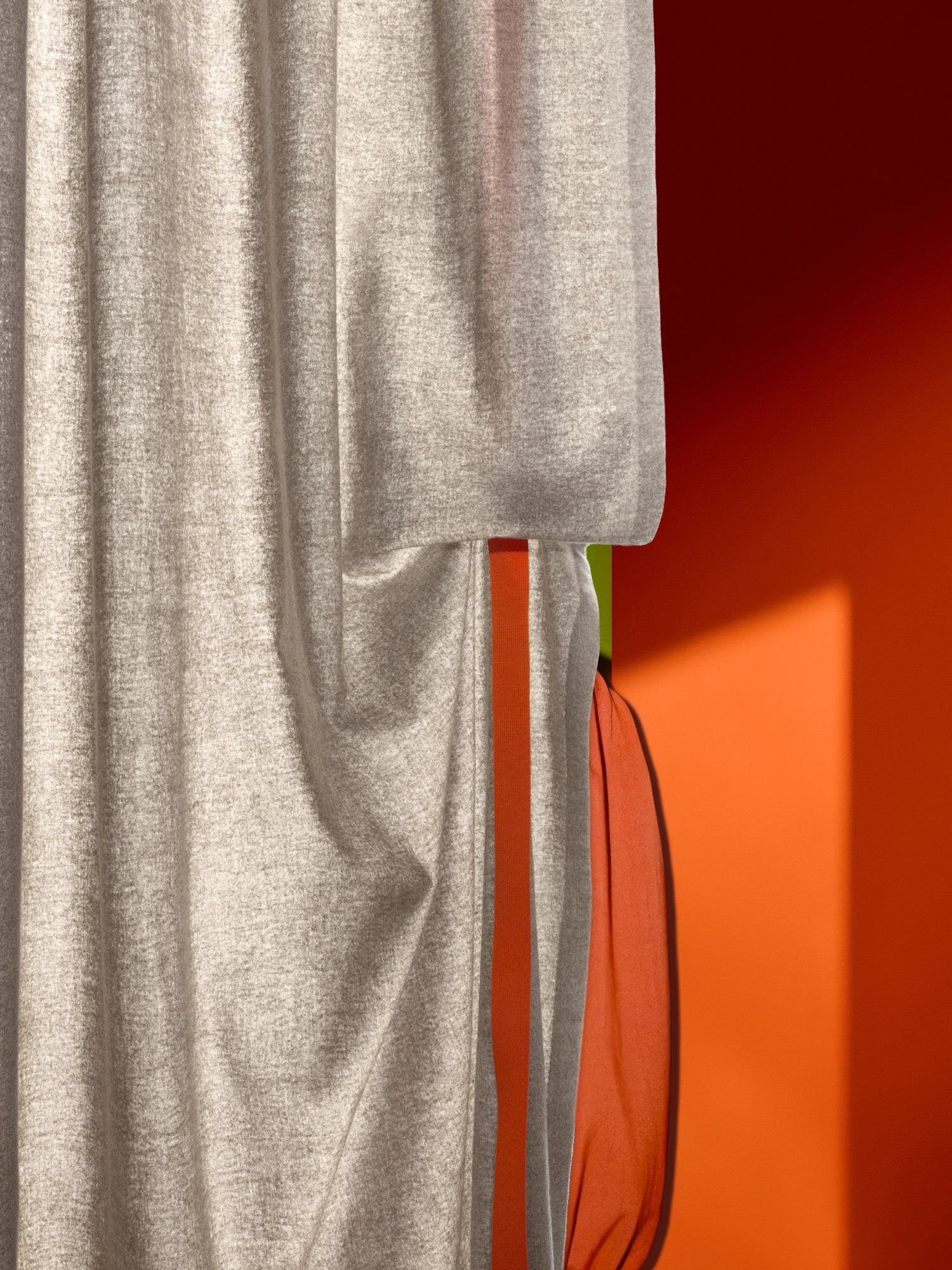
With THREE, its new residential curtain collection, and Loux, a series of lyocell rugs, Kvadrat continues a mission it began over half a century ago: transforming textiles from mere architectural accents into materials capable of reshaping architecture itself.
At Kvadrat, a curtain is never just a curtain. It filters light, alters the perception of a volume, and defines a boundary without enclosing it. It can even become a form—almost a presence. The Danish brand could have rested on the comfortable reputation it has built since its founding in 1968, thanks to the quality of its textiles, the precision of its colors, and its collaborations with some of the greatest names in contemporary design. Instead, it has chosen to treat every new collection as a field for research.
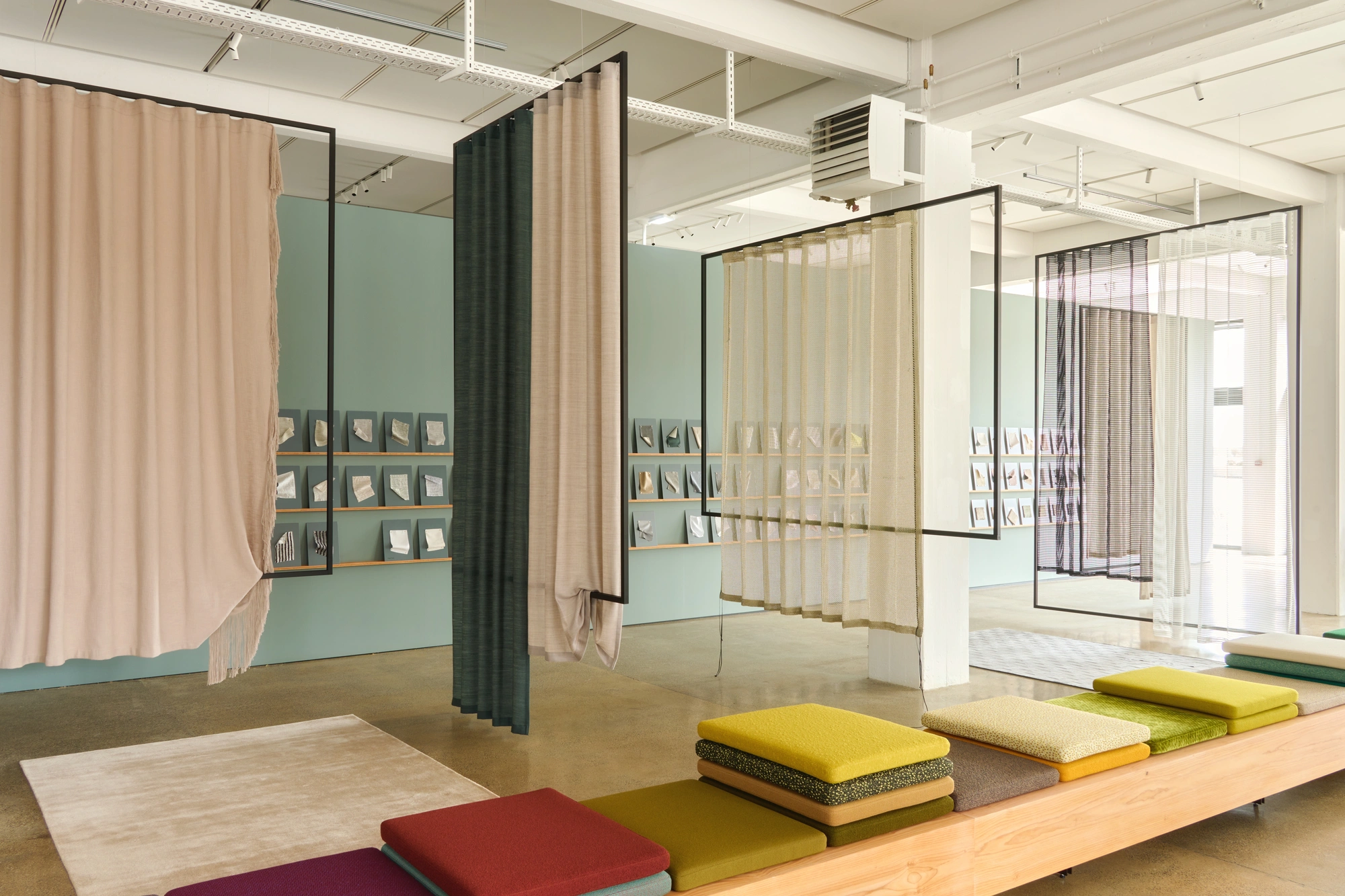
At Kvadrat, technique does not follow an idea to give it substance; it participates in its birth. It is an intention. And even a form. Isa Glink, Design Director at Kvadrat Residential, summarizes this method, where design, fiber, weaving, surface treatments, color, light, performance, and circularity all belong to the same process. What she calls "material intelligence" is precisely the act of looking at a textile deeply enough to understand what it can still become.
FROM SURFACE TO VOLUME
Presented in Copenhagen during 3daysofdesign 2026, the THREE collection carries this approach right into its title. Its starting point is a surface; its true subject is how that surface acquires a third dimension. Draped, folded, stretched, or framed, the curtains are not displayed as mere samples, but as flexible sculptures capable of defining and activating space. The collection explores hemp, wool, organic cotton, and linen, as well as technical fibers chosen for their performance, by drawing out the inherent qualities of each material rather than trying to conceal them.
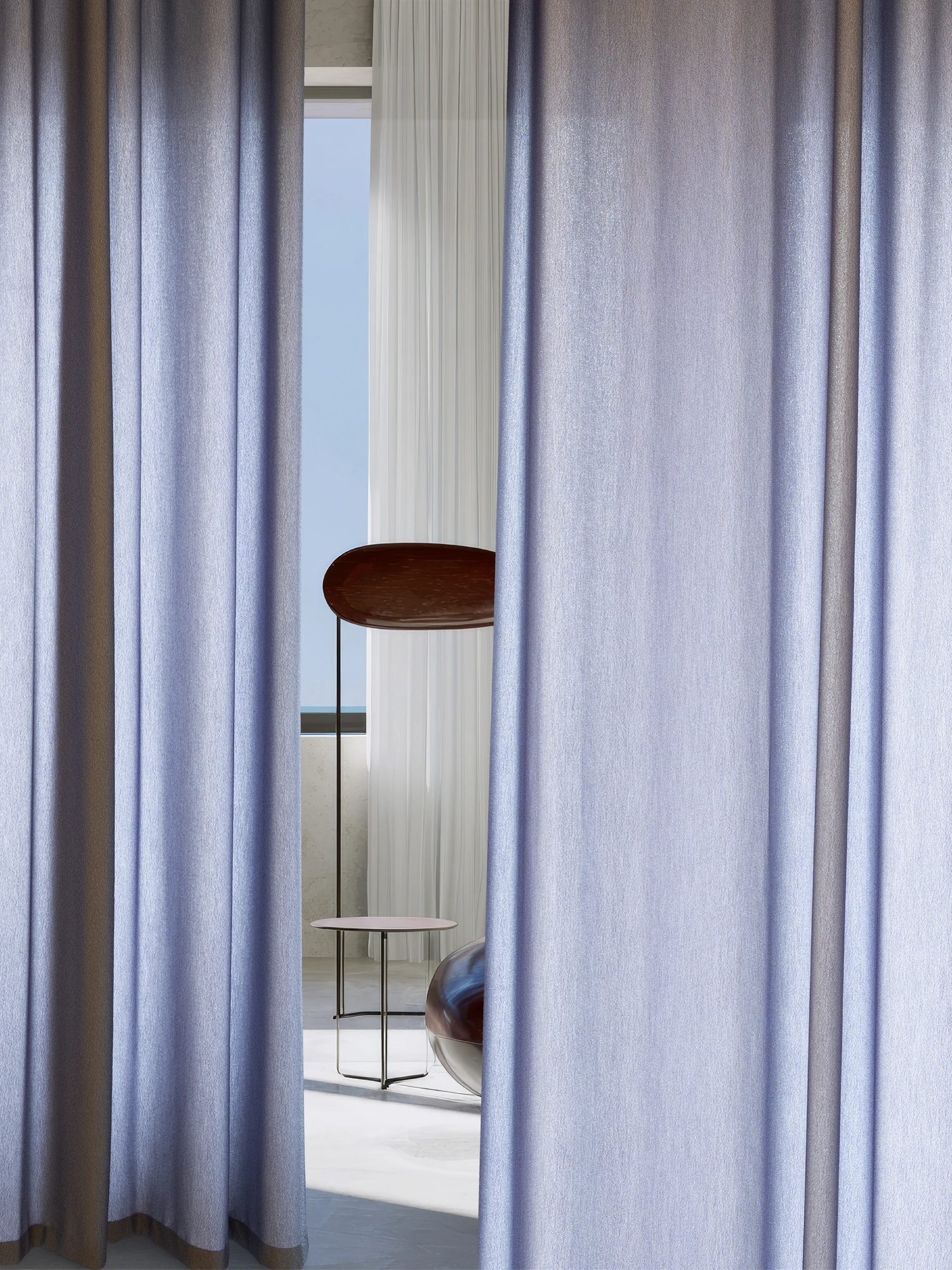
The craftsmanship involved is celebrated and showcased rather than hidden. A traditional fold is scaled up until it becomes an architectural feature. A topstitch, a fastening, or a tension point is no longer a decorative detail, but a way to build rhythm, depth, and a new way of suspending fabric. The influence of fashion is perceptible, yet Kvadrat avoids its seasonal, ephemeral logic. The goal is not to produce an effect destined to be replaced, but to invent a vocabulary meant to last.
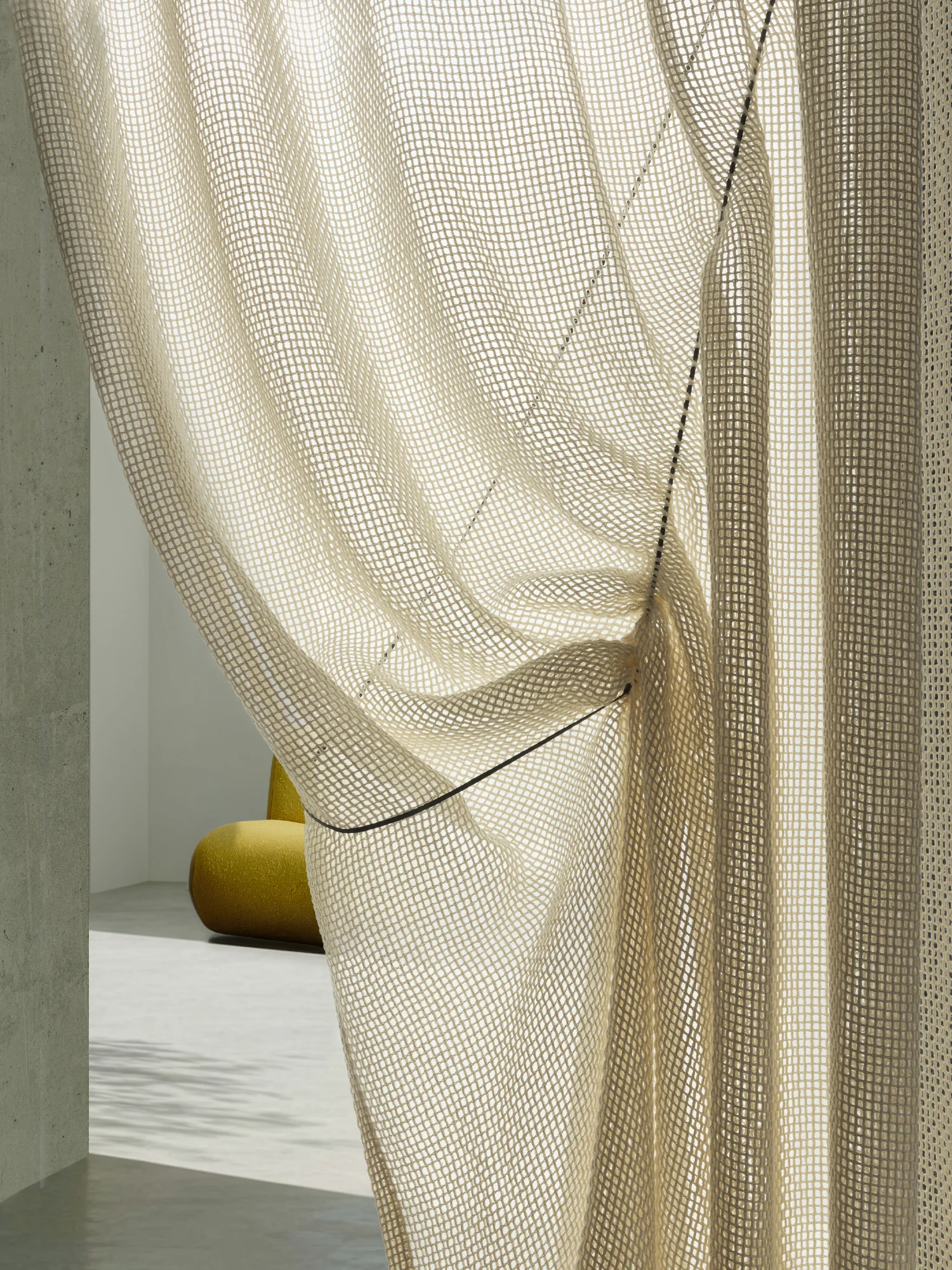
This research is evident in Tetra, whose open-weave structure and densely felted wool yarns create a form that is both airy and three-dimensional. It is also present in Sky Cloud, a blend of hemp, cotton, and wool with a texture reminiscent of paper. Or in Kajak and Stream Line, which translate the movement of water and the intermittent appearance of lines under the influence of light. The palette itself oscillates between mineral tones (salt, driftwood, volcanic rock) and bolder, almost electric colors. Color is never applied to the material; it is born with it.
CRAFTSMANSHIP WITHOUT OSTENTATION
With Loux, Kvadrat approaches flooring with a different logic, yet with the same attention to the relationship between material, light, and movement. The six rugs in the series are made entirely of lyocell, a regenerated cellulose fiber with a fineness that evokes silk. Their density (2.7 million threads per square meter) creates a remarkably soft surface, with reflections that shift depending on the viewing angle. Three constructions are offered: a uniform cut pile, a linear alternation of loops and pile, and a hand-sculpted relief. Luxury here lies not in patterns or excess, but in the richness of the tactile experience.
This way of starting from the material rather than the image says a great deal about Kvadrat’s philosophy. Circularity is not treated as a recognizable aesthetic, nor as a virtuous add-on applied after the product is designed. It becomes a design parameter like any other: choosing mono-materials whenever possible, re-engineering existing references, using recycled materials, and focusing on repairability and extended product lifespans. The brand’s strategy thus combines environmental innovation, maintenance, and service models designed to keep products in use for longer.
Because a sustainable textile is not just one with a reassuring composition. It is also a textile that one desires to keep. Because it possesses a presence, an intelligence, and an ability to continue a dialogue with its space. In this, Kvadrat defends a rare position: that of a deeply technical company that never separates performance from emotion, research from usage, or material from design.
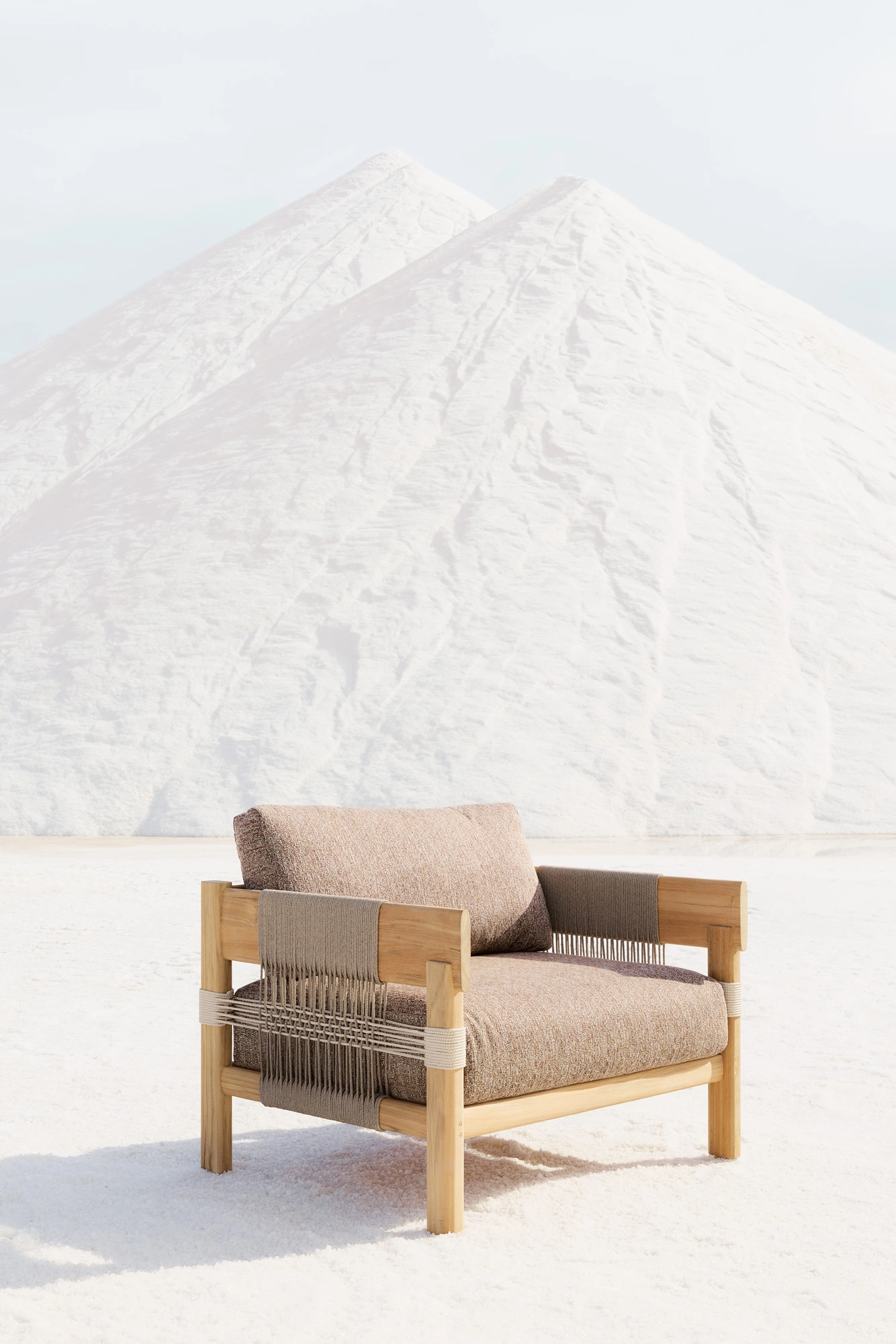
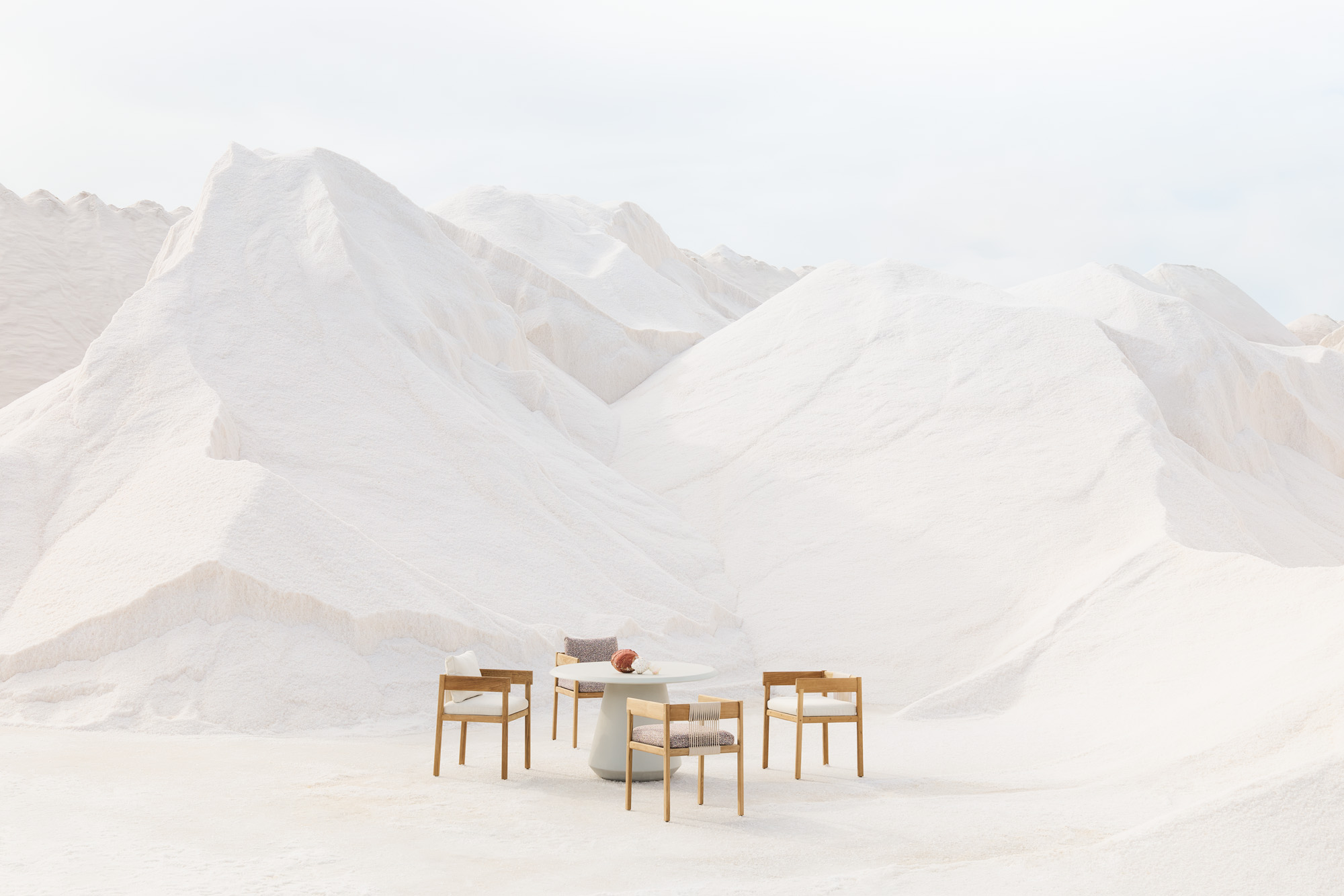
Unveiled in Milan at the latest Salone del Mobile, CORA marks the first collaboration between Unopiù and Federica Biasi. It is a complete collection where teak, rope, and generous volumes create a domestic landscape designed to slow down time.
In Milan, outdoor furniture once again sought to blur the lines between the home and the garden. With CORA, however, Unopiù does not simply transpose indoor living room codes to the outdoors. The Italian brand prefers to view the terrace as a fully-fledged living space, with its own materials, uses, and unique relationship with time.
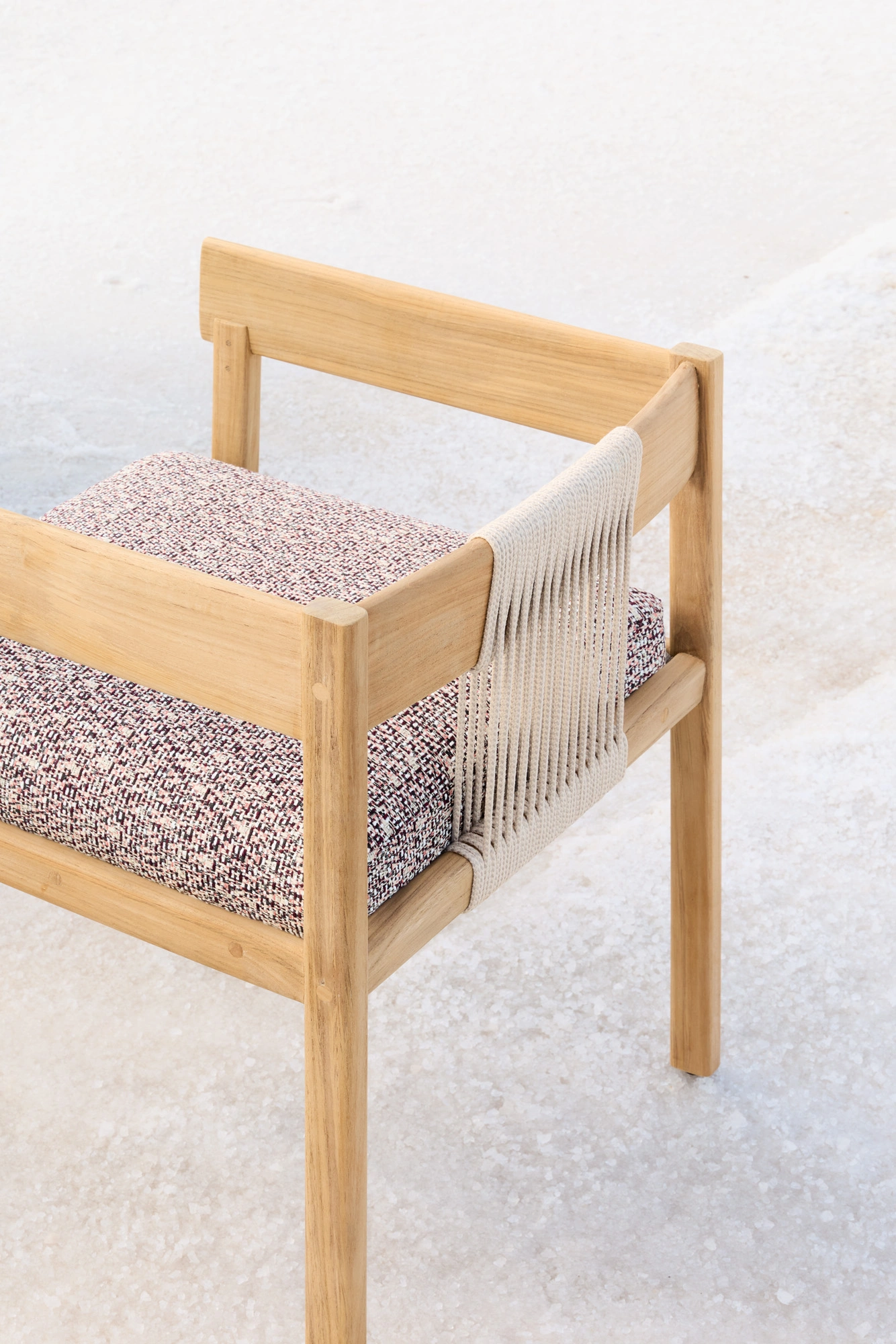
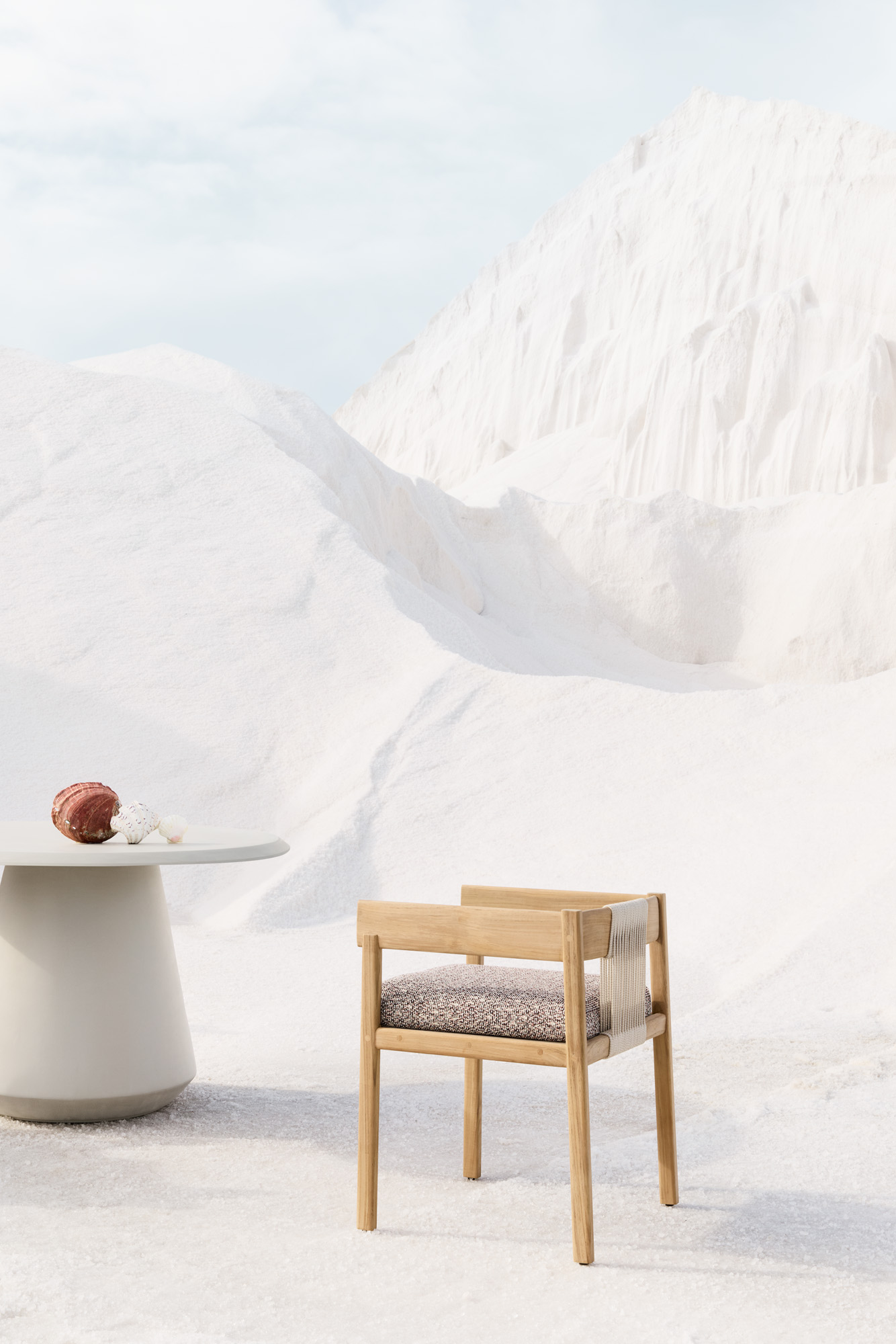
Entrusted to Federica Biasi, the new collection is based on a balance the designer has cultivated since her debut: combining the precision of industrial production with the sensitivity of artisanal craftsmanship. The teak structure creates a sober, almost understated architecture, while the polypropylene rope weaving softens the lines. One builds, the other connects. Their meeting gives rise to a collection whose identity lies less in a formal effect than in the accuracy of its proportions.
THE FABRIC OF COMFORT
The merit of CORA is precisely that it does not confuse generosity with heaviness. Armchairs and sofas feature deep seats, accompanied by cushions in natural tones, yet they retain a certain visual lightness. The weaving allows for breathability within the structure, while the horizontal lines establish a calm presence in the landscape.
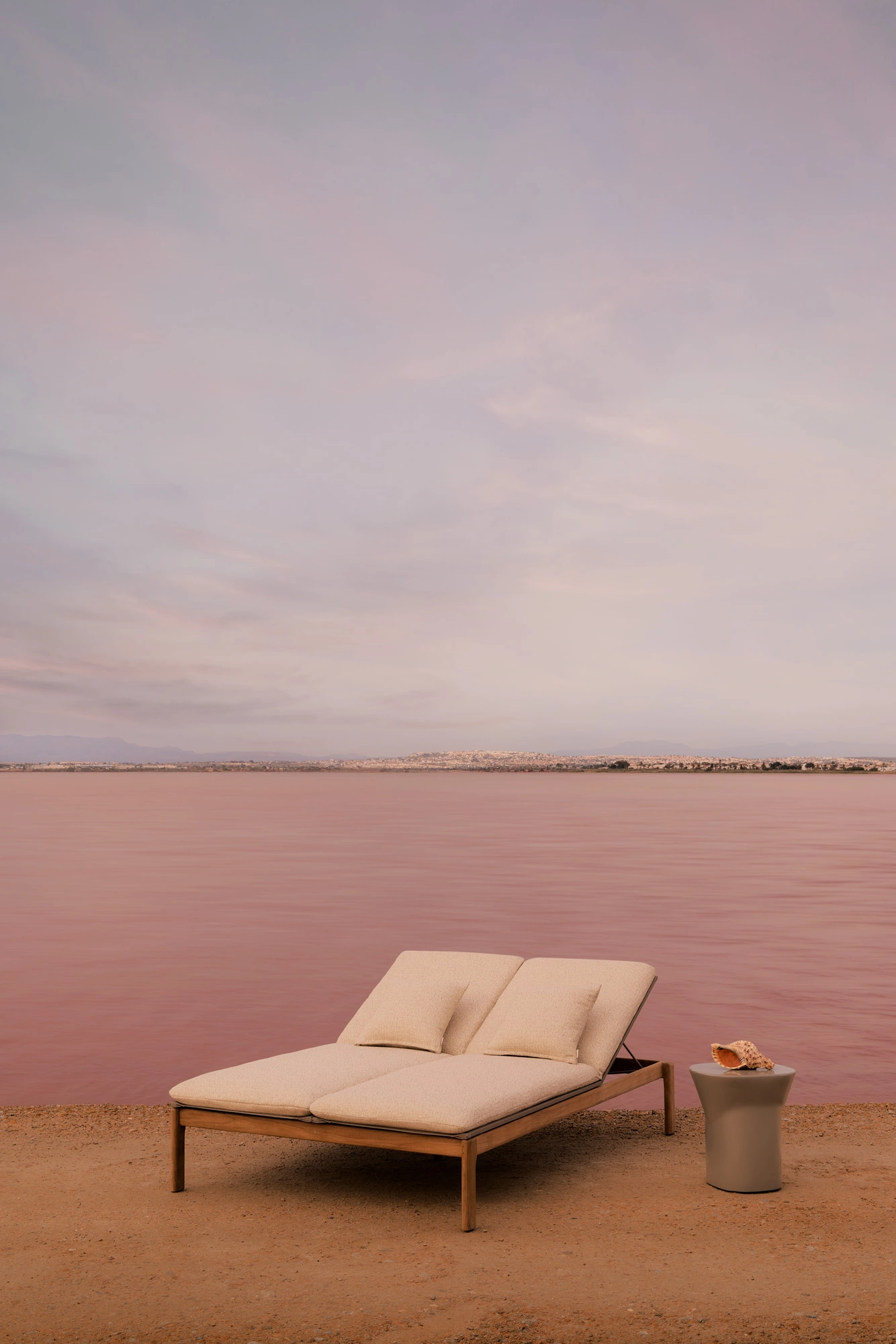
This pursuit of enveloping comfort is expressed through a chair and a round table for dining, an armchair, a two-seater sofa, a single or double sun lounger, and a sunbathing island. More than just a succession of typologies, CORA composes a true vocabulary for accompanying the different moments of the day: eating, entertaining, reading, or simply doing nothing. The collection is thus aimed at both residential spaces and hospitality projects, where outdoor furniture must now combine hospitality, durability, and architectural coherence.
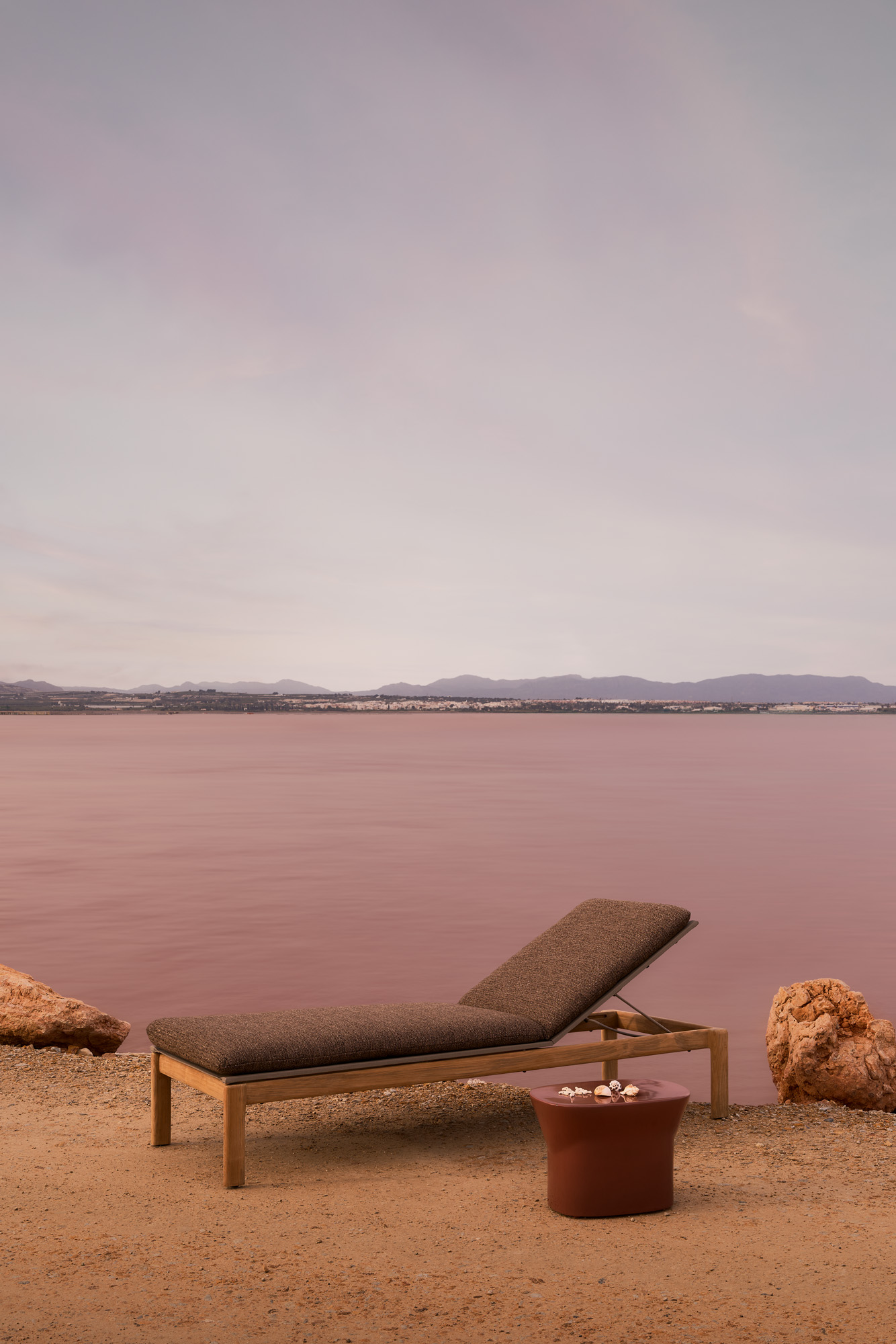
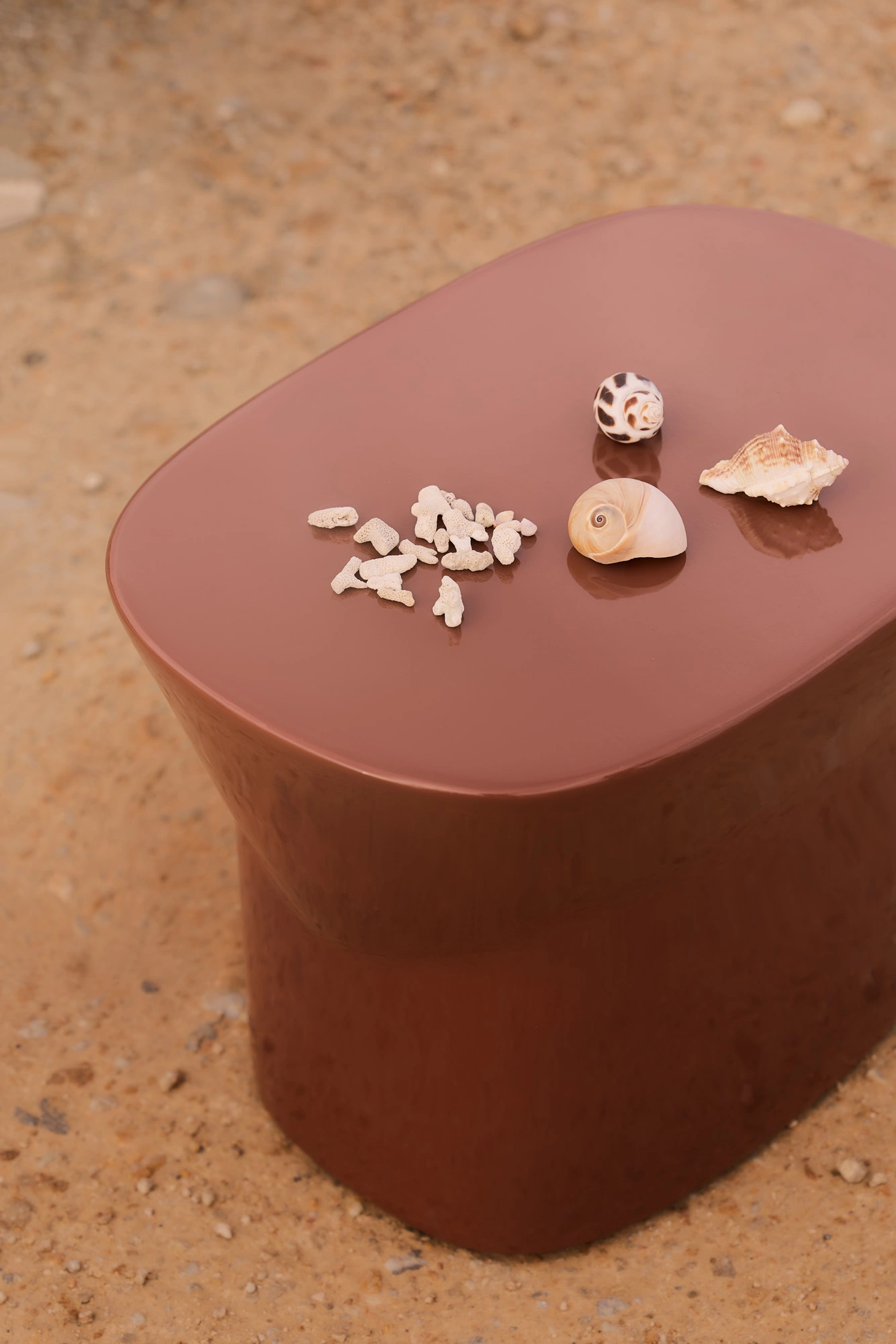
CORA is part of a broader collective project presented by Unopiù in Milan, conceived as a "Travel Journal" in which several designers are invited to take a personal look at the publisher's heritage. Federica Biasi delivers a restrained and tactile interpretation, faithful to her taste for vernacular craftsmanship as well as the brand's Mediterranean culture. It is a way of reminding us that outdoor furniture does not necessarily need to impose itself to take its place in the landscape.
.jpg)

.svg)


.svg)