Jonas Bohlin : “Nous, designers, avons la responsabilité de penser à l'impact de l'objet sur la Terre”

Jonas Bohlin : “Nous, designers, avons la responsabilité de penser à l'impact de l'objet sur la Terre”

Souvent mise en avant depuis le début du siècle, la notion de développement durable commence seulement à être assimilée. En Europe, seule la Suèdeavec son industrie du meuble fait figure d’exception. Dans le cadre de la Paris Design Week, nous avons rencontré Charlotte van der Lancken et Jonas Bohlin, deux designers suédois qui ont fait du développement durable leur mot d’ordre.


Charlotte Van Der Lacken

‍

Jonas Bohlin

Vous êtes deux designers issus de générations différentes. Ces générations portent-elles le même regard sur la durabilité ?

Jonas Bohlin. Lorsque j’étais à l’école d’art Konstfack de Stockholm, entre 1976 et 1981, il n’y avait pas de discussions sur le climat ou sur la Terre. Du moins, pas dans l’industrie du design. C’était plus une question politique. J’ai choisi d’en tenir compte dans mon travail, c’est-à-dire de réfléchir aux matériaux et aux méthodes de construction qui ont un impact minimal sur la Terre. Fondamentalement, cela signifiait, et signifie toujours, de fabriquer un objet qui puisse vivre 100 ans, tant au niveau de la conception que des matériaux.
Aujourd’hui, le sujet est beaucoup plus pris en compte. Cela s’est produit pour de nombreuses raisons, mais je crois que l’une d’entre elles a été la discussion entre professeurs et étudiants : un échange de connaissances entre générations.

‍

Charlotte von der Lancken. Lorsque j’ai commencé en 2004, le changement climatique n’était pas un sujet aussi important qu’aujourd’hui. Aujourd’hui, la prise de conscience est beaucoup plus importante mais nous continuons à consommer : trois fois plus que dans les années 1970. Les professionnels travaillent maintenant pour consommer différemment, créer différemment, et les designers ont un rôle à jouer. Je travaille moi-même avec les scientifiques de l’institut RISE. Il s’agit de remplacer les matériaux nocifs tels que les plastiques, les matériaux d’origine fossile par du bois.

‍

Parlons maintenant de votre démarche design. À quel point la durabilité l’encadre-t-elle ?

C.L. Par rapport à mes débuts, je pense à la durabilité dans une bien plus large mesure. En tant que designer, vous faites partie d’un ensemble plus vaste, composé également du producteur, du consommateur et de toute la sphère économique qui l’entoure, mais nous avons davantage notre mot à dire sur l’impact qu’un objet peut avoir sur la planète. Par notre conception et le matériau que nous décidons d’utiliser, nous devons penser à la fin de vie du produit, d’autant plus si l’on sait qu’il sera utilisé pendant une courte période.

J.B. Le design concerne toute la vie d’un objet, depuis l’idée de celui-ci jusqu’à ce qu’il n’existe plus. Bien sûr, vous ne pouvez pas imaginer ce qui va se passer, mais nous, les designers, nous avons la responsabilité de penser à l’impact de l’objet sur la Terre.

L’objet est-il pensé dans un écosystème plus large que sa simple fonction ? Son interaction avec l’environnement par exemple ?

C.L. Tout se résume au type de matériel que vous utilisez. L’objet que vous créez doit être détachable, et les gens doivent pouvoir en recycler des parties ou même en réutiliser certaines. Mais aujourd’hui, le système n’est pas vraiment pensé pour le recyclage, car les entreprises doivent vendre de nombreux produits pour réaliser la plus grande marge possible. Le système économique doit être adapté à la réalité, encore plus en Suède : en termes de matériaux, le produit est déjà là dans notre forêt, et nous devons nous rendre compte que nous pouvons l’utiliser beaucoup plus de fois qu’une seule fois.

Par quoi votre démarche est-elle guidée ? La recherche de nouveaux matériaux, le recyclage, la traçabilité…

C.L. Nous devons être capables d’utiliser les matériaux dont nous disposons. En Suède, 70 % du pays est couvert de forêts et d’arbres, une source renouvelable qui consomme de grandes quantités de CO2. Pourquoi importer du bois d’autres pays ? Nous devons retourner dans nos forêts et mieux les utiliser.

J.B. Nous nous sommes éloignés de la forêt, et en tant que designers ou architectes, nous devons veiller à l’utiliser correctement, d’autant plus s’il s’agit d’un matériau auquel nous avons librement accès. Mais la durabilité, ou l’écologie, n’est pas seulement une question d’objets et de design. C’est aussi une question d’êtres humains. Nous devons tenir compte du fait que les personnes qui travaillent dans les usines, qui fabriquent les objets que nous avons conçus, doivent également avoir accès à une bonne qualité de vie.

‍

À quel point les industriels sont à l’écoute de votre engagement ?

J.B. Pour ma part, les fabricants doivent m’écouter. Lorsque je réalise des intérieurs, ou des dessins pour des usines suédoises, je décide comment le faire et quels sont les matériaux à utiliser. S’ils ne sont pas d’accord, notamment au sujet des coûts, ils s’adressent à quelqu’un d’autre. Ce que je veux dire, c’est que les fabricants doivent nous écouter, parce que nous, les designers, sommes les cerveaux. S’ils ne le font pas, ils n’obtiennent aucun produit.

‍

C.L. Ils écoutent dans une large mesure ce que nous, les designers, disons. En fin de compte, c’est toujours une question d’économie. Pouvons-nous vendre cela à un certain prix ? Avoir une certaine marge ?
C’est aussi une question de label : en Suède, nous sommes l’un des pays les plus stricts en termes de labels et de certifications, pour vendre aux écoles, aux espaces publics… Il y a des limites. En tant que designer, vous n’êtes pas entièrement libre de tout décider, vous devez vous adapter à la situation, et faire le maximum.

‍

Inside Swedish Design fait cohabiter entreprises de premier plan et des designers de renommée internationale avec la prochaine génération de talents. Qu’apporte l’initiative Inside Swedish Design dans cette quête de développement durable ?

J.B. Inside Swedish Design s’adresse à ceux qui veulent être plus écologiques et placer la durabilité au-dessus de tout. En réunissant entreprises et designers, on se donne l’opportunité de changer plus rapidement et plus efficacement. Il ne faut pas oublier qu’il y a beaucoup de designers, beaucoup d’usines, beaucoup de producteurs, mais il n’y a toujours qu’une seule Terre.

C.L. C’est une question de collaboration. Le design suédois d’intérieur favorise la communication entre les entreprises. Par exemple, il nous aide, à la REIS, à promouvoir les nouveaux biomatériaux. Lorsqu’il s’agit de durabilité, les changements doivent être importants. Et pour cela, il doit toucher le plus grand nombre de personnes.
Rédigé par 
Rémi de Marassé

Vous aimerez aussi

Temps de lecture
29/10/2026
L.I: a bold project, Special Prize from the Mobilier national - Young Creation competition

Winner of a special prize in the Mobilier National’s Young Creation competition, the L.I. table and chairs designed for the Council of Ministers offer new approaches to contemporary design through the use of Drop Stitch technology and recycled carbon.

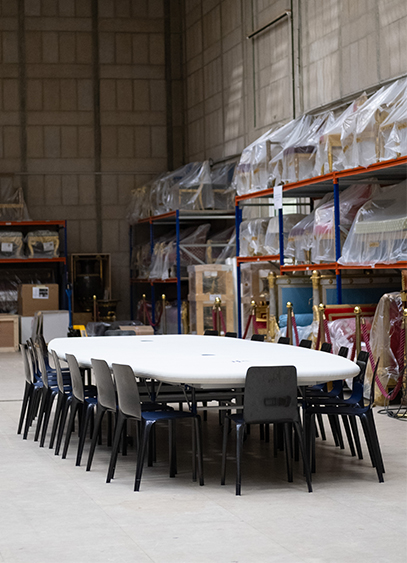
L.I., two letters for lightness and innovation. Found "a bit at the last minute", the name of the table and chairs designed by Yanis Bontemps, Paul Seiller, and Victor Galineau favors the factual over the lyrical. This lack of flourish echoes the approach of the trio, who formed during their final year of studies at Ensaama to respond to the Mobilier National’s Young Creation Prize call for projects. The challenge? To propose a set of furniture that is easy to install and can be stored on a freight elevator for the Élysée Palace’s Council of Ministers room. The three designers worked on this dual constraint for several years with the ARC. Delivered for the 2026 Heritage Days, the project had already been recognized in 2020 with a special prize created specifically for it.

© Julien Seiller


An inflatable table

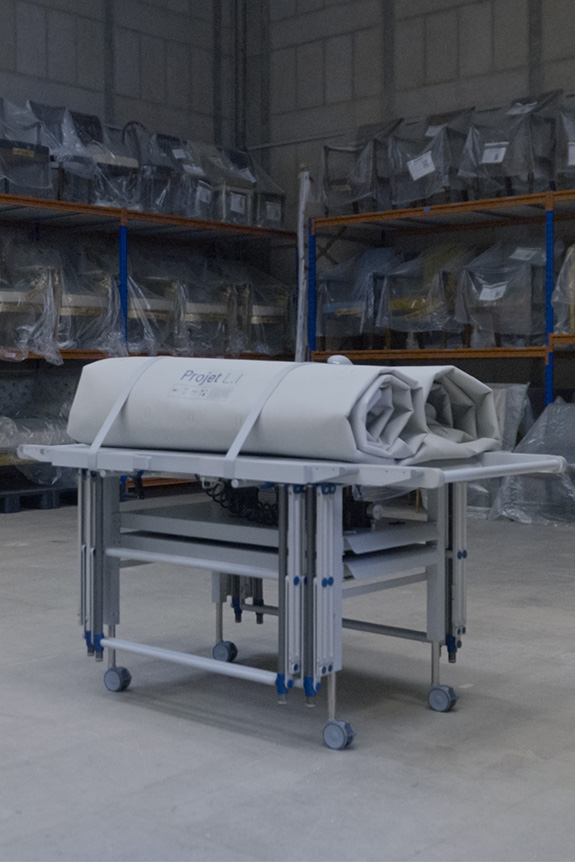
"The initial concept for the table was to make it inflatable so that it could be deployed quickly", explains Yanis Bontemps. The idea led the three students at the time to take an interest in the Drop Stitch material manufactured by the company Musthane. "To put it simply, it is an inflatable membrane where the two walls, top and bottom, are connected by sewn nylon threads. Through a physical phenomenon, the structure becomes tensioned when inflated, offering something very rigid with just one bar of pressure." Used in some paddleboards, this technology is now primarily found in the military sector, notably in the form of cushions for repairing aircraft wings.

Self-supporting, the Drop Stitch led the studio to imagine a table in which the freight elevator is not just a transport tool, but becomes a structural element. Used as a central base, the cart is equipped with a foldable structure featuring eight aluminum legs upon which the elliptical tabletop unfolds. "This project was guided more by semantic constraints than by technology. At first, we had imagined a round table, but it was difficult to fold and didn't fit the usual codes. So we let ourselves be guided by existing conventions" says Paul Seiller.

©Julien Seiller


Letting the raw material speak

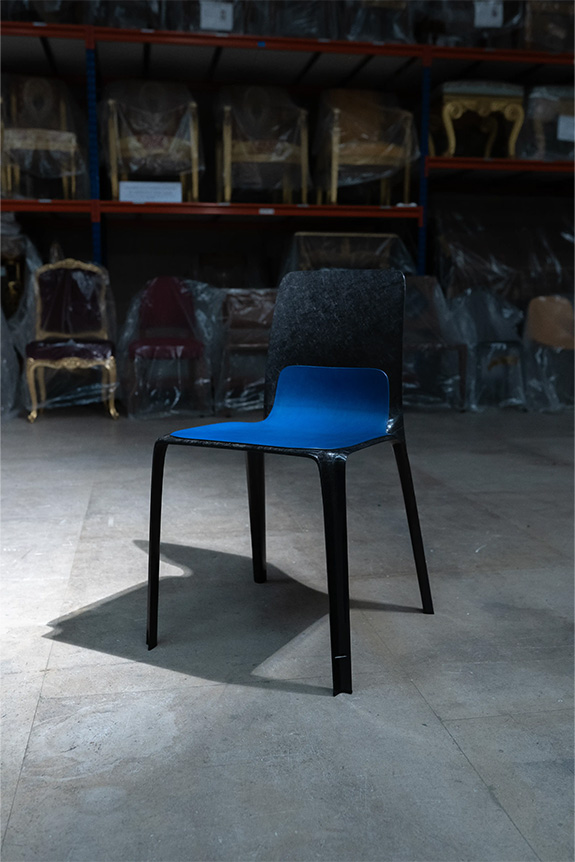
To accompany this table, the three designers drew sixteen chairs. Made from 56% bio-based resin sourced from plant-based channels and an epoxy foam, they also provided an opportunity to work with recycled carbon. "For the chair to be in line with the practicality of the table, we started with this lightweight material. But it led us to wonder how to use a material that is far from 'eco-friendly' in a responsible way." The designers then turned to Workshape. "By heating waste from various industries, such as automotive, to very high temperatures, this company manages to separate the components, including carbon. By working with them, we were able to recover the carbon in the form of felt, which we then molded and baked." A recycling technique that gives rise to seat shells with sleek, aerodynamic lines. "We wanted to let the raw material speak for itself. To convey an industrial language through exceptional furniture. It was a relatively exploratory process, especially since neither of the two companies approached had ever made furniture before." Beyond anodizing and leatherwork, this project brings together technologies applied for the first time to the contemporary design sector. These new approaches, fueled by the ideas of the three designers and the innovation of the ARC, expand the range of French techniques and expertise.

Temps de lecture
29/10/2026
At EspritContract, a room gone wrong

For its fourth edition, taking place at Porte de Versailles from November 21 to 24, the EspritContract trade show is presenting "The Room Gone Wrong." This exhibition, supported by Figurz, CHHO Studio, and Malvaux Interior, showcases recurring flaws in hotel design.

They say you learn from your mistakes. In architecture, it’s a bit more complicated. From leveling issues to problems with consistency or operations, the variety of defects is endless. This challenge is in the spotlight at EspritContract this year. For its fourth edition, the Parisian trade show—held from November 21 to 24 at Porte de Versailles—will unveil a humorous installation titled "The Room Gone Wrong." Designed as a capsule to raise awareness about the obstacles faced by interior fit-out professionals, the exhibition was conceived by three industry players. Initiated by the design office Figurz, creator of an FF&E/OS&E budgeting application for hotel projects, the project was realized in partnership with the interior design studio CHHO and the fit-out firm Malvaux Interior.

"The Room Gone Wrong" ©EspritContract

‍

The mysteries of the yellow room

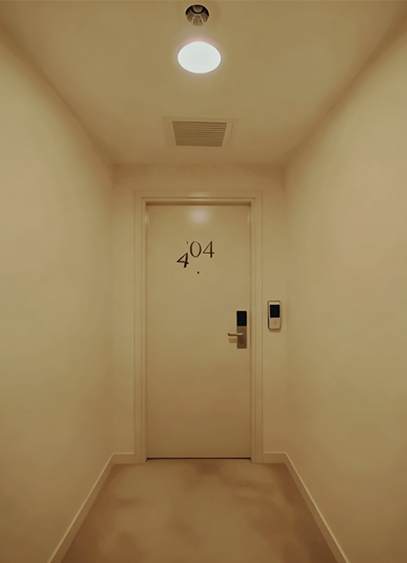
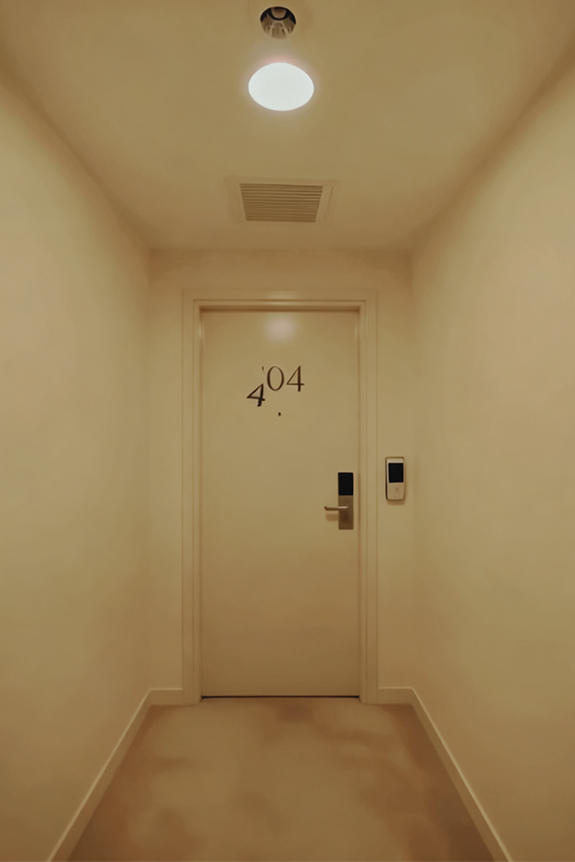
Located just a stone's throw from "the village square" where the talks will take place, the 42-square-meter room was designed based on a standard hotel room layout, minus the bathroom. Visitors will discover a bed, bedside tables, and a large wardrobe. The space was imagined by the three companies, who are often confronted with the lack of foresight or the oversights that plague the contract sector. "We work together regularly, but this project, which is a bit unique, was an opportunity to sit down and list the errors we see and recreate them on purpose," explains Martin Bretecher, founder of Figurz. From a bed that is too wide, requiring two mattresses, to a last-minute electrical outlet that clashes with the others, "The Room Gone Wrong" is full of aesthetic and functional missteps. "What we are showing might seem amusing in this context, but it’s important to understand that every flaw has consequences for the establishment's management, whether in terms of maintenance or cost." An exhibition that is almost a manifesto, intentionally designed to be the opposite of a stylistic statement. Completely smoothed over by a monochrome yellow, the space doesn't appeal to taste, but rather invites reflection on how errors can be avoided. "The hotel embodies the fine line between the prosaic and the poetic; the conceptual and the practical", summarizes Martin Bretecher. A complex environment in which every stakeholder must be able to contribute their expertise and language to serve beauty, but above all, a certain operational logic.

Temps de lecture
20/10/2026
Design Miami Paris 2026: Alternating Currents

For its fifth edition, Design Miami Paris has invited thirty galleries to take over the Hôtel de Maisons. It is an opportunity to bring together French decorative arts, modernist design, and collectible pieces during this art-filled week. Jen Roberts, the event's CEO, tells us about this convergence of worlds.

In recent years, October has become the annual meeting point for collectors and art enthusiasts. Running alongside Art Basel, Design Miami Paris opens this Tuesday, October 20, for a five-day run. Located within the Hôtel de Maisons, behind the high walls at 51 rue de l’Université, this fifth edition is centered on the theme "Design for Presence." This presence is embodied by various artistic movements. Here, the modernist lines of jewelry designed by Pierre Charreau and furniture by Jean Prouvé stand in contrast to the generous forms and ornamental techniques presented by a body of international galleries. Jen Roberts, CEO of Design Miami since 2015, sheds light on this contrasted approach to creation.

©Galerie Rossella Colombari

‍

This year, historic French design and the decorative arts are in the spotlight. Why this choice?

Paris is where a large part of the history of French design and decorative arts was written, and it is where it remains very much alive today. The city is home to an exceptional concentration of specialized galleries, workshops, and collectors who have a deep understanding of these periods. Here, historical works are understood and actively collected. It is therefore logical that our Parisian edition gives them more space than our Miami event.

This dynamic is felt throughout the fair. Galerie Maxime Flatry brings together a rare collection of French modernist works from the 1930s, centered on a major ensemble by Robert Mallet-Stevens and presented alongside works by Pierre Chareau, Eileen Gray, and Pierre Legrain. Laffanour | Galerie Downtown presents works by Le Corbusier, Pierre Jeanneret, and Charlotte Perriand. Mitterrand exhibits works by Claude and François-Xavier Lalanne, including an exceptional pair of "Singes Attentifs" (Attentive Monkeys) and a "Pomme de Londres" (London Apple) dating from 2007. And in the gardens, as part of "Design at Large," visitors will be able to discover "Le Très Grand Ours" (The Very Big Bear) by François-Xavier Lalanne, a three-meter-tall bronze bear.

‍

How will the selection for Design Miami Paris—which focuses primarily on collectible pieces—fit into this historical theme?

There is a natural link between the historical theme and the fair's focus on collectible design. The fair brings together historical and contemporary works, allowing visitors to follow the evolution of design ideas over time. Each piece is vetted by independent experts. Historical works capture a specific moment, whether marked by a technical breakthrough, an artistic movement, or a social or political shift. They offer today's designers a history to build upon and allow collectors to place contemporary works in context. Often, the most interesting moments occur where the two meet. Galerie kreo pairs 20th-century French and Italian lighting with limited editions by designers such as Jasper Morrison and Virgil Abloh. This juxtaposition makes the relationship between eras visible. Salon 94 Design from New York and SIDE Gallery from Barcelona also bring perspectives from beyond France to the fair.

©Galerie Rossella Colombari

‍

Should we expect visual links between these worlds, or a deliberate anachronism?

Both visual links and deliberate contrasts are part of the pleasure of this fair. In just a few steps, you can move from a piece of furniture from the 1930s to one finished this spring. Sometimes the link is explicit. At Galerie SCÈNE OUVERTE, the exhibition "Around a Desk: A Contemporary Vision of Decorative Arts" brings together the desk and German silver totem by Studio Lugo, as well as the sofa by Studio KRJST, designed around a one-of-a-kind tapestry. Both works clearly dialogue with the French tradition of decorative arts. Elsewhere, it is the contrast that gives the exhibition its strength. In the gardens, Jean Prouvé’s 1944 prefabricated house stands near a bronze swing by Irene Cattaneo, created this year.

New exhibitors are also broadening the debate geographically. The A/P Room gallery, based in Dubai, presents mid-century Brazilian works by Joaquim Tenreiro, Abraham Palatnik, and Branco e Preto, alongside "Originform," a new series of sculptural lighting by Rogan Gregory, as well as objects by Lebanese architect and ceramicist Zein Daouk. The connections are established more through form and material than by date, and historical and contemporary pieces occupy an equal footing.

‍

Whether the focus is on modern or contemporary design, does the architectural setting of the Hôtel de Maisons influence your artistic selection in any way?

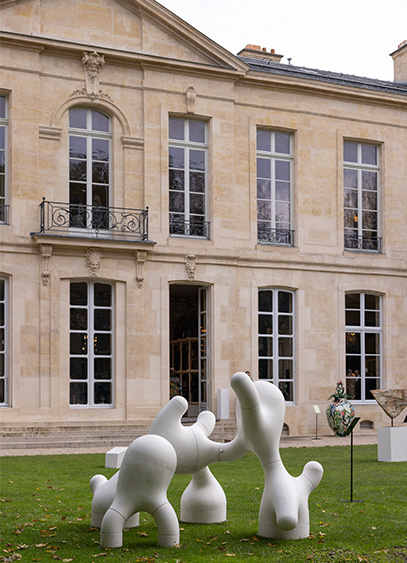
Absolutely. This is our fourth edition at the Hôtel de Maisons, and the setting matters. The venue is a home, not an exhibition hall. Furniture and objects are therefore discovered on a domestic scale, in rooms bathed in natural light and steeped in history. Many galleries adapt their presentations to suit the house. Galleria Rossella Colombari, for example, evokes the atmosphere of a typical Italian home.

Outside, the courtyard and gardens provide the space we need for "Design at Large," our program of large-scale works that could not be exhibited indoors. Cyryl Zakrzewski designed his birch plywood bench for the Craftica Gallery specifically for this outdoor environment, and Abel Macias, a former SCAD student, created a padded floor covering for the house's original 18th-century staircase.

‍

Among the new talents featured in this issue, could you name one or two who you think might stand out in the coming years?

As organizers, it is not our place to pick favorites, but I invite visitors to discover Galerie SCÈNE OUVERTE, where Adélie Ducasse is exhibiting her first Murano glass lamp, as well as Studio Lugo, which is presenting a desk and bookcase in German silver in a limited edition of eight, the result of a first collaboration with the gallery. Both belong to a generation of designers deeply committed to materials and the tradition of the decorative arts.

I would also recommend that visitors check out the four designers selected for "Designers of Tomorrow," our program in partnership with Apple. This year's theme, "Design for Presence," explores how design can help us slow down and create connections. Their creations will be unveiled during the fair.

‍

Below, visuals from the A/P Room gallery: Arte Viva bookcase and Upholstered floor lamp

Temps de lecture
30/9/2026
Artek x Hender Scheme: the patina of time

Finnish brand Artek and Japanese label Hender Scheme present their first collaboration, centered on the natural aging of materials and the aesthetic power of time.

Our attachment to certain objects is not explained by their intrinsic value, but by their history—the kind that causes wear and sometimes alters form, or even function. It is against this backdrop of passing time that Artek and Hender Scheme have partnered. A specialist in bentwood furniture since 1935, the Finnish brand turned a new page in 2024 by embracing the natural imperfections of birch in its seating during a collection with the studio Formafantasma. This relationship with the natural world, which the company founded by Aino and Alvar Aalto continues to explore, is now being examined alongside the Japanese leather footwear and accessories manufacturer, Hender Scheme.

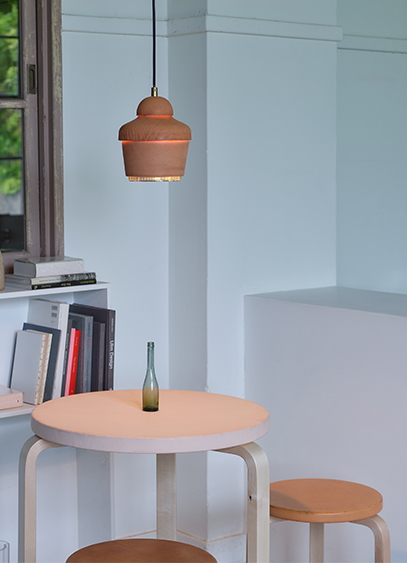
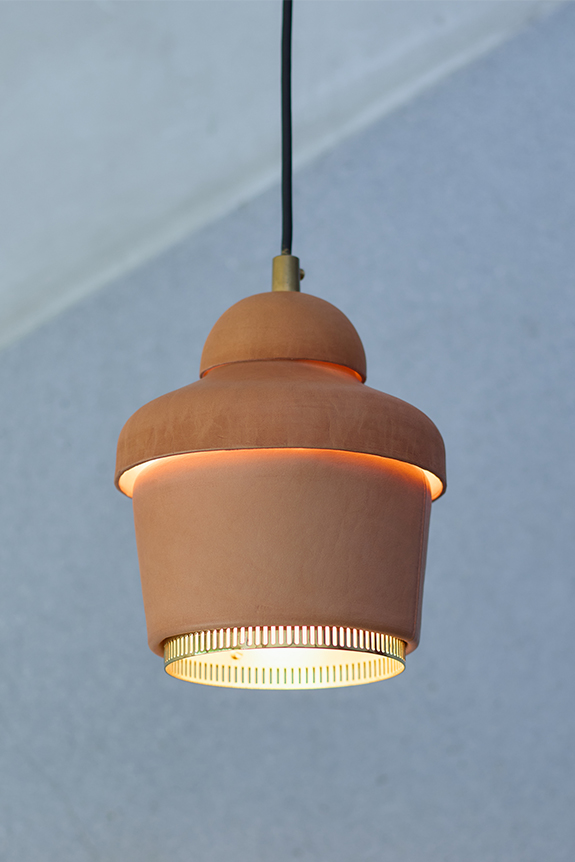
Pendant lamp ©Artek x Hender Scheme

‍

The value of time

While objects are shaped by the industry that creates them, this collection aims to show that they continue to live on in the hands of their users. By making vegetable-tanned leather the central element of this collaboration, the brands offer a new finish that develops a natural patina over time. This sensitive approach to the life of furniture gives each piece its own uniqueness. This choice also fosters an exchange between the two companies: the former introduces the Aalto design language into a codified, Japanese-inspired aesthetic, while the latter brings its expertise by outfitting the iconic Stool 60 with leather "shoes"—a nod that highlights the signature L-shaped legs of the famous seat.

Stool 60 with "shoes" ©Artek x Hender Scheme

‍

"New Craft": the concept of technological craftsmanship

This new connection is also an opportunity for Hender Scheme to develop its concept of "New Craft"—an idea where craftsmanship and modern technology meet and merge to serve new creations. Among them is the A330 Golden Bell pendant lamp, designed by the Aaltos. For this occasion, the brass shade is reinterpreted in molded leather. The traditional technique of wet molding is combined with 3D printing to offer new visual and tactile qualities without altering the original form. This bold proposal echoes the more classic treatment of leather featured on various items, including a clock, a keychain, and coasters that adopt the curved "Riihitie" shape designed by Aino Aalto. Unveiled at the London Design Festival, these objects will be available for purchase starting October 10.

‍

Below, from left to right: coasters and clock

Inscrivez-vous à notre newsletter pour recevoir chaque semaine l’actualité du design.