A+A Cooren, entre technique et poésie

A+A Cooren, entre technique et poésie

À la Carpenters Workshop Gallery, rue de la Verrerie à Paris, l’exposition de « Tiss-Tiss, Flexible Rigidity » est visible jusqu’au 15 octobre 2021. Les créations de A+A Cooren se confrontent aux créations textiles de Simone Prouvé, la fille de Jean Prouvé, dans un dialogue sensible et évident qui replace le travail de la main au cœur de leurs préoccupations. Au Mobilier national, ils profitaient pendant la Paris Design Week d’une première mise en visibilité hors pair de leurs fauteuils et canapé « Dans un nuage de Pixels », habillés par une création textile numérique de Miguel Chevalier. Retour sur un duo de designers qui, depuis la création de leur studio, en 1999, ont travaillé sur des projets d’aménagement d’intérieur, de produits, de design de meubles ainsi que de scénographies pour Shiseido, Artemide, ClassiCon, L’Oréal, Cartier, mais aussi la Manufacture Nationale de Sèvres, Yamagiwa, Saint Louis, Boffi Bains, Vertigo Bird, Noma…


Aki et Arnaud Cooren, identifiés sous le studio A+A Cooren, se sont rencontrés à l’Ecole Camondo. Elle, japonaise, est née à Paris, a grandi à Tokyo, un peu aux États-Unis et est venue étudier à Paris où elle a rencontré Arnaud. Lui, a fui la France après sa seconde pour faire ses humanités artistiques à Saint-Luc, La Cambre et finalement intégrer Camondo, à l’époque la seule école qui offrait un double cursus : « À La Cambre, on faisait beaucoup d’atelier, beaucoup de peintures, des grands formats, des anamorphoses par rapport à l’espace et l’atelier auquel je participais avait pour dénomination « Espaces urbains et ruraux lumière couleur ». Les gens réfléchissaient sur notre environnement, l’espace, la lumière et tout ce qui était de l’ordre du sensible. Cela a éveillé ma curiosité sur l’espace, plein d’autres choses et j’ai eu envie de travailler sur l’objet et sur ce qu’un objet voulait dire ou ne voulait pas dire. »

‍

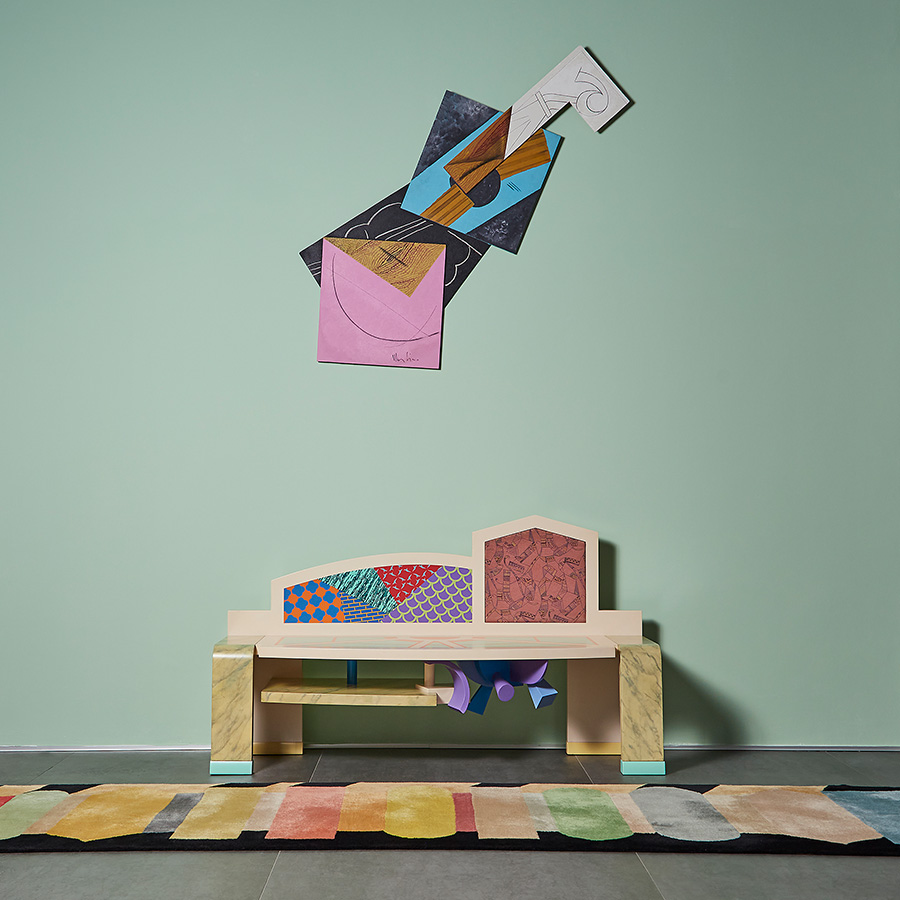
ClassiCon, console Tadaima, création A+A Cooren, 2017 © Thomas Biswanger

‍

Rencontre… du textile et du métal

‍

Quand ils se rencontrent avec Aki, ils détiennent déjà un fond commun et peuvent dialoguer : Aki, formée à l’intensité et Arnaud avec un background de réflexion sur le sujet, le contexte et le sens. Ensemble, ils voient les choses et avancent. « Nous avons grandi tous les deux dans des familles créatives, explique Aki. Mon père a créé un textile au Japon, il a appris à tisser, à faire des teintures sur soie. Il est devenu avec ma mère un créateur de bijoux en argent, dans un principe de fabrication à cire perdue. Il fabrique des modèles de tout, à la main, avec une facilité déconcertante. Il maîtrise l’Art nouveau. Il sait faire du Guimard à la main, de tête. Mais aussi des créations contemporaines… Avec lui, un jouet n’était jamais cassé, il le réparait dans la foulée. Ma mère tissait. Elle avait importé un métier à tisser de Scandinavie au Japon au début des années 70. C’était extrêmement rare. Et ma grand-mère qui était d’une grande famille avait des kimonos pour toute sa vie avec les motifs réservés à certains âges, hyper codifiés. J’ai grandi avec ce code textile autour de moi et l’odeur du métal…C’est toute mon enfance. »

Le textile et le métal, font partie de leur univers depuis toujours. Depuis 1999, date de création de leur studio, ils réfléchissent sur ce même sujet, la combinaison du textile et du métal.

‍

Workshop Gallery, Flexible Rigidity, Simone Prouvé & Aki+Arnaud Cooren © Courtesy of Carpenters Workshop Gallery

‍

« Nous, ce qu’on aime, c’est cette espèce de flexibilité et de fragilité du tissu. Il peut être super souple mais également super dur, régulier et en même temps irrégulier. C’est le côté main-humain du tissu qu’on adore. Il y a toute une instantanéité que l’on voyait en faisant le travail qu’on essaie de retransmettre quand on fait les lampes Ishigaki par exemple. Les lampes sont grandes, mais en même temps, elles tiennent. Il y a un jeu technique, un jeu poétique et on essaie de faire en sorte que l’un ne domine pas l’autre. »

‍

En complémentarité

‍

Ils capturent le moment où le tissu se pose et où les détails de qualité certifient le travail de la main. Ce sont des choix d’instantanés qu’il faut prendre tels qu’ils viennent. Pour eux, les accidents sont des atouts. Quand les gens en fonderie expliquent comment l’accident est arrivé et comment il aurait pu être évité, la coordination est superbe et tous les gens de la chaîne de fabrication sont heureux de livrer un tel produit. « La table Tiss-Tiss fait 2,80m mais elle se porte à deux. Elle est en aluminium avec des reliefs de textile. Pour l’atelier de la Carpenters Workshop Gallery, l’assemblage était léger et rapide. Tous les modules ont voyagé à plat. Et cela se voit sur la vidéo du montage. »

Ils se revendiquent tous les deux, chacun de leur planète, gravitant l’un autour de l’autre avec leur qualité et leur force, homme et femme associés, chacun avec son éducation. « L’éducation à la française t’aide beaucoup plus à développer ton idée. Au Japon, tu ne dois pas sortir du schéma. Tu apprends tout par cœur et sans comprendre ce que tu apprends. À deux, on ne voit pas de la même manière. Cela laisse le champs libre à l’imaginaire de l’autre et nos produits sont comme des jouets pour adultes. Quand on veut que nos objets aillent dehors… on met au point des vernis qui font qu’ils puissent aller dehors. On les teste nous-mêmes, on vérifie tout. Cet hiver, on a laissé nos meubles dehors pour constater les variations, pour les fragiliser, les cramer, les brûler… ça a l’air fragile mais ça ne l’est pas du tout. C’est à l’épreuve de la vie. »

‍

© Courtesy of Carpenters Workshop Gallery

‍

La création numérique

‍

Ils ont fait le grand écart au Mobilier national avec Miguel Chevalier, qui travaille sur le numérique, et Simone Prouvé qui travaille à la main de façon intuitive depuis très longtemps. Ils se sont rendu compte de leur proximité avec Simone Prouvé quand ils ont vu son approche de la photo. Ils photographient les mêmes accumulations comme des enfants que l’on laisse jouer avec un appareil photo. « La beauté est tout autour de nous. Ce qu’on veut montrer aux gens, c’est que si tu changes de point de vue, la beauté est là. Mais s’exprimer dans un milieu qui relève de l’industrie au moment où l’industrie meurt, c’est compliqué. A l’atelier de la Carpenters Workshop Gallery, les artisans étaient très attentifs à ce que je voulais et moi, je ne savais pas ce qu’ils pouvaient. Leur champ des possibles était tellement large. Pareil avec le Mobilier national. C’est finalement tombé au même moment mais il nous a fallu six ans pour développer l’ensemble numérique, un ensemble complet développé entre artistes et designers et artisans d’art de la Savonnerie ou de l’ARC. Miguel avait des dessins, on en a discuté, on a proposé un ensemble sur lequel ses dessins pourraient s’appliquer. On a travaillé le mobilier, on a parlé confort, redessiné les assises. Il y a eu plein d’aller et retour dans tous les sens. Ce qui fait qu’on arrive à quelque chose qui a du sens. On y est bien assis. Il n’y a qu’un set et toute la question est : est-ce que des éditeurs français vont se sentir capable d’éditer cette pièce ? Avant même de fabriquer, au Mobilier national, ils pensent à la restauration. Donc, là c’est tout simple, l’habillage tissu est déhoussable, se lave et se repositionne. (Cela peut paraître compliqué à comprendre). Dans les deux cas, on a essayé de faire des choses pérennes. »

‍

Mobilier national, « Dans un nuage de pixels », création Miguel Chevalier & A+A Cooren, Paris Design Week 2021© Thibaut Chapotot

‍

Le Prix Liliane Bettencourt pour l’intelligence de la main remporté en 2017 dans la catégorie Dialogues avec le fondeur David de Gourcuff, leur a permis de donner une visibilité à leur projet Tiss-Tiss. Une conjonction d’étoiles positives dans un pays où le droit d’auteur est fortement protégé et où le designer trouve une place quoi qu’il fasse, en tant que créateur ou chef d’entreprise. « Depuis 20 ans nous avons réussi à vivre/survivre de notre profession » et c’est un exemple pour les jeunes générations.

‍

Scénographie, Galerie Sèvres- Cité de la céramique, A+A Cooren, 2013© Lorenz Cugini
Noma Editions, chaise SEN ( 93,7% de matière recyclée), création A+A Cooren, © Studio Swissmiss

‍

‍

Rédigé par 
Bénédicte Duhalde

Vous aimerez aussi

Temps de lecture
29/10/2026
L.I: a bold project, Special Prize from the Mobilier national - Young Creation competition

Winner of a special prize in the Mobilier National’s Young Creation competition, the L.I. table and chairs designed for the Council of Ministers offer new approaches to contemporary design through the use of Drop Stitch technology and recycled carbon.

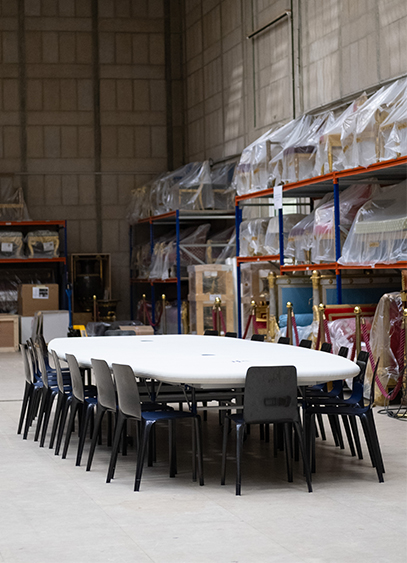
L.I., two letters for lightness and innovation. Found "a bit at the last minute", the name of the table and chairs designed by Yanis Bontemps, Paul Seiller, and Victor Galineau favors the factual over the lyrical. This lack of flourish echoes the approach of the trio, who formed during their final year of studies at Ensaama to respond to the Mobilier National’s Young Creation Prize call for projects. The challenge? To propose a set of furniture that is easy to install and can be stored on a freight elevator for the Élysée Palace’s Council of Ministers room. The three designers worked on this dual constraint for several years with the ARC. Delivered for the 2026 Heritage Days, the project had already been recognized in 2020 with a special prize created specifically for it.

© Julien Seiller


An inflatable table

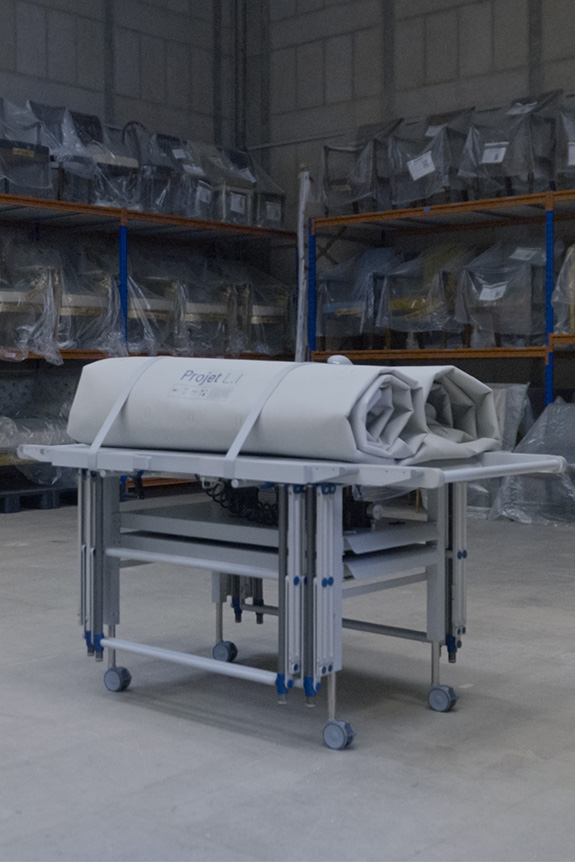
"The initial concept for the table was to make it inflatable so that it could be deployed quickly", explains Yanis Bontemps. The idea led the three students at the time to take an interest in the Drop Stitch material manufactured by the company Musthane. "To put it simply, it is an inflatable membrane where the two walls, top and bottom, are connected by sewn nylon threads. Through a physical phenomenon, the structure becomes tensioned when inflated, offering something very rigid with just one bar of pressure." Used in some paddleboards, this technology is now primarily found in the military sector, notably in the form of cushions for repairing aircraft wings.

Self-supporting, the Drop Stitch led the studio to imagine a table in which the freight elevator is not just a transport tool, but becomes a structural element. Used as a central base, the cart is equipped with a foldable structure featuring eight aluminum legs upon which the elliptical tabletop unfolds. "This project was guided more by semantic constraints than by technology. At first, we had imagined a round table, but it was difficult to fold and didn't fit the usual codes. So we let ourselves be guided by existing conventions" says Paul Seiller.

©Julien Seiller


Letting the raw material speak

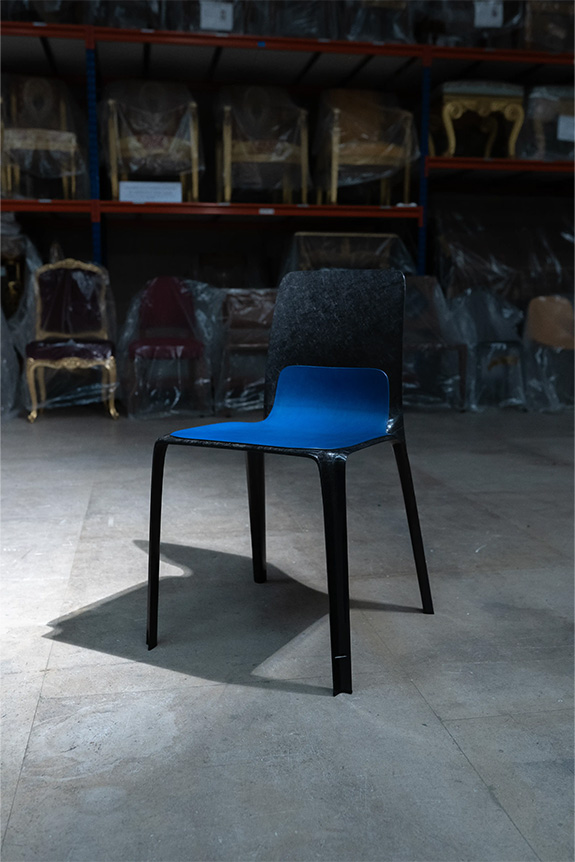
To accompany this table, the three designers drew sixteen chairs. Made from 56% bio-based resin sourced from plant-based channels and an epoxy foam, they also provided an opportunity to work with recycled carbon. "For the chair to be in line with the practicality of the table, we started with this lightweight material. But it led us to wonder how to use a material that is far from 'eco-friendly' in a responsible way." The designers then turned to Workshape. "By heating waste from various industries, such as automotive, to very high temperatures, this company manages to separate the components, including carbon. By working with them, we were able to recover the carbon in the form of felt, which we then molded and baked." A recycling technique that gives rise to seat shells with sleek, aerodynamic lines. "We wanted to let the raw material speak for itself. To convey an industrial language through exceptional furniture. It was a relatively exploratory process, especially since neither of the two companies approached had ever made furniture before." Beyond anodizing and leatherwork, this project brings together technologies applied for the first time to the contemporary design sector. These new approaches, fueled by the ideas of the three designers and the innovation of the ARC, expand the range of French techniques and expertise.

Temps de lecture
20/10/2026
Design Miami Paris 2026: Alternating Currents

For its fifth edition, Design Miami Paris has invited thirty galleries to take over the Hôtel de Maisons. It is an opportunity to bring together French decorative arts, modernist design, and collectible pieces during this art-filled week. Jen Roberts, the event's CEO, tells us about this convergence of worlds.

In recent years, October has become the annual meeting point for collectors and art enthusiasts. Running alongside Art Basel, Design Miami Paris opens this Tuesday, October 20, for a five-day run. Located within the Hôtel de Maisons, behind the high walls at 51 rue de l’Université, this fifth edition is centered on the theme "Design for Presence." This presence is embodied by various artistic movements. Here, the modernist lines of jewelry designed by Pierre Charreau and furniture by Jean Prouvé stand in contrast to the generous forms and ornamental techniques presented by a body of international galleries. Jen Roberts, CEO of Design Miami since 2015, sheds light on this contrasted approach to creation.

©Galerie Rossella Colombari

‍

This year, historic French design and the decorative arts are in the spotlight. Why this choice?

Paris is where a large part of the history of French design and decorative arts was written, and it is where it remains very much alive today. The city is home to an exceptional concentration of specialized galleries, workshops, and collectors who have a deep understanding of these periods. Here, historical works are understood and actively collected. It is therefore logical that our Parisian edition gives them more space than our Miami event.

This dynamic is felt throughout the fair. Galerie Maxime Flatry brings together a rare collection of French modernist works from the 1930s, centered on a major ensemble by Robert Mallet-Stevens and presented alongside works by Pierre Chareau, Eileen Gray, and Pierre Legrain. Laffanour | Galerie Downtown presents works by Le Corbusier, Pierre Jeanneret, and Charlotte Perriand. Mitterrand exhibits works by Claude and François-Xavier Lalanne, including an exceptional pair of "Singes Attentifs" (Attentive Monkeys) and a "Pomme de Londres" (London Apple) dating from 2007. And in the gardens, as part of "Design at Large," visitors will be able to discover "Le Très Grand Ours" (The Very Big Bear) by François-Xavier Lalanne, a three-meter-tall bronze bear.

‍

How will the selection for Design Miami Paris—which focuses primarily on collectible pieces—fit into this historical theme?

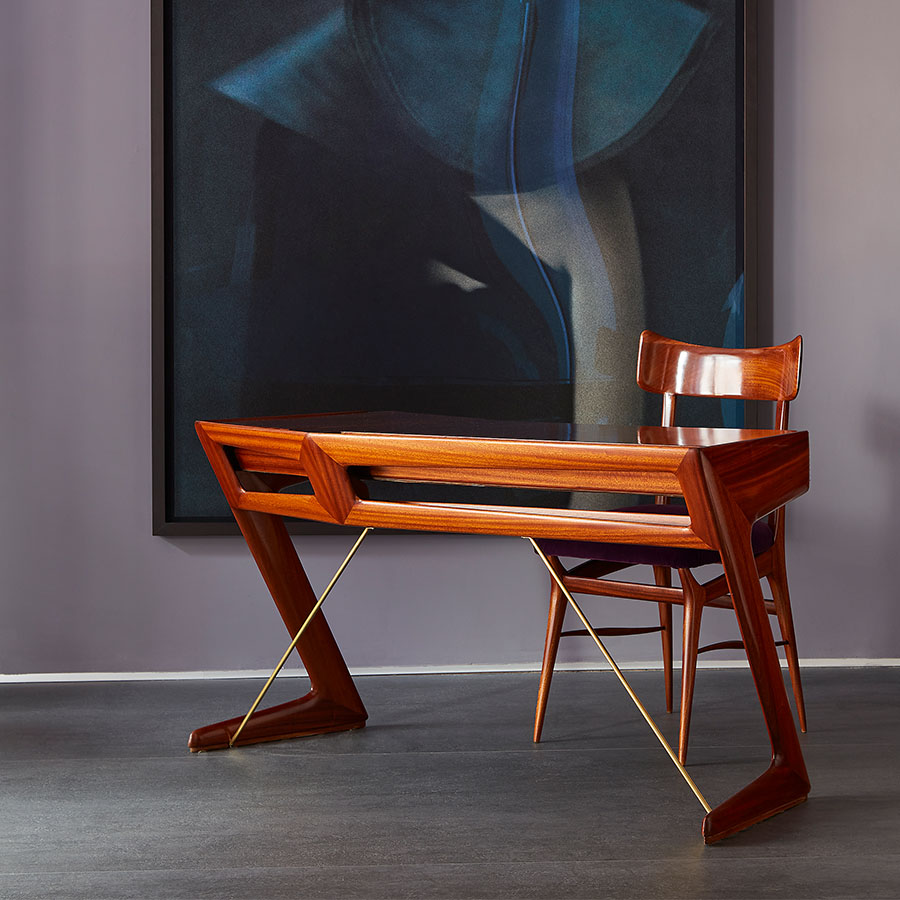
There is a natural link between the historical theme and the fair's focus on collectible design. The fair brings together historical and contemporary works, allowing visitors to follow the evolution of design ideas over time. Each piece is vetted by independent experts. Historical works capture a specific moment, whether marked by a technical breakthrough, an artistic movement, or a social or political shift. They offer today's designers a history to build upon and allow collectors to place contemporary works in context. Often, the most interesting moments occur where the two meet. Galerie kreo pairs 20th-century French and Italian lighting with limited editions by designers such as Jasper Morrison and Virgil Abloh. This juxtaposition makes the relationship between eras visible. Salon 94 Design from New York and SIDE Gallery from Barcelona also bring perspectives from beyond France to the fair.

©Galerie Rossella Colombari

‍

Should we expect visual links between these worlds, or a deliberate anachronism?

Both visual links and deliberate contrasts are part of the pleasure of this fair. In just a few steps, you can move from a piece of furniture from the 1930s to one finished this spring. Sometimes the link is explicit. At Galerie SCÈNE OUVERTE, the exhibition "Around a Desk: A Contemporary Vision of Decorative Arts" brings together the desk and German silver totem by Studio Lugo, as well as the sofa by Studio KRJST, designed around a one-of-a-kind tapestry. Both works clearly dialogue with the French tradition of decorative arts. Elsewhere, it is the contrast that gives the exhibition its strength. In the gardens, Jean Prouvé’s 1944 prefabricated house stands near a bronze swing by Irene Cattaneo, created this year.

New exhibitors are also broadening the debate geographically. The A/P Room gallery, based in Dubai, presents mid-century Brazilian works by Joaquim Tenreiro, Abraham Palatnik, and Branco e Preto, alongside "Originform," a new series of sculptural lighting by Rogan Gregory, as well as objects by Lebanese architect and ceramicist Zein Daouk. The connections are established more through form and material than by date, and historical and contemporary pieces occupy an equal footing.

‍

Whether the focus is on modern or contemporary design, does the architectural setting of the Hôtel de Maisons influence your artistic selection in any way?

Absolutely. This is our fourth edition at the Hôtel de Maisons, and the setting matters. The venue is a home, not an exhibition hall. Furniture and objects are therefore discovered on a domestic scale, in rooms bathed in natural light and steeped in history. Many galleries adapt their presentations to suit the house. Galleria Rossella Colombari, for example, evokes the atmosphere of a typical Italian home.

Outside, the courtyard and gardens provide the space we need for "Design at Large," our program of large-scale works that could not be exhibited indoors. Cyryl Zakrzewski designed his birch plywood bench for the Craftica Gallery specifically for this outdoor environment, and Abel Macias, a former SCAD student, created a padded floor covering for the house's original 18th-century staircase.

‍

Among the new talents featured in this issue, could you name one or two who you think might stand out in the coming years?

As organizers, it is not our place to pick favorites, but I invite visitors to discover Galerie SCÈNE OUVERTE, where Adélie Ducasse is exhibiting her first Murano glass lamp, as well as Studio Lugo, which is presenting a desk and bookcase in German silver in a limited edition of eight, the result of a first collaboration with the gallery. Both belong to a generation of designers deeply committed to materials and the tradition of the decorative arts.

I would also recommend that visitors check out the four designers selected for "Designers of Tomorrow," our program in partnership with Apple. This year's theme, "Design for Presence," explores how design can help us slow down and create connections. Their creations will be unveiled during the fair.

‍

Below, visuals from the A/P Room gallery: Arte Viva bookcase and Upholstered floor lamp

Temps de lecture
30/9/2026
Artek x Hender Scheme: the patina of time

Finnish brand Artek and Japanese label Hender Scheme present their first collaboration, centered on the natural aging of materials and the aesthetic power of time.

Our attachment to certain objects is not explained by their intrinsic value, but by their history—the kind that causes wear and sometimes alters form, or even function. It is against this backdrop of passing time that Artek and Hender Scheme have partnered. A specialist in bentwood furniture since 1935, the Finnish brand turned a new page in 2024 by embracing the natural imperfections of birch in its seating during a collection with the studio Formafantasma. This relationship with the natural world, which the company founded by Aino and Alvar Aalto continues to explore, is now being examined alongside the Japanese leather footwear and accessories manufacturer, Hender Scheme.

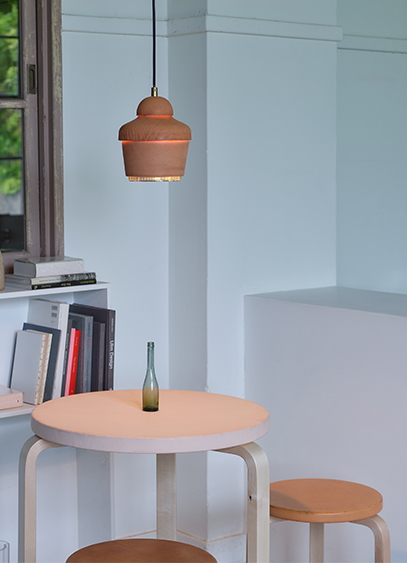
Pendant lamp ©Artek x Hender Scheme

‍

The value of time

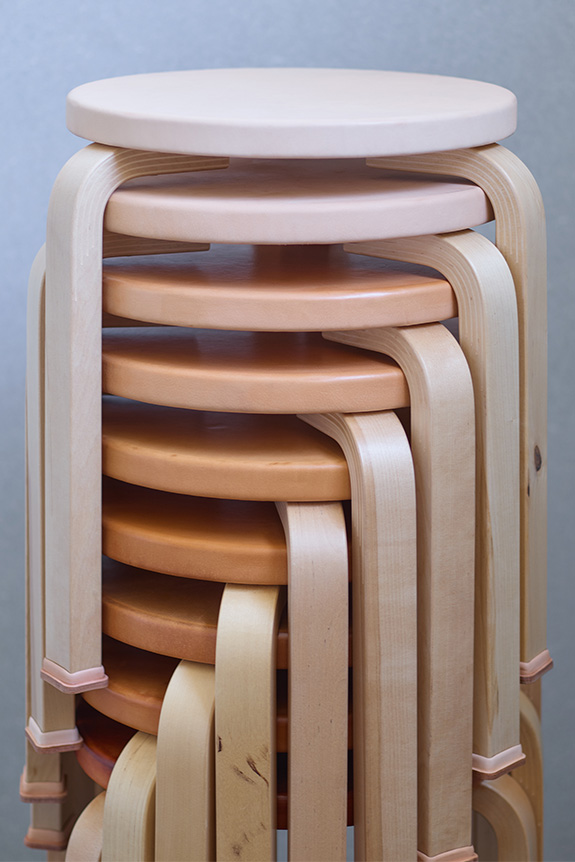
While objects are shaped by the industry that creates them, this collection aims to show that they continue to live on in the hands of their users. By making vegetable-tanned leather the central element of this collaboration, the brands offer a new finish that develops a natural patina over time. This sensitive approach to the life of furniture gives each piece its own uniqueness. This choice also fosters an exchange between the two companies: the former introduces the Aalto design language into a codified, Japanese-inspired aesthetic, while the latter brings its expertise by outfitting the iconic Stool 60 with leather "shoes"—a nod that highlights the signature L-shaped legs of the famous seat.

Stool 60 with "shoes" ©Artek x Hender Scheme

‍

"New Craft": the concept of technological craftsmanship

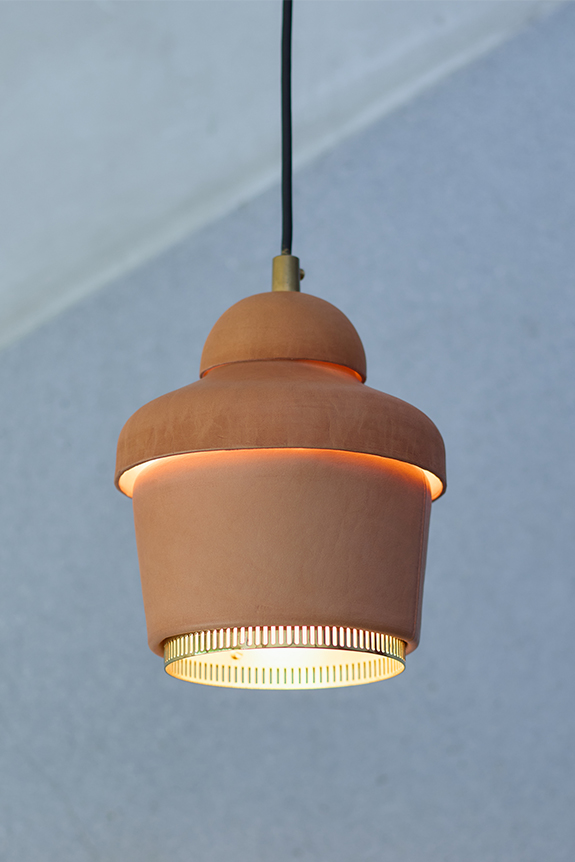
This new connection is also an opportunity for Hender Scheme to develop its concept of "New Craft"—an idea where craftsmanship and modern technology meet and merge to serve new creations. Among them is the A330 Golden Bell pendant lamp, designed by the Aaltos. For this occasion, the brass shade is reinterpreted in molded leather. The traditional technique of wet molding is combined with 3D printing to offer new visual and tactile qualities without altering the original form. This bold proposal echoes the more classic treatment of leather featured on various items, including a clock, a keychain, and coasters that adopt the curved "Riihitie" shape designed by Aino Aalto. Unveiled at the London Design Festival, these objects will be available for purchase starting October 10.

‍

Below, from left to right: coasters and clock

Temps de lecture
30/9/2026
"Under Pressure": Marie and Alexandre exhibit at the Signé gallery

Until October 10, the duo Marie and Alexandre are presenting the "Under Pressure" exhibition at the Signé gallery, in which pressure is explored from several angles: through the techniques and materials used, but also, more broadly, in their relationship to the creative process.

‍

"The idea behind this exhibition was to work with pressure a little differently, using various techniques, with this concept of rapid explosion, and succeeding in bringing them all together." For this exhibition, the design duo formed in 2018 chose to make pressure their starting point. The title, "Under Pressure," refers in particular to hydroforming, an industrial process in which water pressure is used to shape metal. At the gallery, Marie and Alexandre present pieces shaped by various forces and constraints, created in collaboration with several specialized artisans. But pressure here refers to more than just a shaping technique. It also becomes a condition of creation, exerted by the material, by time, by doubt, by sometimes irreversible choices, or by the desire to bring into being something that does not yet exist.

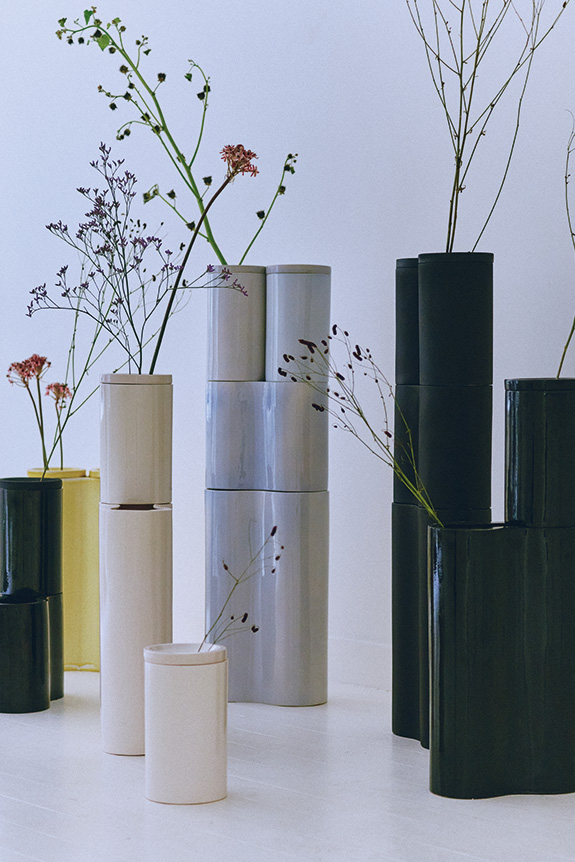
"Under Pressure" exhibition, collection of glazed ceramic vases, design: Marie and Alexandre © Charlotte Robin

Combining techniques and expertise

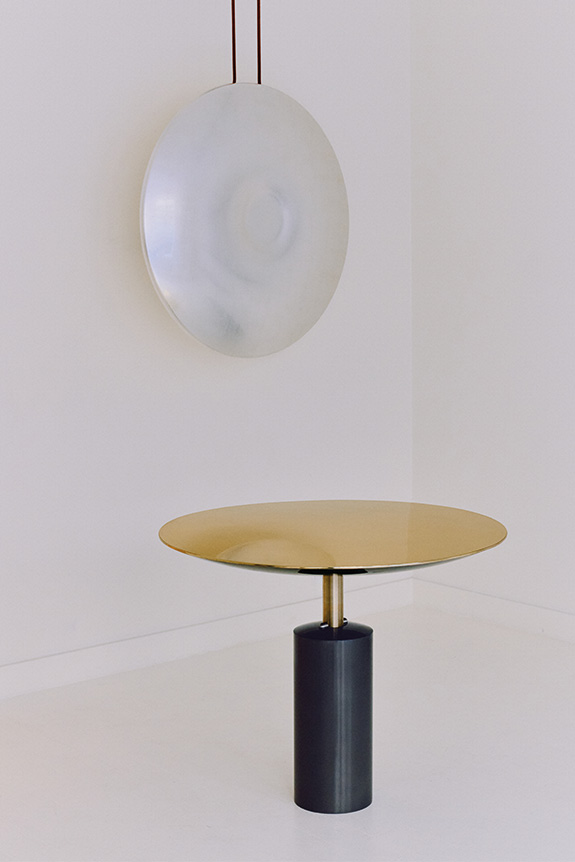
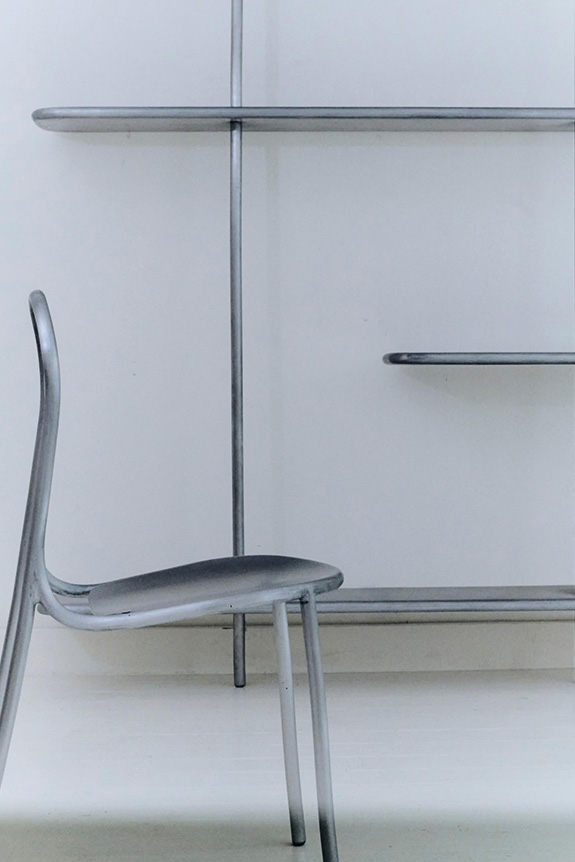
In the exhibition, which brings together around ten pieces, the designers have partnered with various artisans to explore pressure in all its forms. With Antoine Giret, they present a console, a shelving system, and a chair based on work with aluminum, centered on the vibration of the material and the creation of systems. Working with Jean-Marie Foubert, they conceived a collection of ceramic vases, available in single and double versions as well as in different sizes. With glassmaker Simon Rio, they moved into a different register by designing a coffee table with a thermoformed glass top. Finally, with the Blam studio—notably known for their work on the mechanical horse that appeared during the opening ceremony of the Paris 2024 Olympic Games—they designed a piston table as well as a metal and silver leaf medallion whose shape is born directly from the constraint exerted on the material. The latter is destined to join the recently inaugurated Cité du Design in Saint-Etienne.

"Under Pressure" exhibition, medallion and piston table, design: Marie and Alexandre © Charlotte Robin

Through this exhibition, Marie and Alexandre seem to be evolving their formal language toward greater restraint. The forms are tightened and the means are reduced, without losing their function or intensity. Ultimately, it is a way for the duo to question their own creative process.

"Under Pressure" exhibition, aluminum chair and shelving system, design: Marie and Alexandre © Charlotte Robin
Inscrivez-vous à notre newsletter pour recevoir chaque semaine l’actualité du design.