

The Luxembourg chair: anatomy of a contemporary icon
Created in 2003 by French designer Frédéric Sofia and produced by Fermob since 2004, the Luxembourg chair has established itself with discretion and elegance all around the world.
From the Bibliothèque Nationale de France Richelieu to the Art Institute of Chicago and the Humboldt Forum in Berlin, it has come to embody the French art of living and established itself as one of the great French icons of outdoor furniture. A reinterpretation of the historic Sénat chair from the Jardin du Luxembourg, it follows a long tradition of "redesign," while elegantly breaking away from it through a minimalist and sensitive design that has won over audiences far beyond its borders.
A bold genesis for a resolutely contemporary design.
In 2003, Frédéric Sofia submitted his idea to Fermob to profoundly transform the Sénat chair, in which he saw a playful and contemporary creative opportunity. He wanted to turn an uncomfortable object with a rudimentary design into a true piece of outdoor designer furniture. According to Frédéric Sofia, the main inspiration was the Sim chair by Jasper Morrison (created in 1999 for Vitra), itself a "redesign" of the 40/4 by David Rowland (created in 1964), praised for its radical simplicity. The Luxembourg chair also draws on the legacy of Philippe Starck and the Miss Sissi lamp for Flos (1991), whose form speaks to collective memory, a concept dear to the designer. From these influences emerged a desire to explore a design at the crossroads of functionalism and aesthetics, exploring the balance between geometric rigor and biomorphism.
Sensitive design, balancing functionalism and biodesign.
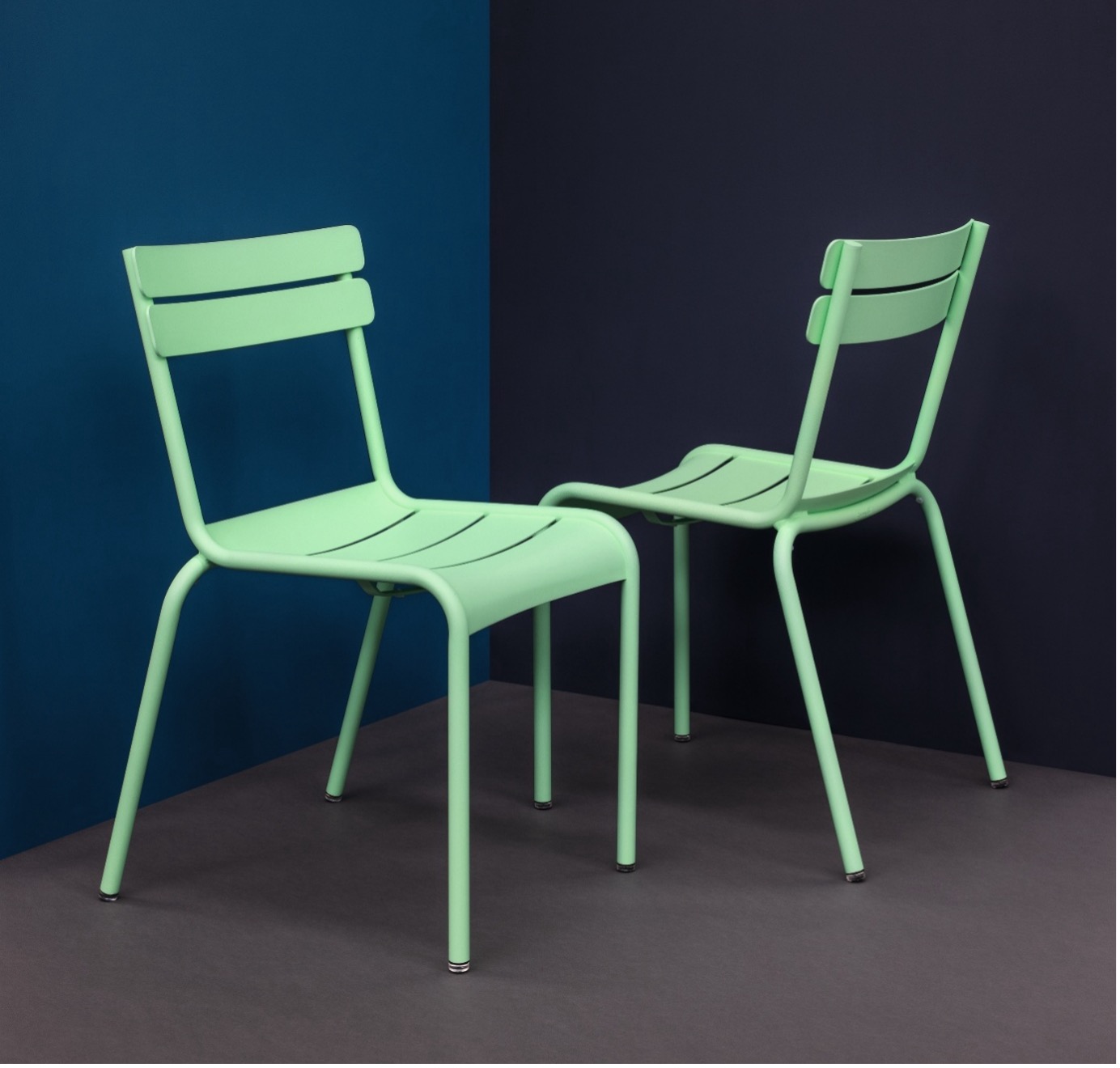
The Luxembourg chair is defined by a clean, streamlined design that decisively breaks away from the heritage icon that is the Sénat chair. Rooted in a search for the intersection of industrial minimalism and organic sensitivity, its lines become airy, its ergonomics are completely rethought, and its wide color palette (26 shades) opens up to a deeply contemporary horizon. Inspired by living forms, its flexibility evokes movement and flow, whereas the Sénat chair remains anchored in its own era. Driven by a desire to breathe new life into the very conception of the product, Sofia made the radical choice to integrate a transparent glide on the base—a feature entirely unprecedented in the world of furniture. Inspired by skateboard wheels, it completes a design that seeks to shed all heaviness, without ever forgetting its origins.
This reflection extends throughout the entire Luxembourg range, which now includes armchairs, footrests, benches, and tables, all while maintaining a harmonious logic and aesthetic and conceptual consistency. The armchair combines industrial aesthetics with a playful, joyful twist, with the armrest serving as its signature piece. Designed in the shape of a small fin, its bold assembly gives the impression that it has been threaded onto the frame like a bead. This principle is applied to the pedestal table and becomes central to the visual coherence and unity of the collection. Finally, the use of aluminum completes an industrial and ergonomic vision of outdoor furniture. Lightweight, durable, malleable, and infinitely recyclable, this exceptional material reflects a deep consideration for the product's primary function and the service it provides.
The "silent citation," a timeless principle.
In the history of design, there are many examples of pieces that evoke their historical sources while emancipating themselves through a strong creative singularity. This principle, which one might call the "silent citation," can be found in the work of Marcel Breuer, whose Cesca (1928) was inspired by the Thonet chair (1859), or in Philippe Starck’s Ghost chair (2003), a reinterpretation of the 18th-century medallion chair. This phenomenon is also observed in the automotive industry with Volkswagen’s New Beetle (1998), a reinterpretation of the iconic Beetle from the 1960s, or in industrial design when Jonathan Ive drew inspiration from Dieter Rams’ 1950s radios to design Apple’s iPods in the 2000s.
The art of redesign has spanned the decades, and Frédéric Sofia is committed to its sublimation. Inspiration is transformed into a new work, and the sampled elements give rise to a fresh and fully realized form. From an archetype, a new myth is born—present in every corner of the globe, a new icon embodying the French art of living. Since 2009, the Luxembourg chair has been part of the National Center for Visual Arts collection, and was added to the Mobilier National in 2021. Today, it stands as proof that history and heritage can intertwine with innovation and creation in an emancipatory and poetic surge.