


Salone del Mobile 2026: The Intramuros Selection
With over 1,900 exhibitors this year, Salone del Mobile.Milano 2026 has once again delivered its share of new releases. The Intramuros editorial team shares the ones that caught our eye.
For this new edition, Salone del Mobile.Milano 2026 brought together more than 316,000 visitors to discover new products and reissues. Bringing together both major international firms and young brands, this Milanese event—slightly less dense than in previous years—remained rich in offerings. New materialities, an increased focus on real-world usage, the hybridization of functions... In a fragile but rapidly changing ecosystem—much like the fair itself, which inaugurated new spaces this year—the Intramuros team spotted some great leads. An intuitive and diverse panorama that we invite you to discover.
Kettal
Among all the new products presented by the Spanish brand, which continues to assert its position in the design sector, two stood out. First, Grosso by Patricia Urquiola: a sofa with sculptural forms that invites us to think of comfort as an art form. It reveals itself as a piece with bold yet spontaneous curves, appearing almost in motion. A model designed for both indoor and outdoor use, capable of seating up to three people. In a completely different register, the Atlantic collection by Jasper Morrison combines structure, rhythm, and continuity. This aluminum range with clean lines consists of a lounge chair, a chair with armrests, and a stackable chair. Designed for comfort and daily use, it adapts just as well to a private terrace as it does to a hotel or urban space.

Bitossi Ceramiche
The Italian ceramic brand Bitossi Ceramiche presented several pieces at its stand, including the Dittico vase collection by Martino Gamper. A project that pits the designer's formal research against the identity of a manufacturer with over 150 years of history. Created using white clay slip casting, the collection reveals pieces with organic, almost architectural curves to be appreciated from every angle. The Belgian duo Muller Van Severen—who celebrated their 15th anniversary during this Design Week—presented an extension of their 2024 Onda collection, titled Onda II. This new version revisits the shapes imagined in the first iteration by reworking them based on the principle of inversion. The pieces thus offer a renewed perception of the objects without altering their primary identity. The vases are all available in three colors: vermilion red, dark blue, and pastel gray.

Campeggi
Known for the intelligent design of its transformable objects, Campeggi unveiled "Bienvenue" this year. Conceived by designer Thélonious Goupil, this inflatable mattress is housed in a compact, portable wooden chest. With a simple opening, it provides a portable bed and a foldable, self-supporting headboard that can also serve as a room divider. A compact and colorful set for sleeping wherever you please.

Glas Italia
A sort of tribute to the great names of design, the 2026 collection brought together Piero Lissoni, Philippe Starck, and Patricia Urquiola, to whom we owe, among other things, Glacier. Entirely made of glass, this range of tables plays on the layering of different colored sheets. A reflection on strata reminiscent of glaciers, filtering light through layers of irregular materials. But the brand's presence at the Salone was also an opportunity to introduce Hlynur Atlason, who presented Akur. Behind the desire to challenge the rigidity and linearity of the medium, the designer focused on the meeting of curves and rectilinear grids. Slightly satin-finished, the textured surfaces of the tabletops offer an unusual reading of the material.

Blå Station
The result of a Scandinavian spirit and the desire to create furniture that is pleasant to live with, Blå Station presented the Frankfurter chair by designer Johan Ansander. Simple and classic in appearance, the seat was rethought with new proportions to offer a unique feel. Closer to the body and deeper, the chair is inspired by the shape of a forearm—a form subsequently materialized in bent beech wood. In addition to this new release, the brand also diversified by expanding its Able range, designed by Bernstrand & Borselius, with high tables and a desk. Two new typologies are immediately identifiable thanks to the die-cast zinc nodes combined with steel tubes. A construction that also recalls the wire-frame aesthetic of the Villhem range—designed by Lindau and Bernstrand & Borselius—launched last year and expanded in 2026 with a lower-back chair, an ottoman, and a coffee table.

NII
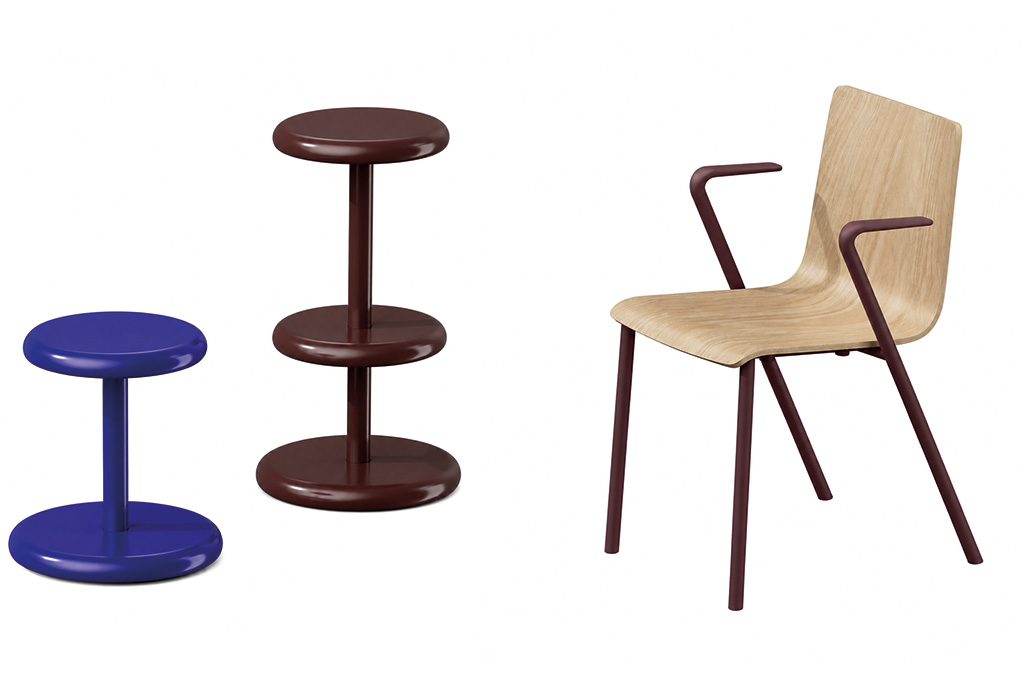
The Japanese brand NII, a member of the Itoki group, unveiled itself outside of Japan for the first time, choosing the Salone del Mobile for its international debut. For this first appearance, NII presented its latest innovations, including the Allround stool by designer Hirotaka Tako and the Hakusan chair by the studio Industrial Facility. The Allround stool stands out for its rounded lines and simple structure, defined by a single central column, resulting in a minimalist product that fits perfectly into any space. As for the Hakusan chair, it asserts its character while remaining subtle and universal. Made of aluminum and steel, it contrasts the solidity of its structure with a certain visual lightness, creating a perfectly balanced result.
B&B Italia
After a twenty-five-year absence (save for a 2019 appearance), B&B Italia made a notable return with a stand designed by Formafantasma. Among the new releases, the Moore lounge chair by Vincent Van Duysen stands out with its woven rattan supported by a frame with continuous curves. Evoking a slightly deformed ring, this fluid design enhances the piece's legibility and highlights its structure. In the same pursuit of formal clarity, Michael Anastassiades presents Metric, a chair crafted from thin sections of solid oak. Its rectilinear construction, reinforced by a crossbar, contrasts with the softness of the slightly curved backrest. Available with or without armrests, it can also be offered in an upholstered version covered in saddle leather. Finally, Ronan Bouroullec completes this selection with the Abaco table, where the object's architecture relies on an entirely visible construction. The precision of the joints and the dialogue between materials—lacquer, cement, or leather—give each configuration a unique identity, leaving the user free to compose as they wish.

Kartell
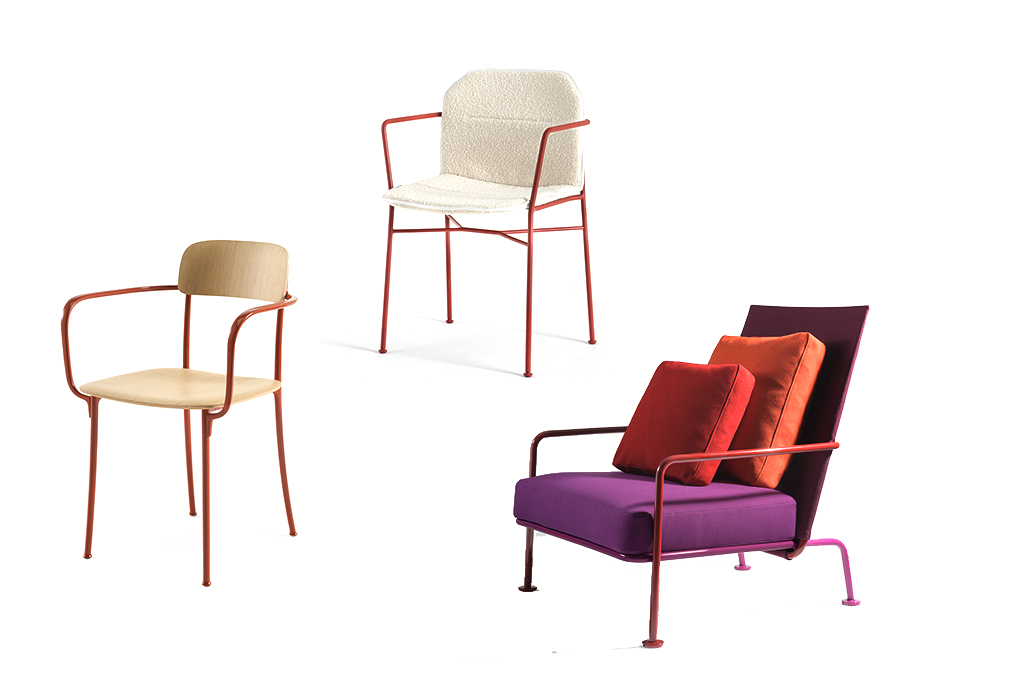
This year, Kartell made a strong impression, both in terms of its offerings and its collaborations. For the first time in several years, the Italian manufacturer expanded its field of experimentation by inviting the British duo Barber & Osgerby to collaborate. They exclusively presented the Savoia chair: an elegant, customizable aluminum piece offered with a seat in recycled plastic, wood, or leather, and available in several colors. It comes with or without armrests and is suitable for both indoor and outdoor use. Eight years after Papyrus, designer Erwan Bouroullec exhibited the Snik chair—a compact, minimalist model in recycled technopolymer with a steel frame, available with or without armrests. A nice bonus: it can be personalized to your liking with interchangeable covers that protect and transform it, ensuring you never tire of it. Meanwhile, Piero Lissoni revealed Yve’s, a minimalist armchair whose tubular structure is defined by a single curved line. Suitable for both indoor and outdoor use thanks to independent covers and cushions, Yve’s is available in various colors and fabrics, resulting in a generous product with a refined aesthetic.
Vergés
Spanish chair manufacturer Vergés was also present at this Milan edition to showcase its latest novelties. Among them is the Trek armchair, designed by the Norwegian duo Andersen & Voll. For this meticulous seat, the designers combined two noble materials—solid wood and leather—for a result that blends flexibility and robustness. Technically, the backrest and seat are covered in a single piece of leather, while the horseshoe-shaped rear crossbar gives Trek a unique character. The London-based studio Mentsen—founded by Japanese designers Risa Sano and Yasuyuki Sakurai—presented the Ensemble bench, inspired by church pews. It is a piece with a simple structure, faithful to Japanese craftsmanship, yet robust and versatile. It will be available with or without a backrest and, for added modularity, can be accompanied by a pivoting side table.



.svg)


.svg)