


In Milan, Zanotta balances heritage and new dialogues
During Milan Design Week 2026, Zanotta unveiled a bold ecosystem at its Via Durini flagship, bringing together vibrant new editions and pieces designed by Carlo Mollino, produced for the first time. It was a stylistic and temporal confrontation that felt perfectly at home with the Italian manufacturer.
In Milan, Zanotta presented a space entirely reimagined by the Calvi Brambilla studio, where a palette dominated by coffee tones engaged with geometric patterns, a nod to the historic Quaderna collection. It was a refreshed setting where color took center stage, whether in standout pieces introduced last year or new arrivals from long-standing collaborations. Among them is the partnership with Vincent Van Duysen, who expands the Fedrigo sofa system with new curved and asymmetrical modules, while also introducing the Campa dining line. Comprising a chair and a table, this range, defined by its fluid lines, is available in light or black-stained wood, paired with leather or smoked glass tops.
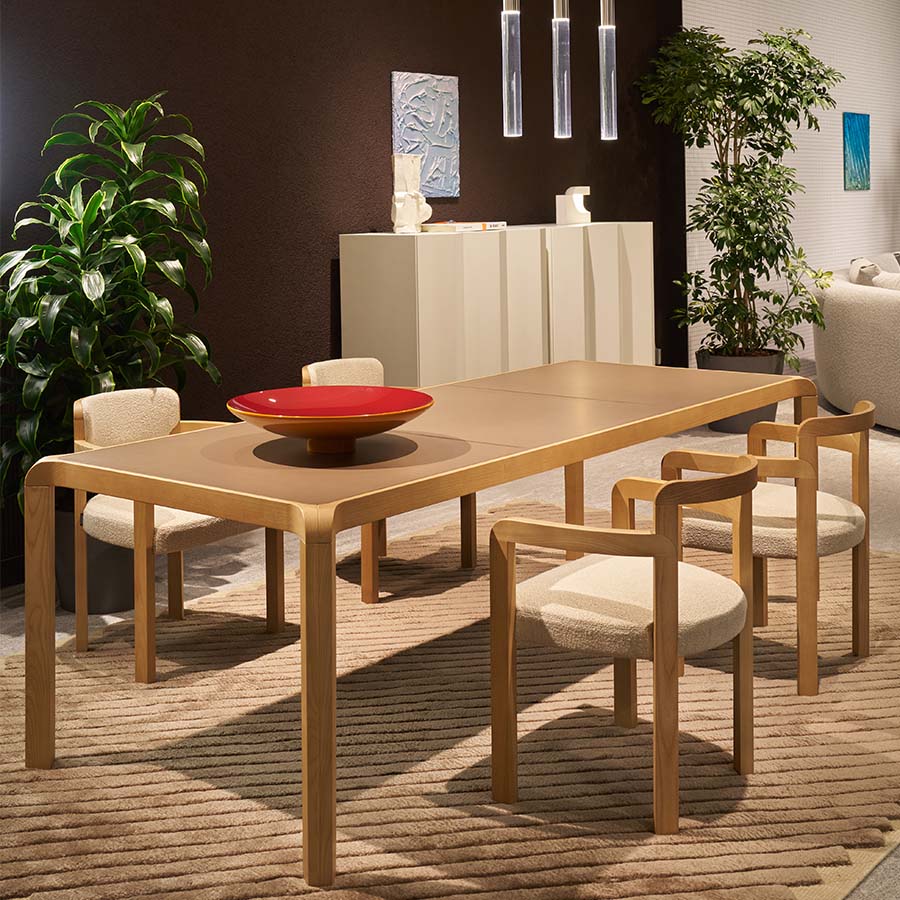
Meanwhile, Palomba Serafini Associati has evolved the Pianoalto sofa with more sinuous forms, while Monica Armani designed the Rond(e)vu loveseat—also available as an armchair—which sits alongside the Alfàrè tables. It is a classic formal approach, renewed by a concrete treatment that evokes the materiality of wood. Furthermore, the manufacturer’s ecosystem is enriched by new signatures, such as Brogliato Traverso, creators of the architectural Binata chair, and Studiopepe, behind the Slice Me Nice tables that play on the contrast between colored lines and metallic surfaces. This design is in tune with the times, complemented by the Low Bol tables designed by Zaven. The collection is rounded out by pieces from Pierre Charpin and a bed by Simone Bonanni, marking his first collaboration with Zanotta.

Radically modern (re)editions
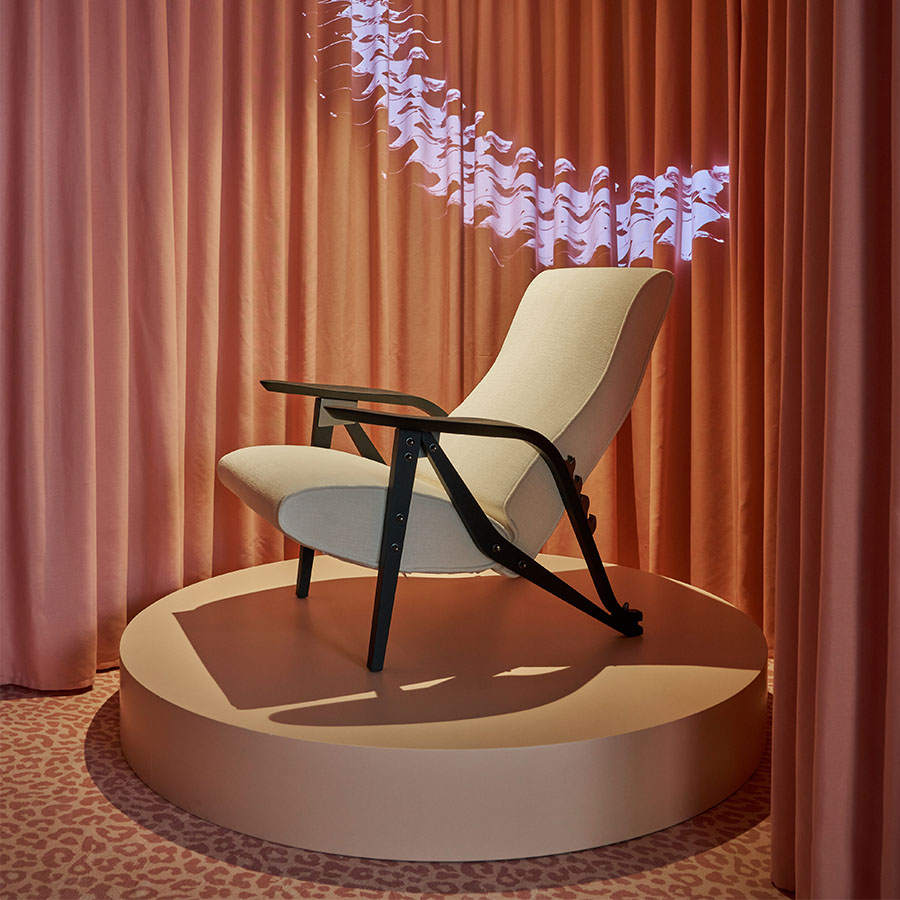
At the heart of this 2026 presentation, Zanotta dedicated a central space to Carlo Mollino. Initially conceived for specific projects and later reinterpreted throughout his career, the works of this architect—renowned for his zoomorphic forms and sinuous lines—are now part of the Italian manufacturer's catalog. This initiative, supported by the Italian state and legally guided by Rositani Suckert, marks a significant milestone. Displayed throughout the showroom, these creations illustrate the multifaceted work of Carlo Mollino, a professor at the Politecnico di Torino and a major figure in 20th-century aesthetics. His vision is embodied in the debut presentation of the Tavolo Vertebra table, whose wooden structure, weighing about twelve kilos, supports a glass top of nearly 90 kilos.

Surrounding this signature piece, Zanotta brings together several iconic reissues, including the Fenis chair, the Arabesco coffee table, the Milo mirror, and the Gilda and Ardea armchairs. These pieces serve as testaments to the richness of a body of work preserved in Turin, consisting of thousands of drawings, archives, and photographs. Through this editorial work, Zanotta confirms its role as an interpreter and conduit of a modernity that remains ever-contemporary.




.svg)


.svg)