


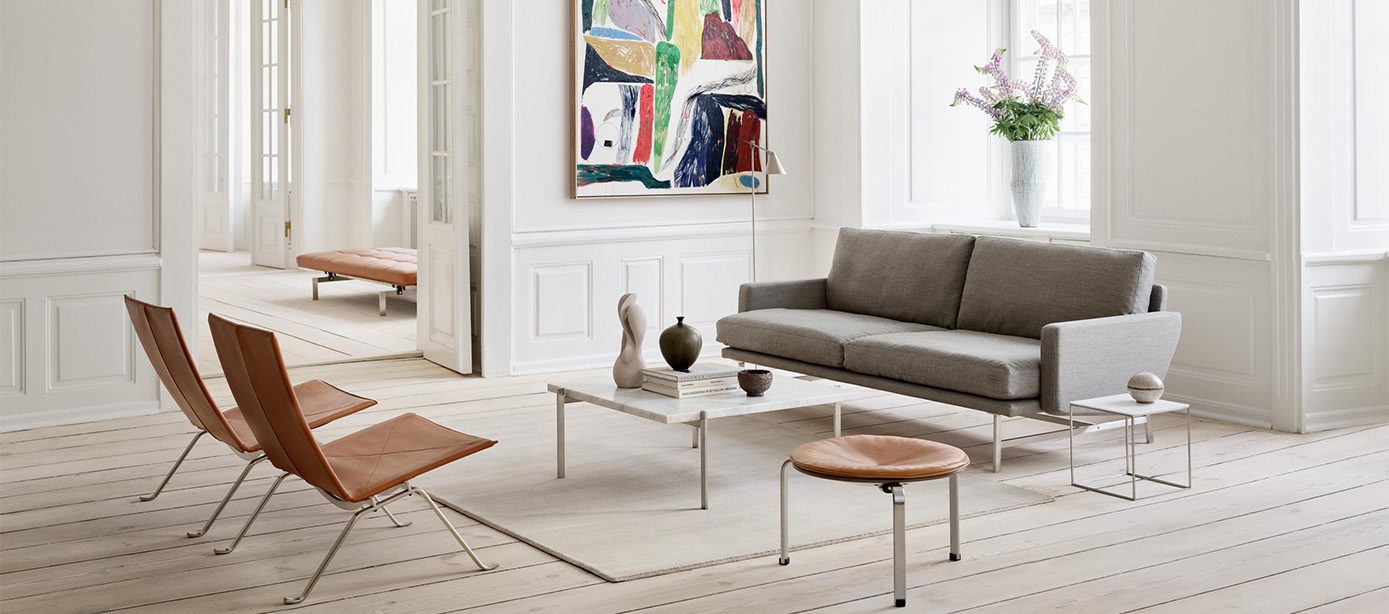


Fritz Hansen celebrates the 70th anniversary of the PK22 lounge chair
Designed by Danish designer Poul Kjærholm, the PK22 lounge chair celebrates its 70th anniversary this year. As a gift, Fritz Hansen is launching a new leather option and expanding its collection by releasing another piece by the designer.
"We are celebrating one of the most precocious designers of the 20th century this year" says Stéphane Legue, Sales Director for France at Fritz Hansen. A central and iconic figure for the brand, Poul Kjærholm is being honored on the 70th anniversary of his PK22 chair. It is an iconic piece of the Scandinavian modernist movement so dear to the creator, whose collaboration with the Danish manufacturer began with The Element—since renamed the PK25—an innovative graduation project he completed at age 21.
Structure in the service of thought
A Danish cousin to Mies van der Rohe’s Barcelona chair, the PK22, designed in 1956, embodies a vision of design that was resolutely modern for its time. "Poul Kjærholm’s approach to design was stripped back. He didn't want upholstery, the metal wasn't supposed to reflect light, and because he believed that even perfect welds would always be imperfect, he incorporated Allen screws into his pieces—fasteners previously reserved for the aeronautics industry." The designer also distinguished this ingenious design through the use of flat metal. "Kjærholm was a socialist at heart, and for him, metal was a way to ensure consistency in the industrial process. But unlike Breuer, who had imagined a tubular structure inspired by a bicycle frame, he favored flat uprights that offered different structural possibilities." This attention to detail meant the PK22 would never become a mass-market chair due to its production costs. Regardless, the model was awarded the Grand Prix at the Milan Triennale in 1957, bringing its creator international acclaim.
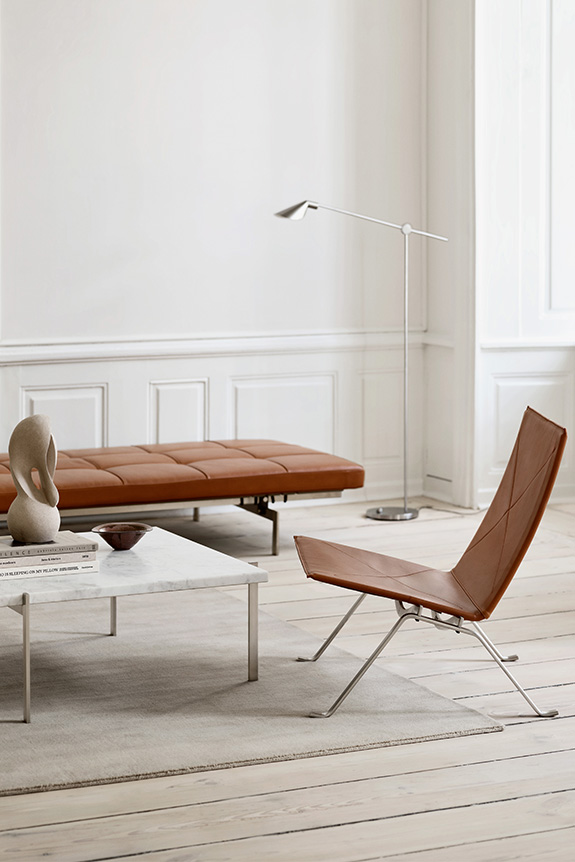
Simplicity as a collection aesthetic
Over the course of his sixteen-year collaboration with Fritz Hansen, Poul Kjærholm developed a particularly rich body of work. Showcasing a wide variety of materials (steel, leather, canvas, granite, wood, rope, etc.), the collection champions a discreet and balanced aesthetic, favoring pieces that use no more than three different mediums. " He was very inspired by what he saw outdoors and often said, 'There are no blue or red cows in the fields, so I only want natural colors.' This approach is still evident today", says Stephen Legue.
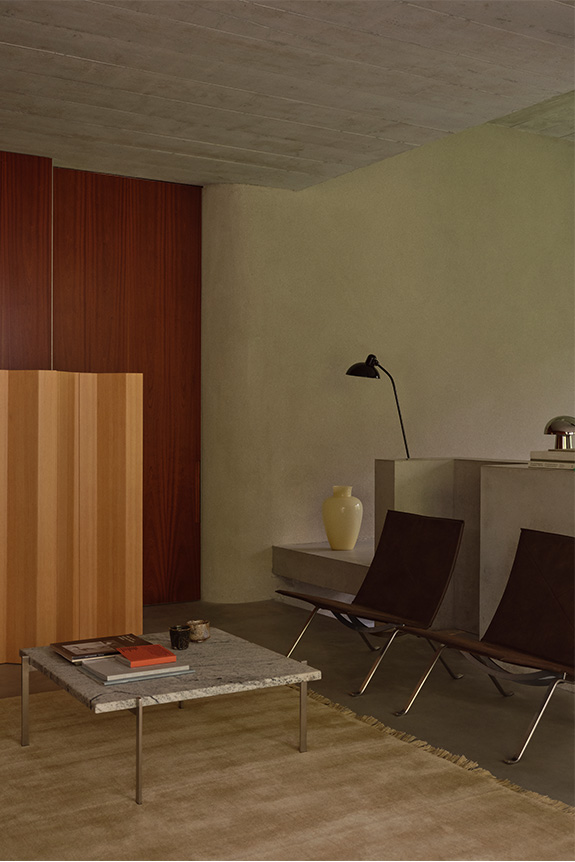
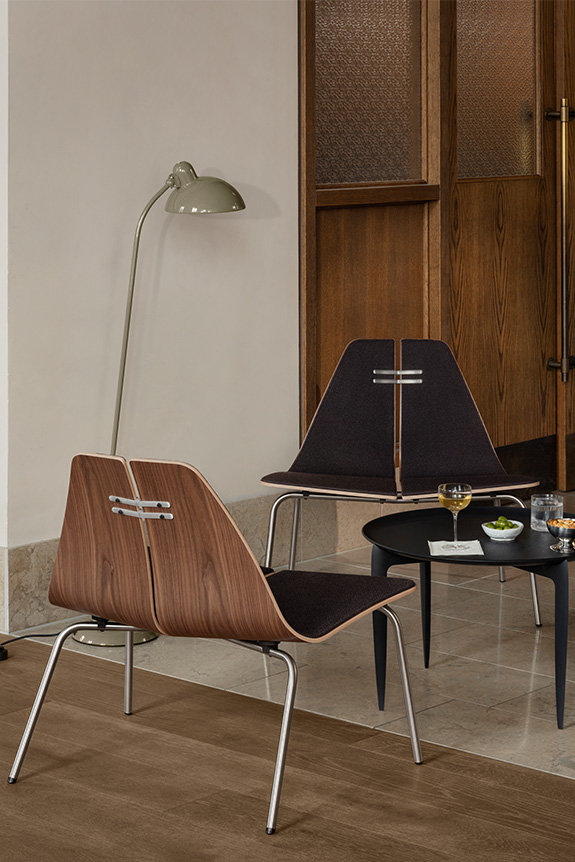
Unchanged for over half a century—with the exception of the steel, originally nickel-plated chrome, which became stainless steel in the early 2000s—the furniture designed by the designer has nonetheless evolved with the times. For its anniversary, the PK22 is enhanced with a new, exceptional leather called Haze, with a lightly sanded surface. At the same time, Fritz Hansen is introducing a new grey-white polished granite for the top of the PK61 table, whose geometry echoes the work of Piet Mondrian, and is producing the PK111 screen for the first time. Composed of clip-on Douglas fir plywood panels, this new 140 cm high typology was designed to provide a sense of privacy while seated at a table, while offering an unobstructed view of the room when standing; a design directly linked to Poul Kjærholm’s home, which opens onto the outdoors. Both pieces testify, each in their own way, to his interest in the principles of modernism and his search for a balance between functionality, architecture, and space. A lineage extended by the PK3 chair, reissued since late 2025, and the PK23 lounge chair, unveiled during 3daysofdesign 2026. Recognizable by their split backrests, the seats were cut to achieve a 3D backrest at a time when only two-dimensional bending was possible. More than just an anniversary, it is above all a tribute to the ingenuity of a mind that the Danish brand honors.

.svg)


.svg)