

L.I: a bold project, Special Prize from the Mobilier national - Young Creation competition
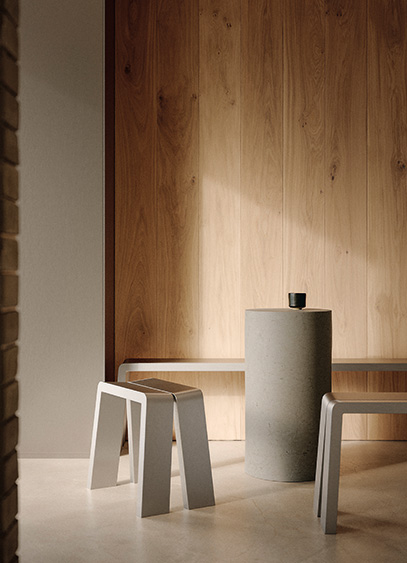
Winner of a special prize in the Mobilier National’s Young Creation competition, the L.I. table and chairs designed for the Council of Ministers offer new approaches to contemporary design through the use of Drop Stitch technology and recycled carbon.
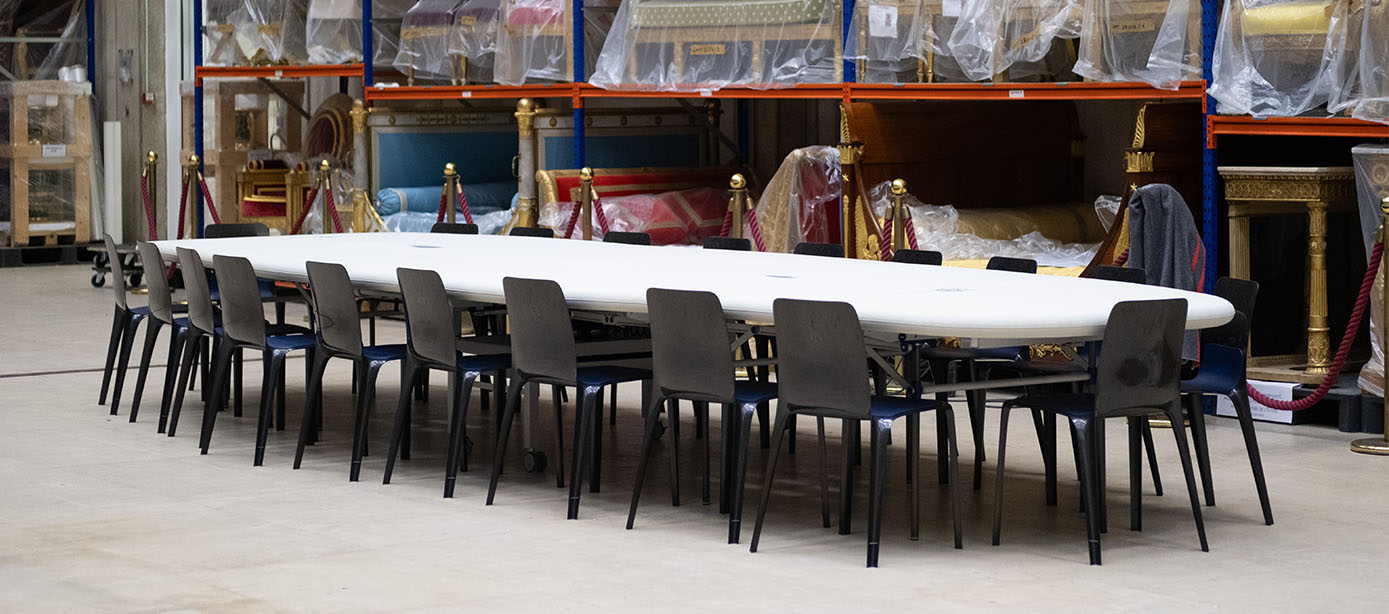
L.I., two letters for lightness and innovation. Found "a bit at the last minute", the name of the table and chairs designed by Yanis Bontemps, Paul Seiller, and Victor Galineau favors the factual over the lyrical. This lack of flourish echoes the approach of the trio, who formed during their final year of studies at Ensaama to respond to the Mobilier National’s Young Creation Prize call for projects. The challenge? To propose a set of furniture that is easy to install and can be stored on a freight elevator for the Élysée Palace’s Council of Ministers room. The three designers worked on this dual constraint for several years with the ARC. Delivered for the 2026 Heritage Days, the project had already been recognized in 2020 with a special prize created specifically for it.
An inflatable table
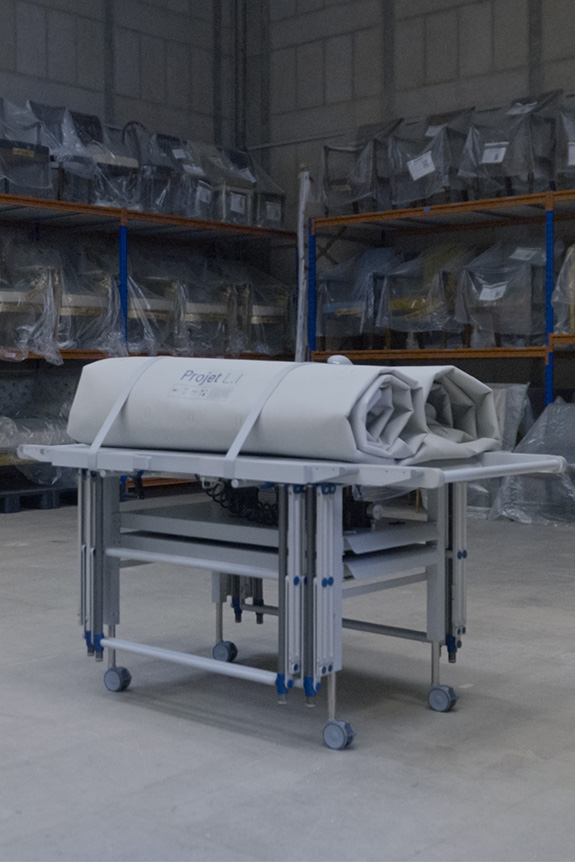
"The initial concept for the table was to make it inflatable so that it could be deployed quickly", explains Yanis Bontemps. The idea led the three students at the time to take an interest in the Drop Stitch material manufactured by the company Musthane. "To put it simply, it is an inflatable membrane where the two walls, top and bottom, are connected by sewn nylon threads. Through a physical phenomenon, the structure becomes tensioned when inflated, offering something very rigid with just one bar of pressure." Used in some paddleboards, this technology is now primarily found in the military sector, notably in the form of cushions for repairing aircraft wings.
Self-supporting, the Drop Stitch led the studio to imagine a table in which the freight elevator is not just a transport tool, but becomes a structural element. Used as a central base, the cart is equipped with a foldable structure featuring eight aluminum legs upon which the elliptical tabletop unfolds. "This project was guided more by semantic constraints than by technology. At first, we had imagined a round table, but it was difficult to fold and didn't fit the usual codes. So we let ourselves be guided by existing conventions" says Paul Seiller.
Letting the raw material speak
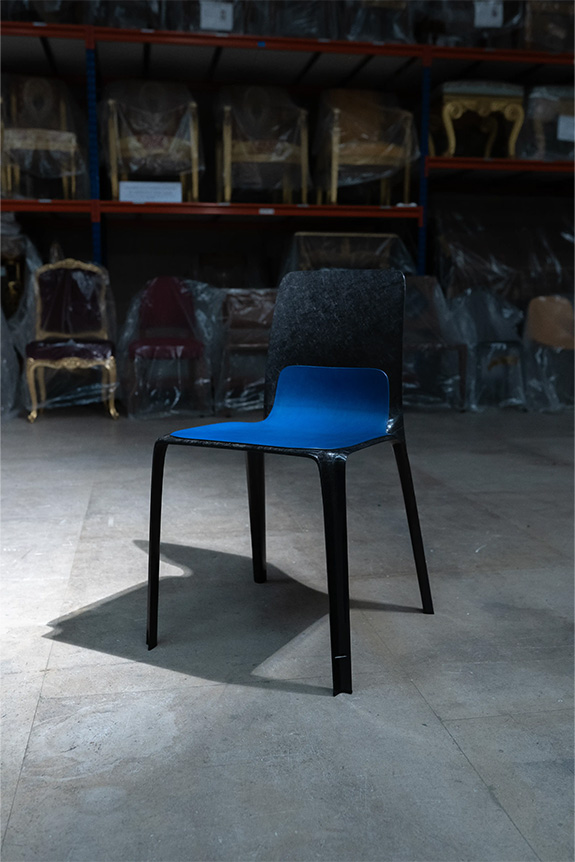
To accompany this table, the three designers drew sixteen chairs. Made from 56% bio-based resin sourced from plant-based channels and an epoxy foam, they also provided an opportunity to work with recycled carbon. "For the chair to be in line with the practicality of the table, we started with this lightweight material. But it led us to wonder how to use a material that is far from 'eco-friendly' in a responsible way." The designers then turned to Workshape. "By heating waste from various industries, such as automotive, to very high temperatures, this company manages to separate the components, including carbon. By working with them, we were able to recover the carbon in the form of felt, which we then molded and baked." A recycling technique that gives rise to seat shells with sleek, aerodynamic lines. "We wanted to let the raw material speak for itself. To convey an industrial language through exceptional furniture. It was a relatively exploratory process, especially since neither of the two companies approached had ever made furniture before." Beyond anodizing and leatherwork, this project brings together technologies applied for the first time to the contemporary design sector. These new approaches, fueled by the ideas of the three designers and the innovation of the ARC, expand the range of French techniques and expertise.