


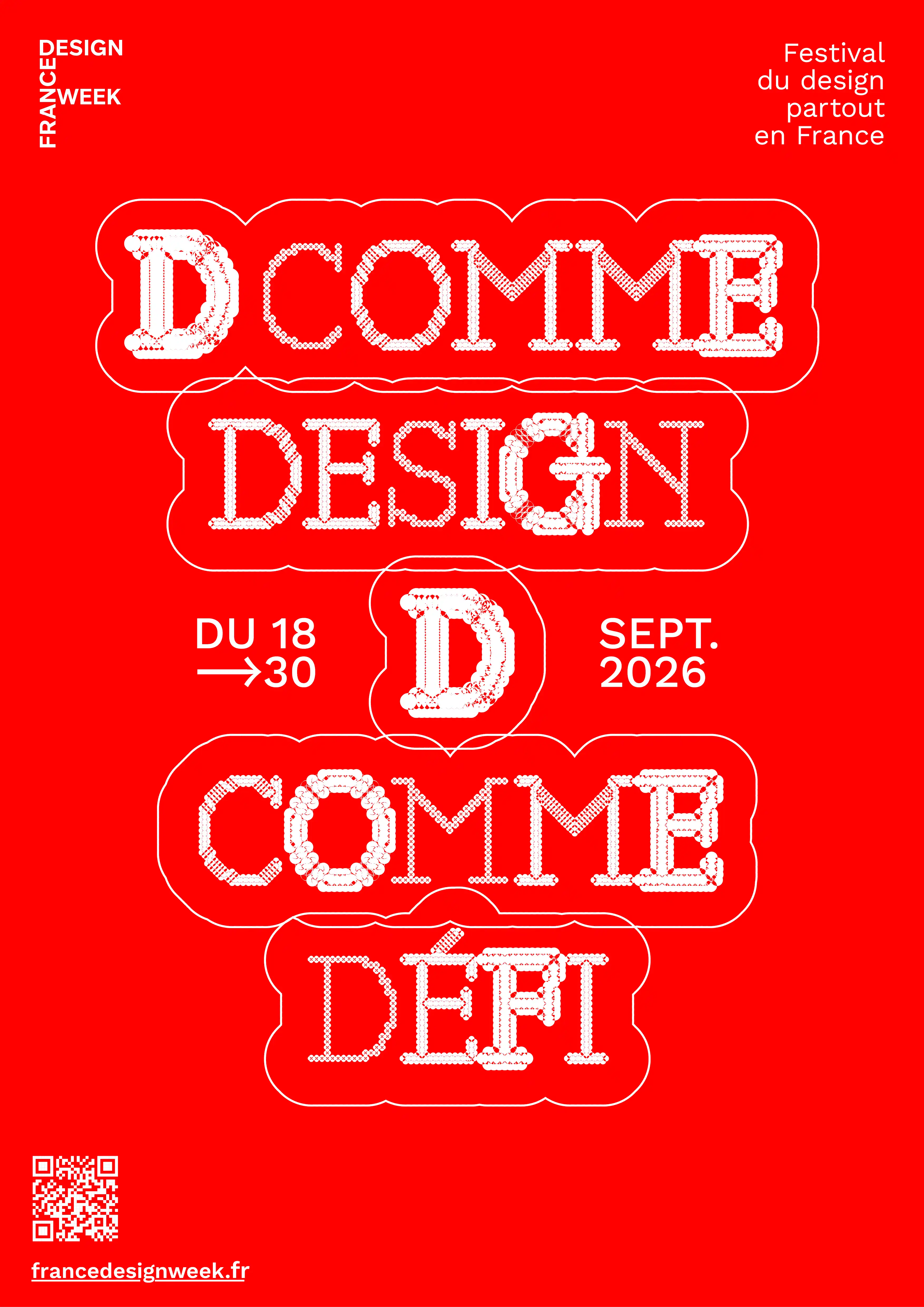


France Design Week 2026: The challenge of reality
From September 18 to 30, the seventh edition of France Design Week will take place across the country under the theme "D for Design, D for Defi" (Challenge). Hundreds of events will showcase how design can go beyond the mere aesthetics of an object to support the major transformations of our time.
The "D" for design is perhaps only meaningful today if it accepts the challenge it faces. Whether climatic, technological, demographic, or social, our era is not lacking in problems to solve or systems to rethink. Faced with their complexity, design can no longer be considered the final aesthetic layer added to a finished product. It now intervenes upstream, where uses, services, spaces, and, more broadly, the conditions of our collective life are defined.
It is precisely this evolution that the seventh edition of France Design Week, organized from September 18 to 30 around the theme "D for Design, D for Challenge," aims to highlight. Exhibitions, conferences, workshops, installations, tours, and meetings will make up a program widely accessible to the public, driven by designers, as well as companies, schools, local authorities, cultural institutions, and research stakeholders. Design as a method
Ecological transition, artificial intelligence, health, an aging population, inclusion, the evolution of work, or the transformation of territories: design is now venturing far beyond the historical scope of the object. Not that it is abandoning form, material, or beauty—these remain the means by which a solution becomes understandable, accessible, and desirable—but because it embeds them in a broader reflection.
Designing a public service, a patient's experience, a user's journey, a recycling system, or a neighborhood requires looking simultaneously at technical constraints, behaviors, the project's economics, and its long-term consequences. The designer no longer just draws what we use: they help organize the way we live.
This ambition will be a recurring theme throughout the 2026 edition. In Chalon-sur-Saône, a foresight workshop will imagine the patient experience in 2040 in a hospital where artificial intelligence is omnipresent. In Marseille, the design of technologies that influence our behavior will be the subject of critical reflection. Elsewhere, projects will address well-being, education, biomaterials, reuse, circular design, and the transformation of public space. The France of designs
One of the strengths of France Design Week lies precisely in its decentralized organization. French design is not limited to Paris. It is fueled by the industrial, cultural, and geographical realities specific to each region.
From Grenoble to Mont-Saint-Michel, from Nantes to Marseille, the program draws a new map of French creation. Near Grenoble, the UGA Design Factory will show how design, research, and local action can support ecological and social transitions. At Mont-Saint-Michel, a monumental exhibition will examine changing landscapes. Other initiatives will focus on local resources, expertise, the graphic identities of cities, or new forms of creative entrepreneurship. Here, the territory is no longer just a backdrop for design; it becomes its raw material: a set of constraints, resources, narratives, and uses from which to imagine necessarily localized solutions.
Ionna Vautrin, design at the service of the user
As the patron of this edition, Ionna Vautrin perfectly embodies this concept of design that is sensitive, accessible, and useful.
The tour organized at Notre-Dame de Paris, featuring the new furniture she helped create, will be one of the highlights of the national opening on September 18. Within the cathedral, the design cannot simply be the work of an individual author. It must harmonize with heritage, ritual, daily use, the presence of millions of visitors, and the integration of pieces into a timeline that far exceeds that of an industrial product. It is a perfect demonstration of what it means to design under constraint—and how that constraint can become fruitful. Measuring impact
September 18 will also host the ceremony for the second France Design Impact Award. As the only French prize entirely dedicated to positive-impact design projects, it recognizes initiatives that provide concrete solutions to environmental, social, economic, or territorial challenges.
The forty finalist projects will be presented beforehand from September 10 to 14 at Maison&Objet. Whether products, services, collective systems, digital tools, or new organizational models, their diversity serves as a reminder that the impact of design cannot be reduced to choosing a more virtuous material. It is also measured by transformed habits, saved resources, created activities, and a project's ability to sustainably improve the lives of those it serves. The winners will be announced on September 18 in Paris. Through this seventh edition, France Design Week does not just seek to celebrate a discipline; it intends to demonstrate its necessity. For while design cannot solve all contemporary challenges on its own, it possesses a quality that has become rare: the ability to connect vision to reality, innovation to use, and transformation to desire. In other words, to make change not only possible but livable.


.svg)


.svg)