


Paris Design Week
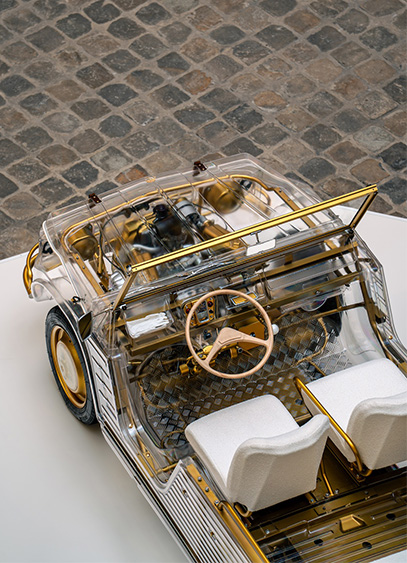
For Paris Design Week, and running until October 4, the Hôtel de la Marine is hosting a Méhari. This lunar-inspired hybrid vehicle was reimagined by Maison Lacmé as a tribute to fine craftsmanship.
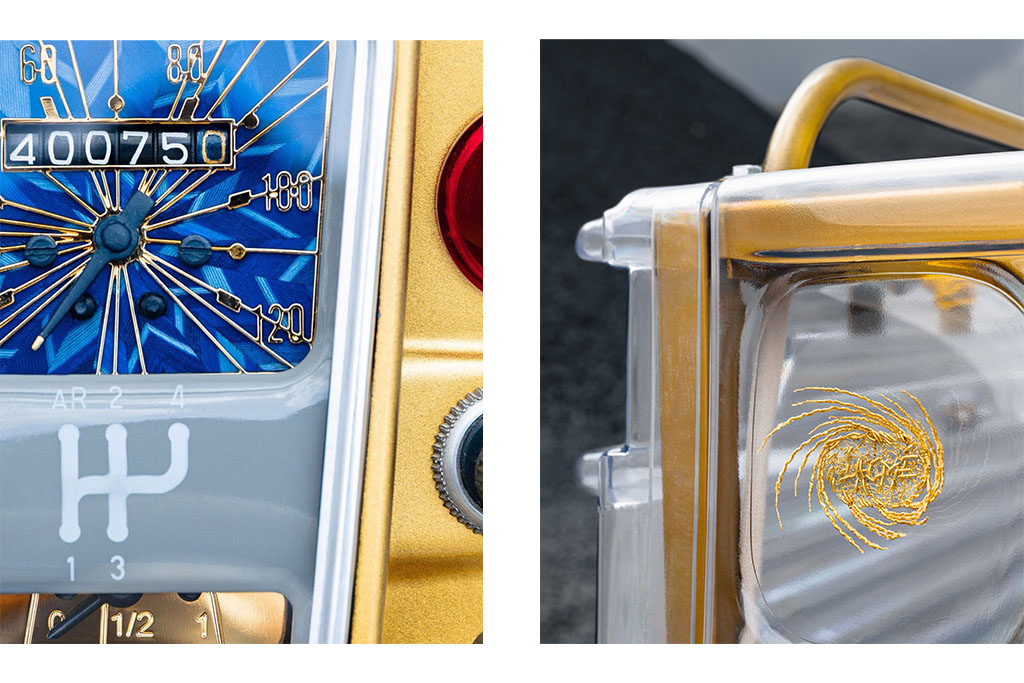
While the Hôtel de la Marine has established itself as a key venue for Paris Design Week, this year’s bold choice is sure to surprise. A curious car is parked right in the center of the courtyard, its odometer—fresh from the workshop—seemingly stuck at 40,075 kilometers. A malfunction? No, a clue. Because behind this familiar silhouette, that of the Citroën-produced Méhari, lies a true design manifesto and a tribute to the decorative arts.
A collision between industry and craftsmanship
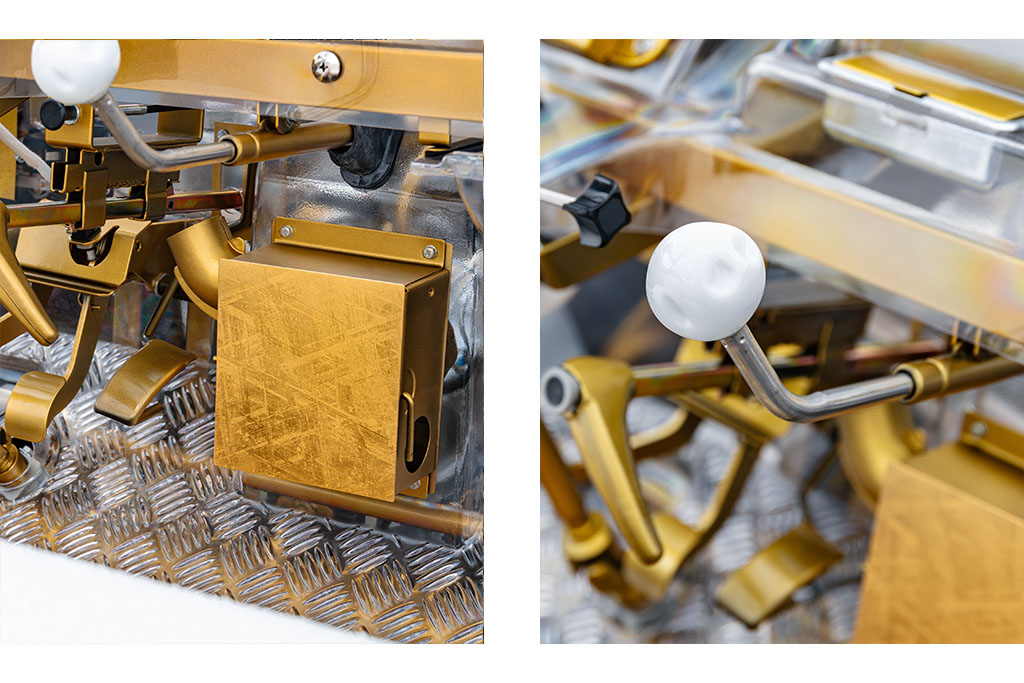
Behind this project are Cécile and Antoine Tauvel, the founders of Maison Lacmé, established two years ago. Their goal: to create functional works of art from everyday objects. This ambition led the two vintage car enthusiasts to explore the potential of the Méhari. "For many French people, it evokes the 60s or memories of seaside vacations. But for me, it was also the lunar aspect that spoke to me, reminding me of the covers of certain Tintin albums. So our role was to reveal the symbolism and the sense of wonder that were already there," explains Antoine Tauvel. The couple then designed the frame. It would be gold, echoing French decorative arts and art history, applied in touches to a transparent chassis. "What we found interesting was creating a certain balance between industry and fine craftsmanship by playing with contrasts." This aesthetic research was conducted with a French manufacturer to rethink the polymer composition and prevent the chassis from yellowing, after which a layer of transparent ceramic was applied. "The challenge was to transform this purely industrial typology into an art object without giving it the status of a luxury item. We first had to spark formal curiosity to then draw the eye to the smaller elements," details Cécile Tauvel. A quest for storytelling where the automobile conveys the imagination.
A concentration of expertise
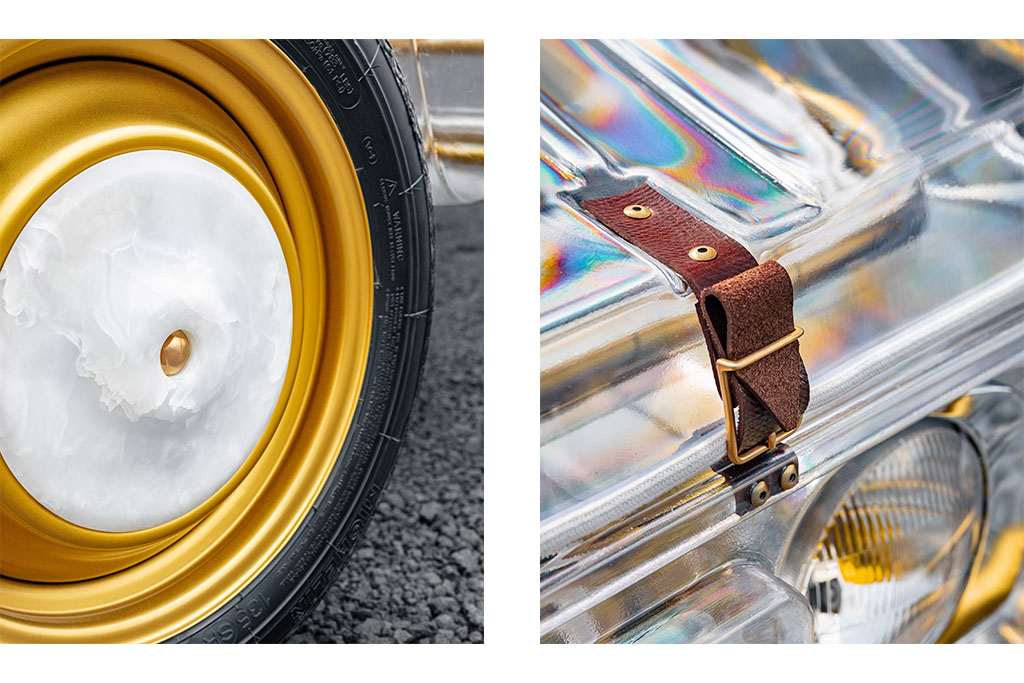
Who said a hubcap and a lamp, or an automotive logo and a brooch, don't belong to the same world? Certainly not Maison Lacmé, whose project is centered on the ambivalence of objects. Each of the twelve elements created by master artisans has a practical function. "This car is a Trojan horse, a mobile cabinet of curiosities that hides things within itself," summarizes Antoine Tauvel, who originated these dual functions. "This idea is central. We did all the preparatory drawings and aesthetic choices in-house, then presented them to the artisans." From then on, the project became collaborative, and the sketches were adjusted for aesthetic coherence. The steering wheel, crafted from driftwood, and the seashell-embroidered upholstery open up a maritime horizon, while the feather-marquetry odometer—stuck at the Earth's circumference—can be removed and used as a desk clock. Beyond their utility, the techniques used recall those of the golden age of French decorative arts. Among them is the trompe-l’œil technique, used to replace the stone hubcaps with painted versions when the vehicle is in motion.
A true "poetic travel tool," the Maison Lacmé Méhari will be on display in the courtyard of the Hôtel de la Marine until Sunday, October 4.
For this new edition of Paris Design Week, the Intramuros team slipped through the capital's arteries to discover the season's latest exhibitions and new releases. Here is a look back at the ones you shouldn't have missed.
From September 10th to 19th, design once again took over the streets of Paris, much to our delight! Whether industrial or collectible, the creative sector made headlines again, both through new collections and new gatherings. It was an opportunity to rediscover certain profiles and meet new minds driven by innovative concepts. Among all the installations we discovered, here are the ones that particularly caught our attention.
Picnic by Cluzel / Pluchon: an invitation to lunch
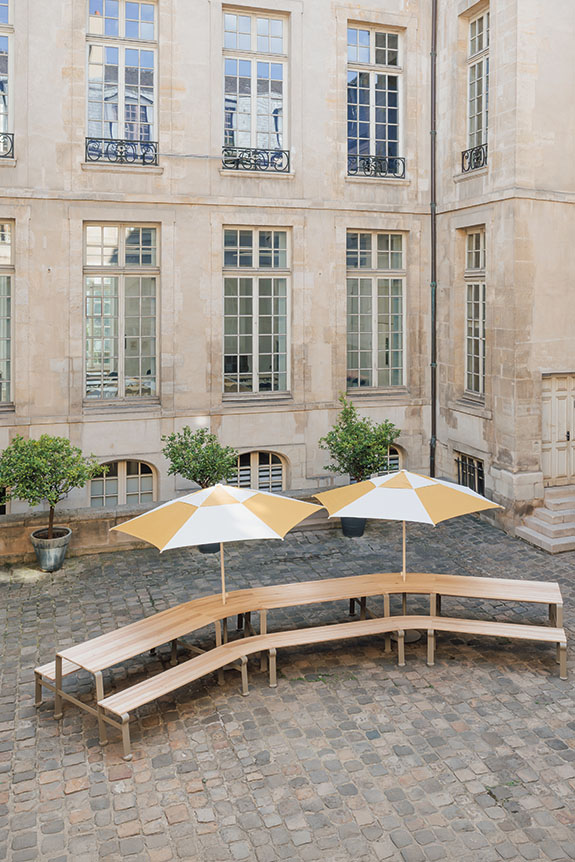
Following Marianna Ladreyt last year, designers Cluzel / Pluchon took over the courtyard of the Hôtel d’Albret to present the Picnic installation, created in collaboration with manufacturer Guyon Mobilier Urbain. Conceived as an invitation to share and wander, Picnic was unveiled as a life-sized picnic table over seven meters long. Continuing the Gier duo's well-known collection, it combined locust wood slats with a powder-coated steel structure, drawing a generous curve to create a dialogue between urban furniture and conviviality.
GOOD SELECTION by Lucas Zito and Marika Caputo: new scenes
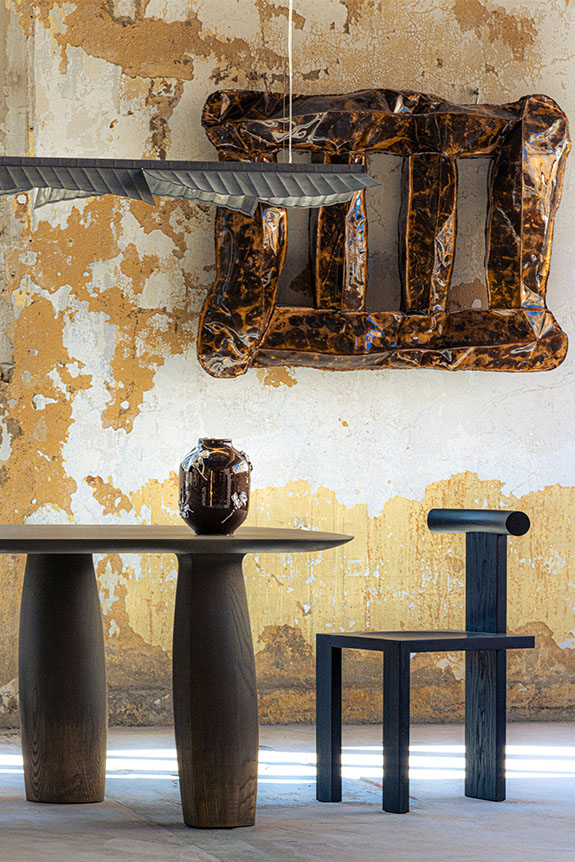
Organized by Lucas Zito and Marika Caputo, the second edition of GOOD SELECTION was held this year in the heart of the Fondation Fiminco in Romainville. Now disused, the former pharmaceutical factory—reminiscent of some of the most surprising Milanese venues chosen by Alcova—was taken over for the occasion by 47 international designers. Favoring dialogue between creations rather than formal classification, the exhibition offered various living spaces. A combination of styles and atmospheres provided visitors with a new, more embodied perspective on this so-called "collectible" design.
Volt Face by Studio 5.5 and Schneider Electric: high-voltage collection
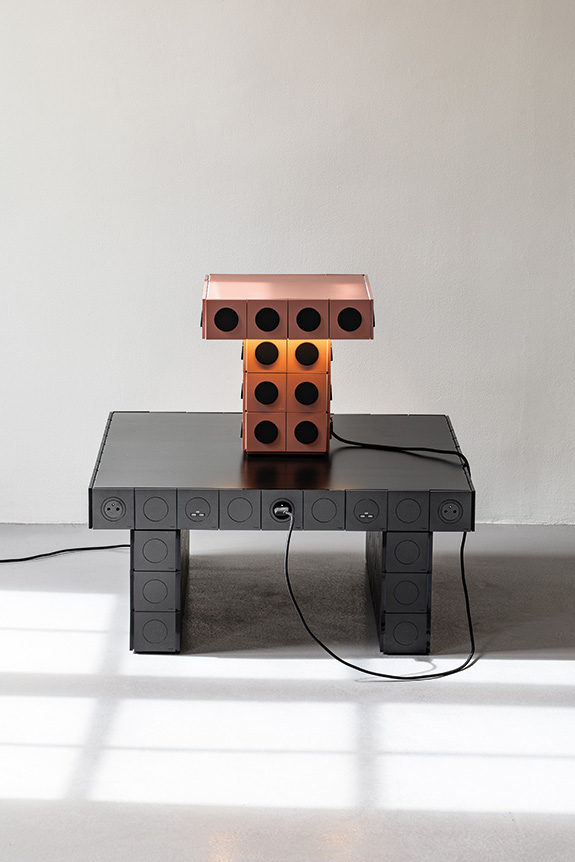
Studio 5.5 teamed up with Schneider Electric to imagine the Volt Face lighting and furniture collection, designed using the Odace range and presented at the Galerie Joseph on Rue des Minimes. Faithful to their taste for repurposing everyday objects, Vincent Baranger and Anthony Lebossé chose to make the socket and switch the main element of their creation, rather than an afterthought. Developed as wall lights, pendants, lamps, tables, and even nightstands, each piece plays with the repetition and assembly of the modules. Conceived as a true creative palette, the Odace range thus becomes a material to be composed, but also to be touched and operated, making these pieces playful and offering a fresh look at these familiar yet often undervalued objects.
Tout est Chaos by PLI Office: ordering the desirable
After initiating "Pour que tu m’aimes encore" in 2024 and "Design Disco Club" the following year, Christopher Dessus returned this year with "Tout est chaos." Presented at the Gaîté Lyrique, the exhibition brought together a body of work that acts as a vector for surprise. A feeling conveyed by the material or the form, but also and above all by a freer consideration of usage. It is a counterpoint to modernist design, which is generally serial and fundamentally utilitarian, here abandoned in favor of narrative. It was an opportunity to see very personal research collide, such as the non-linear or even random work of the series, the reinterpretation of industrial archetypes reworked by hand, or new explorations blending industry and craftsmanship. Driven by a nearly free participation, the 66 selected designers delivered a specific idea of design, claimed by 10 of them through installations and even a projection imagined as a manifesto.
Victoria Wilmotte: Stainless Steel Collection
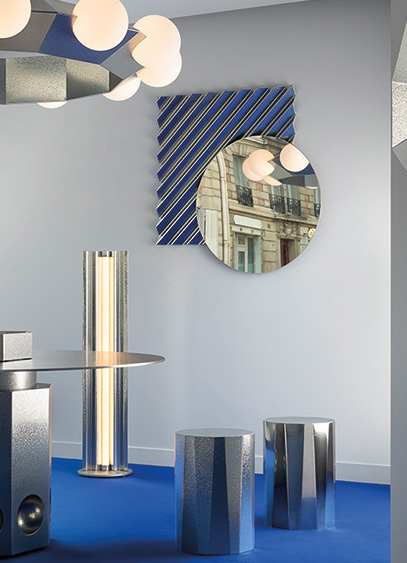
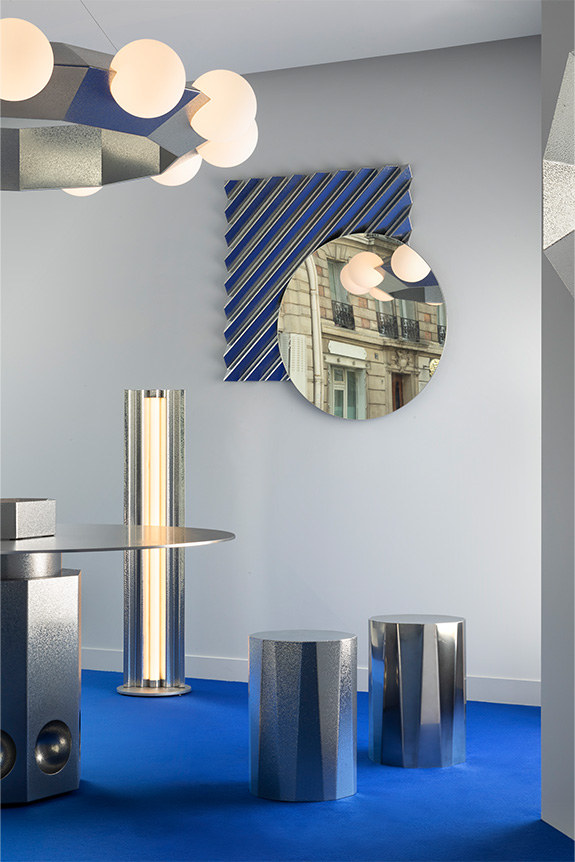
For this year's Paris Design Week, Victoria Wilmotte unveiled nearly a dozen pieces. Whether brand new or reimagined existing typologies, this collection continues to explore a world defined by geometry and a distinct industrial spirit. Crafted from stainless steel—sometimes featuring textures that evoke the technique of hammering—the various objects diffused light, along with the signature blue hue championed by the designer.
Opus by Studio CHHO: A New Trajectory
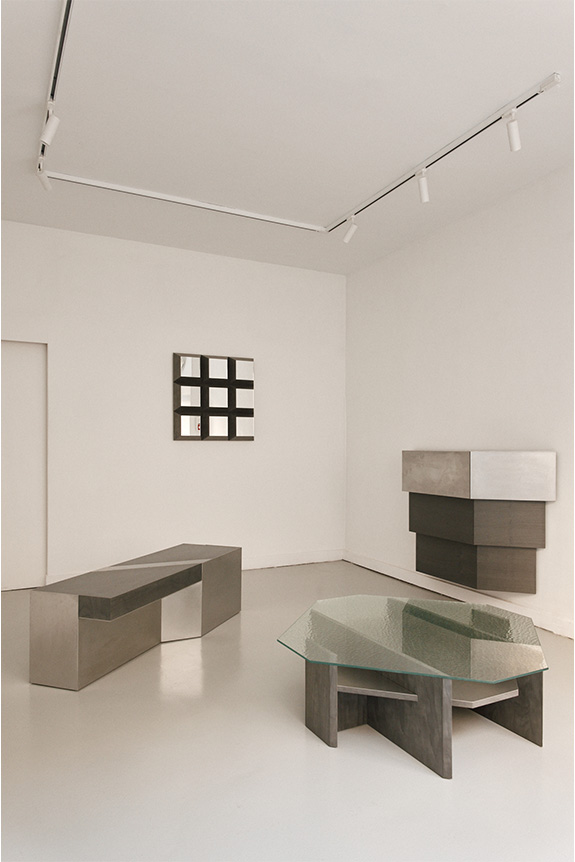
Launched a decade ago, the interior architecture firm Hoch unveiled Studio CHHO, the creative force behind Opus. This debut furniture collection, whose name suggests both a first chapter and a technical term for stone masonry, consists of five pieces. Developed over a year and a half, it highlights taut lines and 90° and 45° angles, delivering a bold aesthetic language with generous forms. Enhanced by a restrained palette of three materials—stained birch veneer, hammered glass, and vibrated stainless steel—the pieces were conceived as "objects of presence." This term, unique to the studio, reflects creations made in the south of France that embody the firm's sober yet characterful DNA.
"The Light Library" by Studio Meaningfull: Coloring Light
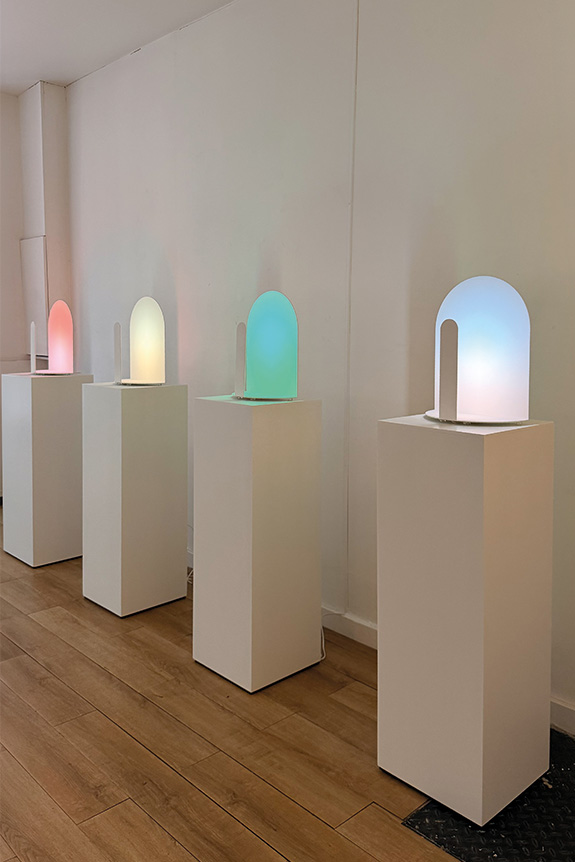
Continuing their research into color, which began with the Agora du Design grant they won in 2021, Studio Meaningfull—comprising Marine Rouit-Leduc, Galilée Al Rifaï, and Nicolas Rouit-Leduc—presented "The Light Library" at Galerie Ideal Place. The exhibition showcased nearly four years of experimentation with the color of light, conceived not as a material, but as a means of interaction. Each shade was developed with reference to natural phenomena, such as the aurora borealis, dawn, and twilight, to achieve a realistic and natural effect. The trio displayed several light-based objects and sculptures, including the Milan lamp, which recently joined the Mobilier National collections. The exhibition was designed to engage the senses and emotions while establishing new chromatic references for light, through an approach that is both sculptural and architectural.
Following an initial event in June, Frgmnt decided to repeat the experience for Paris Design Week by presenting its first exhibition, titled "Edition 01." On view until September 19, the show aims to put "the materials no one looks at" in the spotlight.
For its first participation in Paris Design Week, Frgmnt selected 43 designers and 11 material manufacturers, brought together to showcase a process and pieces imagined from forgotten or discarded industrial materials, scraps, and waste. Initiated by Meryl Benitah, the Frgmnt project began as a creative challenge launched last June. Over 48 hours, groups of designers, paired up for the occasion, imagined pieces using mediums often considered "undesirable". From wood to metal, the project also incorporated new materials, such as the one designed by Etnisi from windshields, or the Tissium developed by the company Maximum. "It was a bit like a hackathon format, but dedicated to design. We started with materials that were either salvaged or upcycled to show that reuse or even a second life can be desirable. Even though the participants didn't know each other, a certain creative synergy quickly emerged, and groups formed rapidly, managing to produce pieces in just two days", says Meryl Benitah.
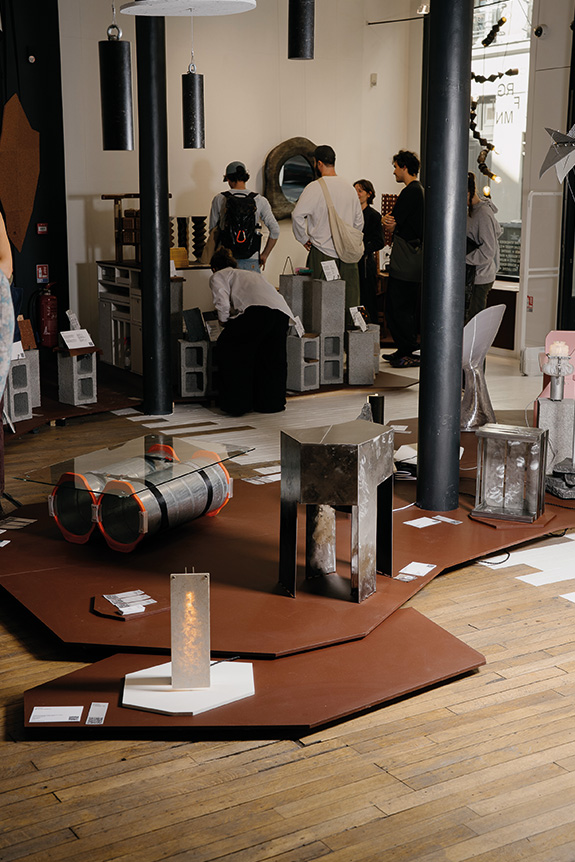
This initiative caught the attention of Sabrina Piperno, manager of the Heureux les Curieux space, who wanted to support the project by inviting Frgmnt to exhibit during Paris Design Week in September. "For this edition, the idea was to invite other material manufacturer partners to create, on one hand, this material library, and on the other, to bring in designers with the same approach. Whether through the material itself or the design manufacturing process", continues Meryl Benitah.
A new way of thinking about material
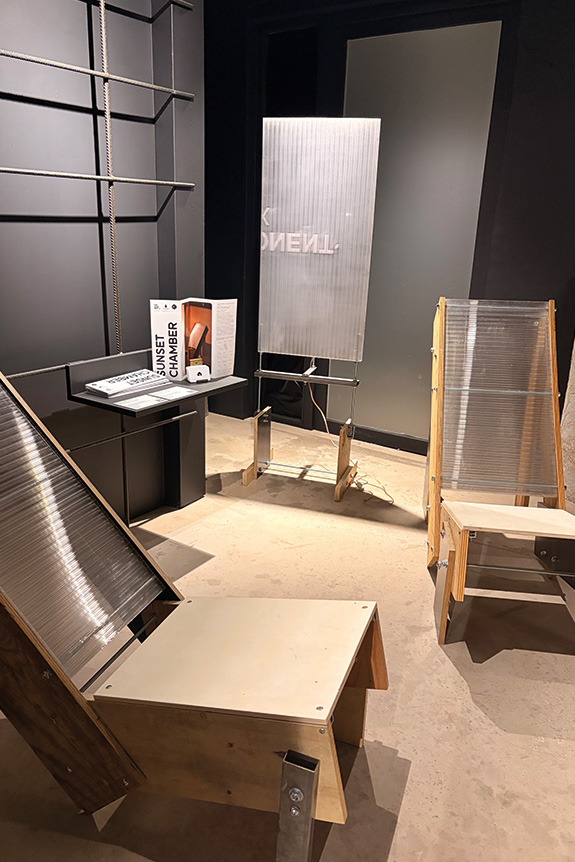
Spread over two floors, the exhibition presents unique worlds, united by a single ambition: to create from what already exists or to explore the potential of new materials. "There are many ways to make a well-designed object that meets market needs. Some use reuse, others respond through the material, while some do it through function. But they all tell a story through a piece, always asking how to create objects that are desirable in the long term." This inquiry led designers to partner with manufacturers, such as hors-studio, whose Caretta Caretta lamp was made from Celullio, a material developed in collaboration with Matériaux Urbains. The latter is also the creator of Paperio, a new medium that Atelier Alcova used to bring Tecto to life. Meanwhile, other creators are presenting original pieces born from their own unique processes. Notable examples include Atelier Perret, creator of the Séléné pendant light made from coffee grounds; the T65 vase designed from bread by studio Copain; and Emma Batsheva Cohen’s concept focused on optimizing vegetable leather.
Fostering connections
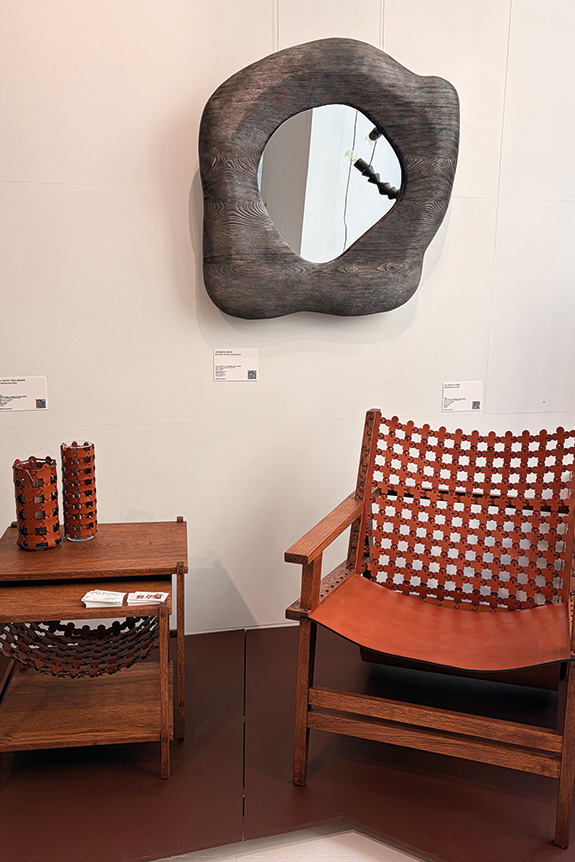
These diverse profiles and explored avenues aim to demonstrate that materials, initially overlooked, can become desirable once design takes hold of them. "My personal goal is to foster this link between manufacturers, designers, and specifiers by creating a beautiful ecosystem that will encourage them to collaborate and allow these pieces to find their way into hotels, restaurants, and support their development on a larger scale." With this exhibition, Meryl Benitah intends to build new bridges between key sectors of the design industry.
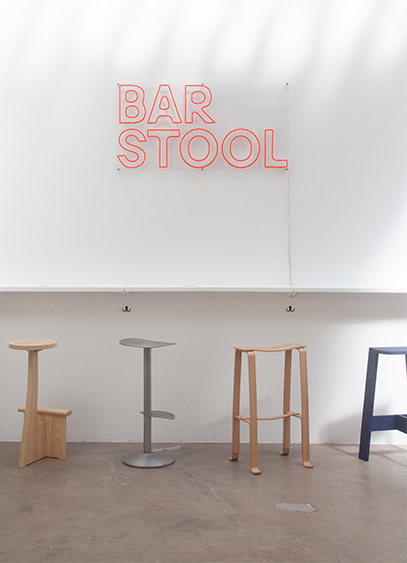
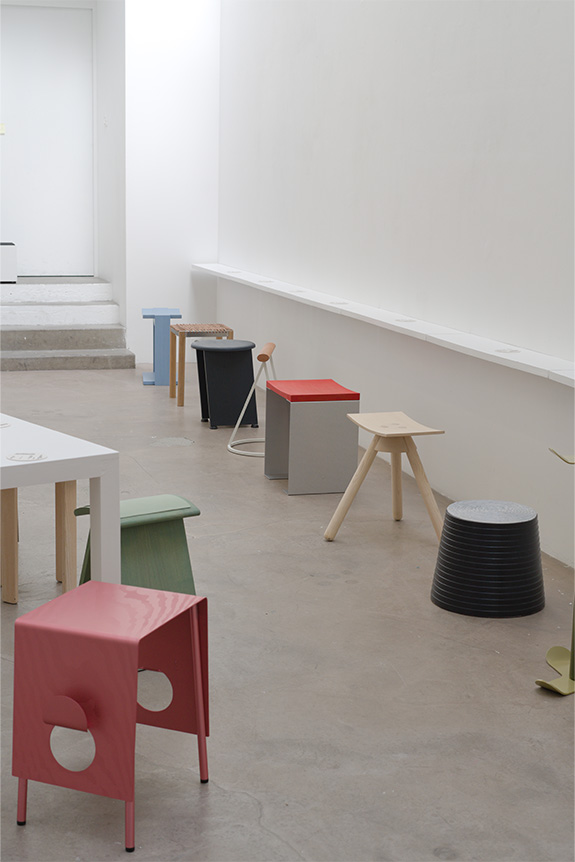
For their first joint exhibition, Athime de Crécy and Quentin Frichet have invited 35 designers to each create a stool. This free-spirited and convivial initiative, centered on utilitarian design, is on view at Espace Brownstone in Paris until September 19.
It is a sentiment some might find overused, but design, beyond its commercial and aesthetic dimensions, must be utilitarian. This philosophy, often challenged in the context of collectible design and shifting trends, is shared by Athime de Crécy and Quentin Frichet. Both ECAL graduates, having trained under Philippe Starck and Erwan Bouroullec respectively, the two young designers have taken over Espace Brownstone in Paris until September 19. It is a white-box space where 35 stools are displayed—not for visitors to look at, but for users to experience. "We had wanted to create a self-service exhibition for a long time. We initially thought about doing it in a bar, but in the end, the typology of the object took precedence over the venue," explains Athime de Crécy. Here, behavior is not dictated by the decor—which is nonexistent, save for a central table and drink storage at the entrance—but by the very nature of the pieces themselves. Presented without pedestals or labels, the seats invite everyone to pick them up, move them around, and sit down, effectively transforming the gallery into a living space. "We believe that a design exhibition that separates objects from the public invariably loses an essential aspect of what makes the discipline so powerful." The social dimension is an imperative here, carried by the stool and its characteristically lighthearted tone.
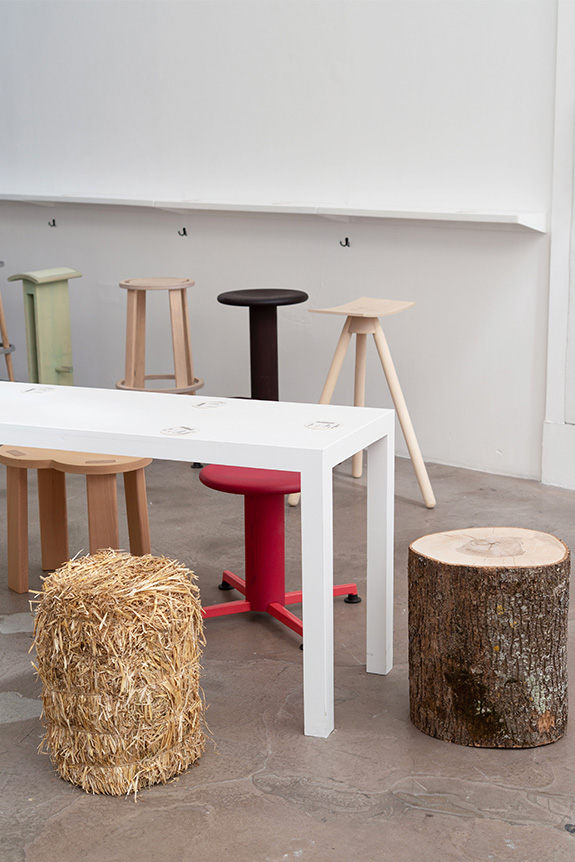
A shared idea expressed in every form
If a single object can spark different visions from one mind to another, *Bar stool* is the perfect illustration. A true synthesis of forms and materials, the exhibition is an ode to creativity. From the technical mastery of molded wood by Arthur Desmet to the high-tech 3D-printed stainless steel by the German studio Wint, the exhibition reveals a paradoxical coherence driven by the balance of diverse ambitions. "We didn't have to look far to find the designers. They are friends with whom we share a common sensibility for utilitarian and expressive design. We simply gave them total creative freedom, without even imagining that the projects might end up looking alike." A curation that gives this ephemeral refreshment bar its unique character and connects the aesthetic experience with everyday life. "It’s an approach that, in our view, draws the maximum amount of meaning from the minimum amount of resources."
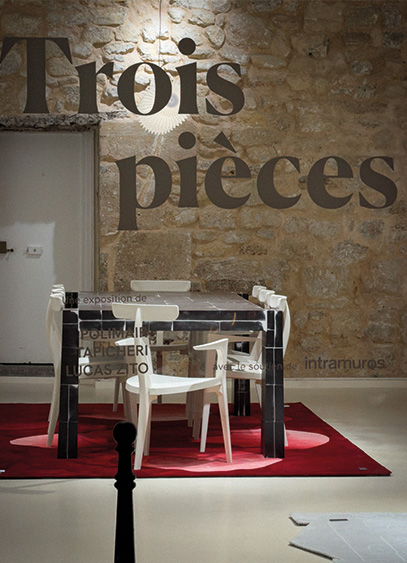
For Paris Design Week, Polimair, Tapicheri, and Lucas Zito came together for a joint exhibition titled "Trois-Pièces" (Three Rooms). Presented at 52 rue Charlot from September 10 to 13, the exhibition was conceived as an interior where furniture, lighting, and textiles explore new ways of producing and living.
Set along a path imagined as an apartment—complete with a hallway, dining room, and living room—Polimair, Lucas Zito, and Tapicheri presented the aptly named "Trois-Pièces" exhibition. More than just a succession of objects, the exhibition plays on the dialogue between them and the complementarity of practices that pay special attention to materials and manufacturing processes. "The starting point for Trois-Pièces was the idea of bringing together three Parisian designers with very different yet complementary practices, following a 'curated ensemble' logic where we present a bench, a rug, and a light fixture—the fundamental elements of a welcoming space." says Arthur Gaudenz, co-founder of Polimair.
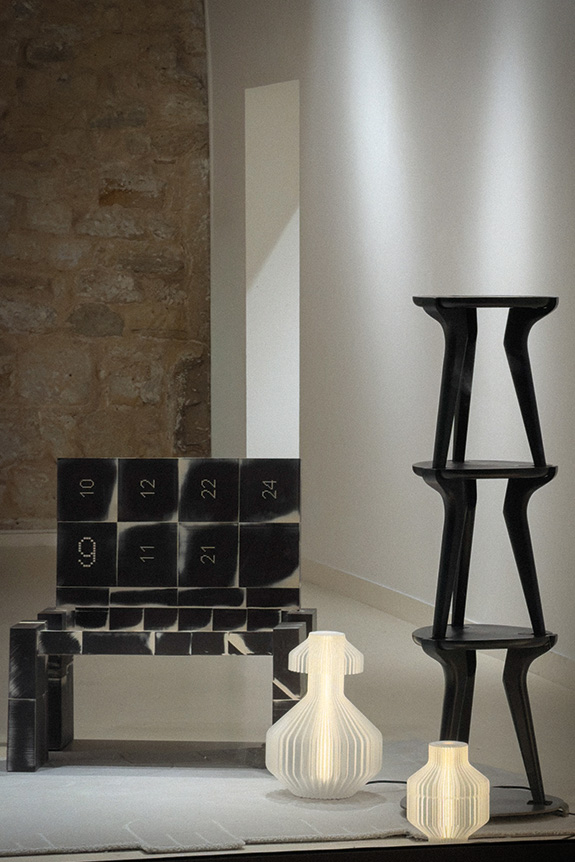
Three rooms, three worlds, three interpretations of material
For this exhibition, the designers offered new pieces from their respective worlds. First, Polimair presented its Baiji bench, a continuation of the stool of the same name introduced a few months earlier. The bench, developed in collaboration with Gabriel Fabrics, is a modular system with limitless configuration and assembly possibilities. Lucas Zito continued his experiments with 3D printing through his Patch collection, unveiling a large 240cm-long table in the dining room area, displayed alongside his Buoy lamps. Finally, the French rug design house Tapicheri, founded by Camille de Villartay, revealed the La Cité Perdue wool rug collection, designed specifically for the exhibition, with a 350 × 210 cm model as the centerpiece. "The biggest challenge of the exhibition was bringing together these three sets of ideas that are difficult to combine. On one hand, there's us, doing mass production; Camille from Tapicheri does bespoke work; and Lucas is focused on collectible, one-off pieces. So, these are projects that don't usually coexist," continues Arthur Gaudenz.
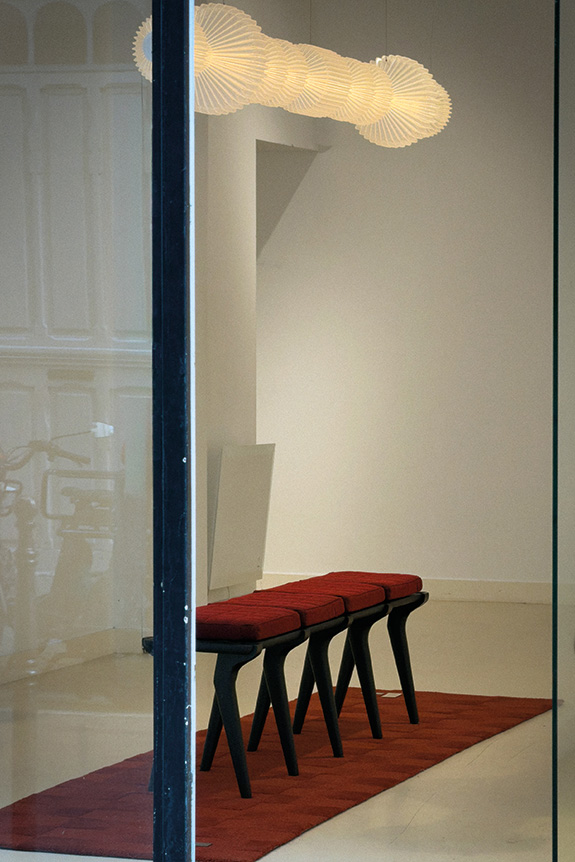
Pieces from very distinct worlds, then, but ones that, once brought together, assemble with perfect coherence. The "Trois-Pièces" exhibition successfully brought industry, technology, and craftsmanship together to offer a shared vision of contemporary living, while championing a design approach where innovation lies as much in the form as in the production method.
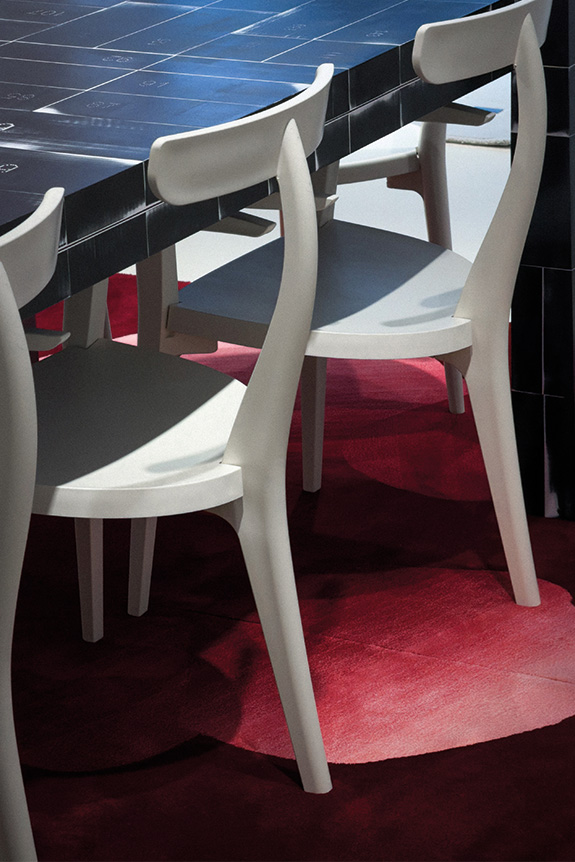
For Paris Design Week, Pierre Castignola and Alexandre Delasalle have brought together the work of 27 designers for the exhibition "take one just in case." It is a tribute to forgotten, sometimes incongruous typologies and unexpected styles.
While Paris Design Week is keen to celebrate design in all its diversity, the field remains a relatively closed concept. It was based on this observation that Alexandre Delasalle and Pierre Castignola conceived an exhibition for this September edition to celebrate alternative typologies. "Over the years and editions, we were frustrated to see that the pieces presented were generally the same, ranging from chairs to tables to mirrors. Yet, my pop-culture aesthetic and Pierre’s very classic, everyday objects don’t fit into the codes of postmodern design.", analyzes Alexandre Delasalle. Convinced that the sector is more abundant than it lets on, the duo created an exhibition celebrating neglected objects.
A heterogeneous gathering
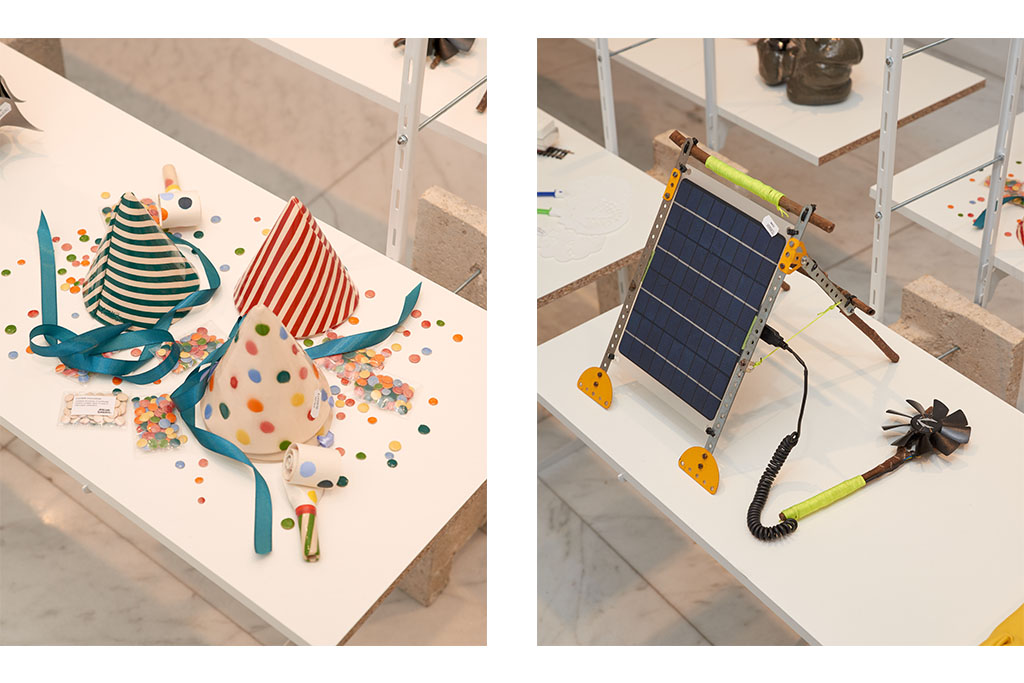
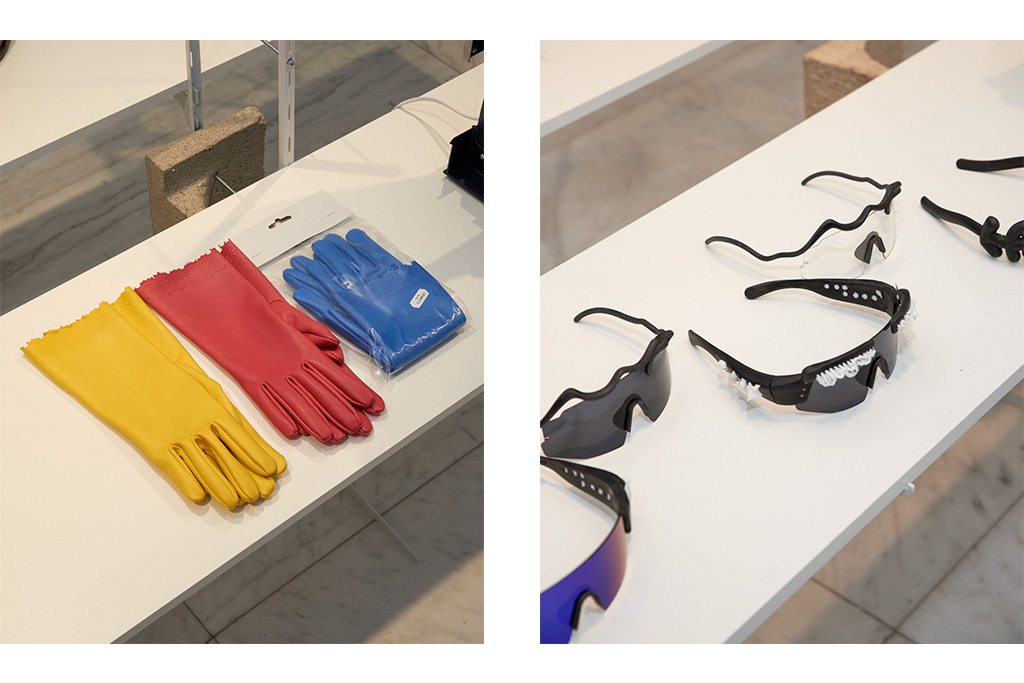
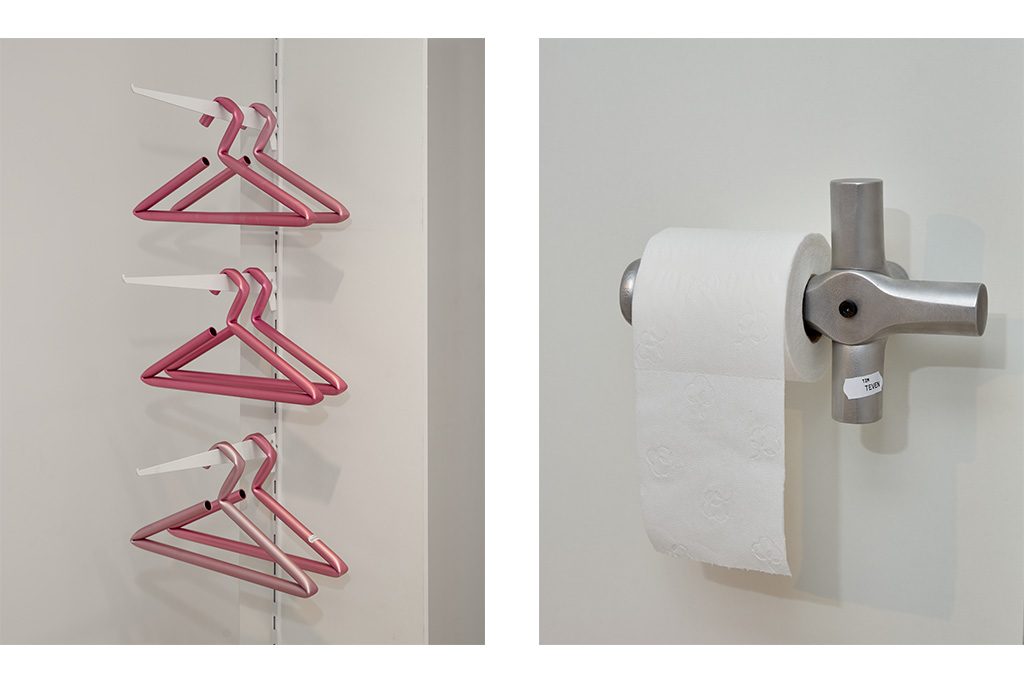
To help illustrate this diversity, the two friends invited 27 different profiles—designers and artists alike—to rework object archetypes. "Originally, Pierre and I thought of objects like a pizza cutter or a bucket, because these are objects that don't have a name in design. The former is usually inhabited by something else, like a superhero shape or an offbeat color, while the latter is so forgotten it becomes the zero degree of writing." Two opposing approaches—one loud and one silent—quickly expanded by the unique visions of the other creators. From the leather dishwashing gloves by Alice Clermont to the industrial toilet paper dispenser by Tim Teven, and the ceramic box topped with a spiked collar by visual artist Sacha Lefèvre, the approaches, sometimes very literal or more embodied, intertwine within the exhibition. "What seemed most important to us was to establish a corpus capable of surprising us. Overall, we knew all the profiles to varying degrees, but our discussions and reflections now allow us to exhibit very different objects, whether they were designed specifically for the event or not."
A creative bazaar
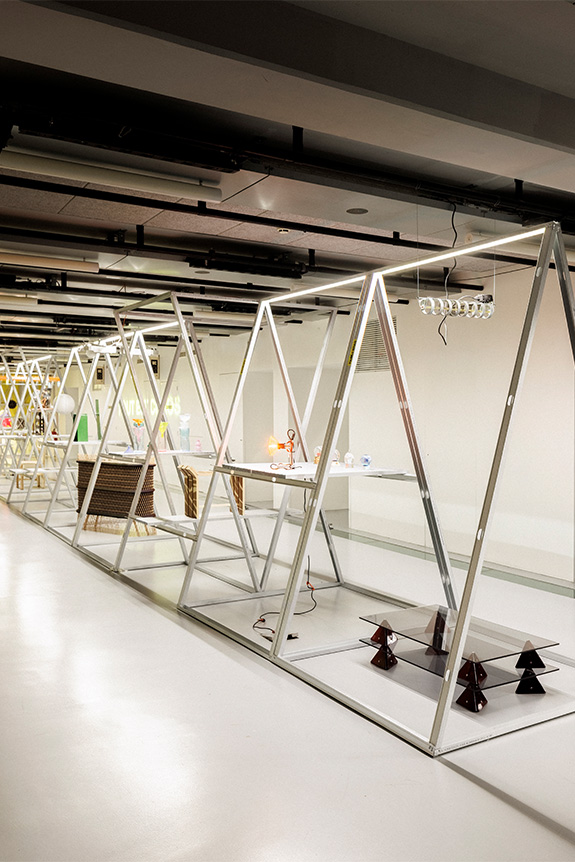
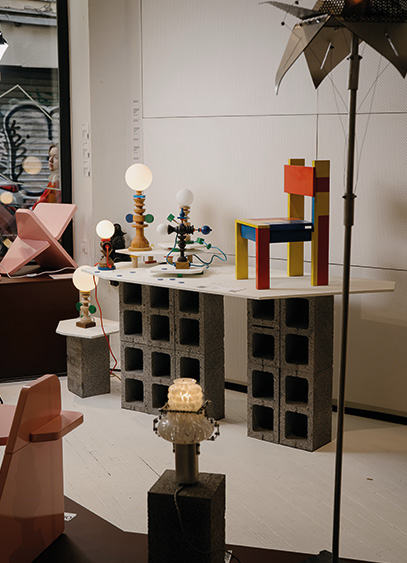
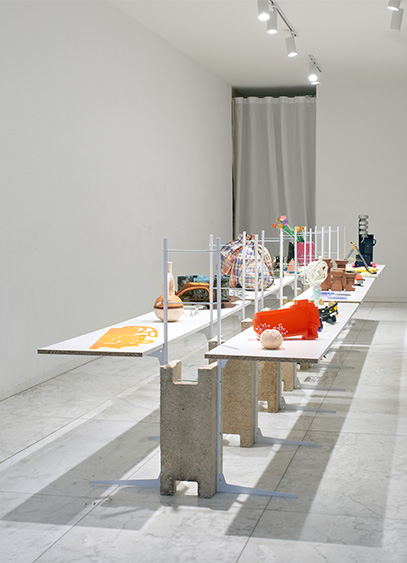
Inspired by the multitude of invisible objects that inhabit our storage spaces, Alexandre Delasalle and Pierre Castignola took an interest in bazaars. "These are spaces that bring together very contradictory elements, ranging from classics that can last a lifetime, like a frying pan, to very striking but sometimes very ephemeral things, like slippers." Drawing on the idea of these markets, the exhibition space, formerly a garage, has been shaped into a long, narrow layout. "What was interesting is that the notion of a bazaar isn't the same from one country to another. I have the one in Belleville in mind, but for other creators, it might be chain stores like Action. However, the idea of a small storefront with longitudinal aisles is common. We wanted to capture that feeling of entering the space.", explains Alexandre Delasalle. In keeping with this vision, the exhibition space features a long central shelf where a neo-futuristic hand brush and a baroque mini-fan straight out of a Disney movie engage in dialogue. "The scenography is DIY, using cinder blocks and storage racks, but it serves the concept. It’s the accumulation of a certain number of objects that gives the bazaar its spirit, not the other way around. And it’s this idea that gives 'take one just in case' a polyphonic quality," concludes the designer.
For Paris Design Week, the Chinese creative scene is taking over several venues across the capital. From the Palais-Royal to the Marais, three events showcase a movement in flux, bridging cultural heritage, experimentation, and new applications.
Long associated primarily with manufacturing, China is now carving out a new position in the international design landscape. During Paris Design Week, designers, artists, architects, and publishers are unveiling three spaces in Paris that offer diverse approaches. Far from a single aesthetic, they are united by a shared focus on craftsmanship, materials, and the dialogue between heritage and contemporary creation.
Wu Bin gives shape to time
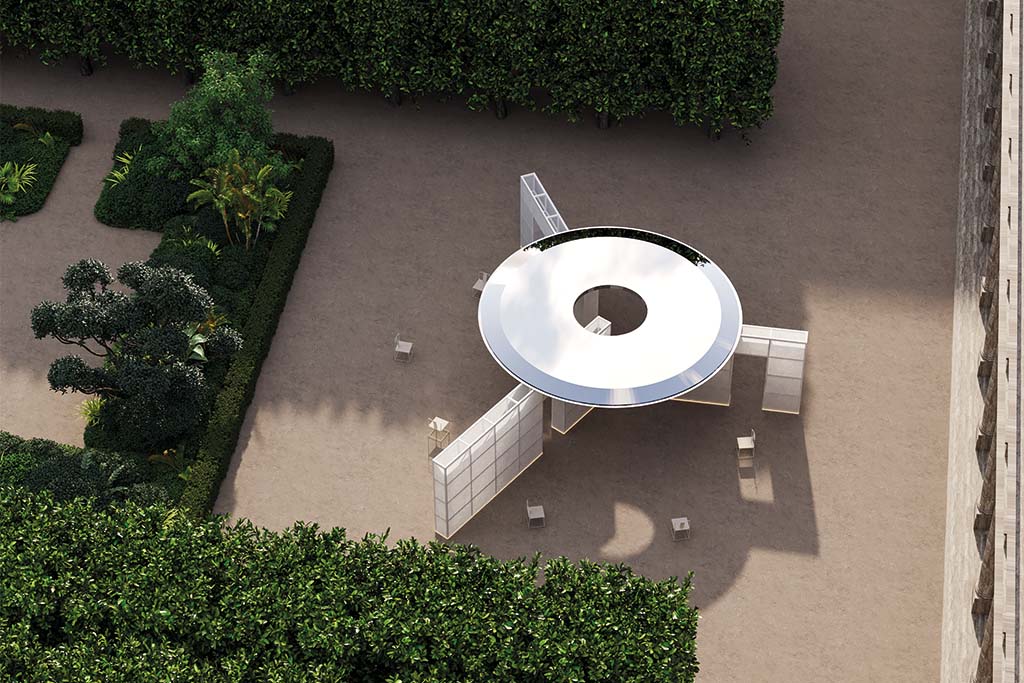
In the heart of the Palais-Royal gardens, the signature style of designer and interior architect Wu Bin is showcased through The Pavilion of Time, from September 9 to 17. Crafted from mirror-polished stainless steel and wrapped in a membrane inspired by Xuan paper, the structure evolves with the light and movement of its surroundings. Divided into three segments, the pavilion transforms throughout the day into a contemporary sundial, blurring the lines between art, design, and architecture.
"Good taste" according to Chinese design
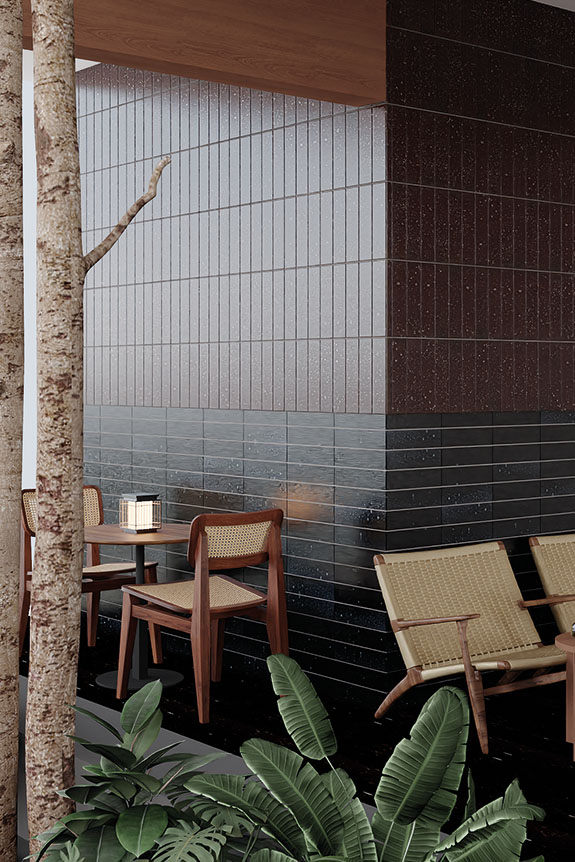
From September 10 to 14, the China Creative Pavilion brings together around twenty brands and talents at the Paris Design Week Factory. Under the theme " Good Taste!, the exhibition explores the relationship between aesthetics, sensory experience, and utility. Among the featured projects, Anta has partnered with artist Liu Tong for a paper installation inspired by its ANTA FOLD technology, while SDCC transforms discarded ceramics from Jingdezhen into architectural cladding, blending porcelain craftsmanship with a circular economy.
When art meets everyday life
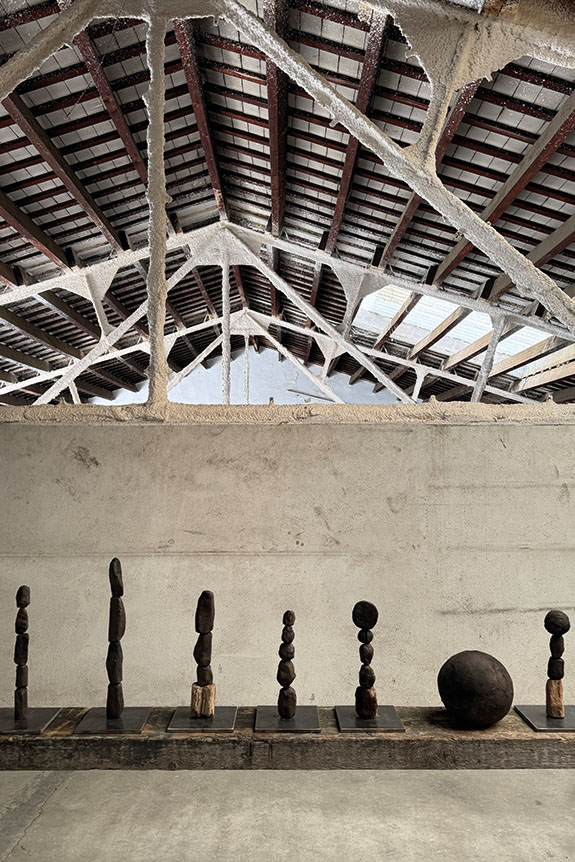
Finally, the "Form Before Form" exhibition, presented at Espace AUBE from September 9 to 19, marks the European debut of YUAN, a project founded in Beijing by Song Tao. Ceramics, painting, floral art, and organic installations converge here, reflecting a vision of design as an extension of artistic research and a way of living. Notably, ceramicist Du Qinfen presents the YUAN Collection 01, which translates her artistic vocabulary into everyday objects.
Paris Design Week returns to the capital from September 10 to 19 to celebrate design in all its forms. Here is a look at the must-see exhibitions for this year's edition.
September 5-7 : Shoppe Object Paris Trade Show, Paris Expo Porte de Versailles, 75015 Paris
September 8-27 : "Contrepoint" exhibition by Anthony Guerrée, Musée Bourdelle, 16, rue Antoine-Bourdelle, 75015 Paris
September 9 and 10 : "Trames" exhibition by Heju Studio at Tarkett, 43 Rue de Saintonge, 75003 Paris
September 9-13 : "The Light Library" exhibition by Studio Meaningful, Ideal Place Gallery, 38, rue des Gravilliers, 75003 Paris
September 9-19 : "Sotto Voce" exhibition, 3 rue Paul Bert, 75011 Paris
featuring: Clément Pasquier, Justine Ménard, Florie Berger, Mélissa Wago-Lala, Mathilde Martin and Sòler Paris
September 9-20 : The "Re-prise de la Bastille" by studio 5.5, Place de la Bastille, 75004 Paris
September 10-13 : "Trois Pièces" exhibition with Polimair, Lucas Zito and Tapicheri, 52 rue Charlot, 75003 Paris
September 11-13 : "Take one just in case" exhibition, 10 rue Tesson, 75010 Paris initiated by Pierre Castignola and Alexandre Delasalle
featuring: Augustin Puzio, Atelier Burrata, made by ASTRONAUTS, Lana Arih, Jules Barton, Tin Alaya, Pierre Castignola, Laura Casañas Maya, Alice Clermont, Alexandre Delasalle, Laura Dominici x Basil Schu, Lewis Duckworth, e8 Tableware, Tim Teven, Diego Faivre, Lucas Muñoz Muñoz, Helene Falgayrette, Olga Flor, Lino Gasparitch, LS Gomma, Ebba Studio, Flora Lechner, Anna McAllister, Mark Malecki, Johanna Pichlbauer, Jovien Panné, Sacha Lefèvre, Sigurd Schelde, Marie Verdeil
September 10-14 : Paris Design Week Factory:
Espace Commines: 17, rue Commines, 75003 Paris
Galerie Joseph: 116, rue de Turenne, 75003 Paris
Galerie Joseph: 16, rue des Minimes, 75003 Paris
Galerie Ellia: 10, rue de Turenne, 75003 Paris
September 11 and 12 : IKEA "Home of the Year", 4 rue François Miron, 75004 Paris
September 10 to 19 : PICNIC installation by Cluzel / Pluchon, Hôtel d’Albret, 31 rue des Francs Bourgeois, 75004 Paris
September 10 to 19 : "Bar Stool" Exhibition, Espace Brownstone, 26 rue Saint-Gilles, 75003 Paris, initiated by Athime de Crécy and Quentin Frichet
featuring: AC/AL, Antonin Fassio, Arthur Desmet, CPRV, Athime de Crécy, Camille Donias, Claire Lavabre, Cluzel & Pluchon, Denise Merlette, Formel Studio, François Lafortune, Guillaume Bloget, Guillaume Gindrat, Gini Moynier, Giuseppe Formica, Hugo Chaffiotte, Marine Quéré, Meta, Paul Tubiana, Quentin Frichet, Romain Sillon & Clara Ormières, Sacha Parent & Valentine Tiraboschi, Sara Decampos, Théo Leclercq & Camille Viallet, Thelonious Goupil, Tobias Brunner, and Wint Design Lab.
September 10 to 19 : Frgmnt Design Week at Heureux les curieux, 23 rue du Pont aux Choux, 75003 Paris
featuring: Alexandre Veillon, Alicia Bonnard, Amalgame Studio, Ariane Ronot, Atelier Anova, Atelier Apara, Atelier Perret, Benoit Porte-Proust, Claire Buet, Clémence Birot, Clémence Lucchini, Clément Thevenot, Céline Proust, David Jacquinot, Emma Batsheva Cohen, Faustine Perret, Florence Boujnah, Judith Chauvel-Levy, Kr.Atelier, Louis Daigre, Mahée Billères, Marine Gaillard, Marion Gaudino, Maxime Wan Meenen, Mickaël Gayet, Mileno Guillorel-Obregón, Nessim Kaufmann, Nicolas Guillamot, Olive®, Post Industrial Crafts, Richard Rondelez, Sarah Remy, Studio CoPain, Studio Évaporer, Studio Jumel, Tancrède de Beaumont, Théo Laverne, Valentin Bony, Vincent Cassat, Yohan Thomas in collaboration with Etnisi, La Tête Dans Les Nuages, La Fabrique Materia, Matériaux Urbains, NaturLoop, Pierre Plume, Reed Material, Renature Materials and Tissium
September 10 to 27 : Paris Design Week at BHV Marais, 52 rue de Rivoli, 75004 Paris
featuring: Jean-Baptiste Durand and Simon Geringer, Théo Charasse with Vous pouvez dormir dans la grange, Gaspard Fleury-Dugy, Laure Philippe with studio BrichetZiegler, Gregory Lacoua and BehaghelFoiny
September 10 to October 3 : "Multiples" Exhibition, Galerie des Ateliers de Paris, 30 rue du Faubourg Saint-Antoine, 75012 Paris
featuring: Camille Viallet & Théo Leclercq, Cluzel / Pluchon, CPRV, Jules Levasseur, Julie Richoz, Kevin Lebouvier - Klaes studio, Laure Philippe, Lila Guédin, Lucien Icard, Nicolas Verschaeve, Selah Creative Office, Studio Poirier Bailay, Valentine Tiraboschi & Sacha Parent, Thelonious Goupil and Unknown Untitled
September 10 to October 4 : "La Tempête" Exhibition by Jérémy Pradier-Jeauneau with Fermob, Arc de Triomphe, Place Charles de Gaulle, 75008 Paris
September 10 to October 10 : "Under Pressure" Exhibition by Marie and Alexandre, Galerie Signé, 33 Rue Bonaparte, 75006 Paris
September 11 to October 31 : "Petals" exhibition by Patrick Jouin, Galerie de Sèvres, 4 place André Malraux, 75001 Paris

Pendant la Paris Design Week, Florence Bourel présentait la collection Mexican Boudoir, réalisée en collaboration avec M éditions et Toulemonde Bochart. Déjà présentée en avril au Labo à Milan, la collection se compose de 5 pièces, toutes confectionnées à partir de chutes de matériaux.
Connue pour aimer mixer les influences et les savoir-faire, Florence Bourel s’est associée à M éditions et Toulemonde Bochart pour cette collection au parti-pris fort puisque celle-ci est conçue à partir de matériaux recyclés. Une collection dont le nom, Mexican Boudoir, laisse peu de place à l’interprétation, puisqu’il s’inspire directement d’un voyage au Mexique de la designeuse. Un pari audacieux, mais dont le résultat parle de lui-même.

Une collection aux lignes géométriques
La collection est composée d’un fauteuil et de deux tables basses édités par M Editions spécialisés dans les produits en marbre et travertin, de deux tapis en laine confectionnés par Toulemonde Bochart et d’un paravent en cuir, signé par le studio Florence Bourel. Inspirée de l’architecture mexicaine, la collection Mexican Boudoir est à la fois poétique et colorée, arborant des lignes géométriques et des formes communes entre chaque pièce, quand bien même celles-ci ne sont pas toutes du même éditeur ou faites avec le même matériau.

Un défi esthétique et responsable
Mexican Boudoir n’est pas simplement une réalisation esthétique, elle est surtout un engagement fort de la part de la designeuse avec les éditeurs. En effet, tous les produits sont réalisés à partir de chutes de matériaux ou de stocks inutilisés. Les tables basses et le fauteuil par exemple, sont réalisés à partir de fragments de blocs de pierres, rendant ainsi chaque pièce unique. En effet, Jean-Pascal Morvidoni, marbrier depuis 3 générations et fondateur de la maison d’édition en 2019, souhaitait mettre la pierre en valeur différemment, à travers une série de collections avec une démarche plus responsable. Pari tenu !


À l’occasion de l’ouverture du nouveau magasin Ikea, Place d’Italie à Paris, l’enseigne suédoise a fait appel au designer Anthony Authié, fondateur de Zyva Studio pour imaginer un concept de chambre holistique, entre rêve et réalité.
Imaginer des solutions destinées spécifiquement aux espaces de vie des Parisiens n’avait jusqu’ici jamais été fait. Au sein de son nouveau magasin Place d’Italie, ouvert le 12 septembre dernier, Ikea passe un nouveau cap. Contrairement à l’offre que l’on pouvait retrouver au sein du IKEA de la Madeleine, celui-ci, implanté au cœur de Paris, dispose de la même offre que les enseignes situés hors de Paris. Une gamme de choix proposants plus de 5000 produits, dont 3000 disponibles en libre-service. Pour célébrer ce nouveau tournant, et la Paris Design Week par la même occasion, Ikea s’est associé à Zyva Studio, fondé par Anthony Authié pour imaginer sa « chambre idéale ».

Un concept entre rêve et réalité
Prenant le pas sur la Paris Design Week et son désir de faire évoluer les chambres des Parisiens, Ikea s’est approché d’Anthony Authié pour penser un concept de chambre, qu'il décrit comme "un espace immersif et expérientiel", adapté encore une fois puisque celle-ci mesure 9 m2. « On pense souvent que bien dormir, c’est juste un bon matelas et un oreiller, mais je pense que c’est tout un éco-système et contexte à prendre en compte. L’intime et la personnalité qu’on met dans cette pièce sont importants pour être en phase dans le lieu dans lequel on vit. C’est important que chaque espace soit vécu » racontait Anthony Authié. Il propose ainsi un espace monochrome avec des nuances de bleu, qui fait penser à un monde imaginaire voir cartoonesque selon les termes du designer. De quoi se laisser tenter par un moment de rêve, au sens propre comme figuré.

Un focus particulier sur le sommeil
Pour agencer les intérieurs du magasin et ses fameux espaces aménagés qui sont propres à Ikea, les équipes se sont appuyés sur les intérieurs des premiers concernés : les Parisiens eux-mêmes. En effet, les 20 espaces aménagés, dont 4 « home », s’inspirent directement des appartements parisiens, à la superficie souvent réduites. « Toutes les solutions apportées sont développées à partir des besoins des Parisiens. Nous les avons rencontrés pour comprendre leurs frustrations et leurs envies » déclaraient les membres de l'équipe d’IKEA présents pour l’inauguration. Plus spécifiquement, le challenge autour de cette ouverture a été de mettre en avant l’espace chambre, et plus spécifiquement de se pencher sur le sommeil. En effet, d’après les études réalisées par la marque, 77 % des Français seraient conscients de l’impact du sommeil sur le bien-être tandis que 81 % pensent que la chambre est la pièce la plus intime de nos intérieurs. Pour autant, elle est très souvent négligée. Ainsi, les équipes se sont penchées sur la question pour travailler autour de 6 grands pôles : confort, nuisances sonores, température, éclairage, rangement et personnalisation, avec l’objectif de proposer des solutions larges et adaptées.

JSBlanc2024-min.jpg)
Pendant la Paris Design, le studio 5.5 dévoilait MUJI MUJI, une nouvelle collection de 12 objets « ready-made », en collaboration avec Muji et présentés au sein d’une maison manifeste installée rue des Francs-Bourgeois. Un habitat basé sur l’essentiel, qui invite à se questionner sur nos modes de vie.
Reconnus comme de véritables pionniers de l’upcycling, les designers Claire Renard et Jean-Sébastien Blanc, co-fondateurs du studio 5.5, ont eu envie de pousser leur réflexion encore plus loin. Accompagnés de Muji, avec lesquels ils ont travaillé sur le projet pendant 2 ans, les designers avait cette volonté de questionner nos modes de vie actuels en imaginant un espace de vie modulable. « On s’est rendu compte en tant que designers qu’on a un tas d’objets qui ne servent à rien » raconte Jean-Sébastien Blanc. Un constat qui avait été fait pendant la période de confinement, qui avait fait naître chez les designers une envie de reconsidérer leur façon de vivre et leur rapport aux objets.
JSBlanc2024-min.jpeg)
Une maison manifeste, modulable et suffisante
Répartie en différents modules : la chambre, la salle de bain, la cuisine ou l’espace atelier pensé dans le but de pousser à plus de travail manuel, la maison MUJI est une solution de 15 m2 pensée pour répondre aux besoins du plus grand nombre, tout en se focalisant sur l’essentiel. « Nous avons imaginé un habitat à géométrie variable, qui peut être agrandit ou rétrécit grâce aux différents blocs. Le but étant de s’adapter aux modes de vie de chacun » continue Jean-Sébastien Blanc. Chaque pièce est ainsi optimisée afin de ne pas perdre de place inutilement. De plus, tout ce qui est proposé à l’intérieur est pensé avec ce qu’il y a à l’extérieur.

Un habitat respectueux de l’environnement, d’abord car il est posé « comme un meuble » et n’impacte donc pas directement l’espace où il est placé. Ensuite, l’ensemble des éléments qui le compose ont été pensés autour d’une « réflexion saine et grâce à des solutions astucieuses », pour reprendre les mots de Claire Renard.
12 objets ready-made
Pour équiper l’espace, le studio 5.5 présente une collection de 12 objets dits « ready-made », car des derniers sont imaginés à partir de collections déjà existantes. « Les produits Muji sont intemporels, bien dessinés et s’inscrivent dans la durée. Ils se questionnent vraiment sur ce qui est essentiel. On ne parle ici plus de matière première, mais d’objets premiers » explique Claire Renard. Ainsi, aucun nouveau dessin d’objet n’a été réalisé pour cette collection, c'est leur fonction qui a été repensée. L’objectif final étant de pousser les utilisateurs à créer leurs propres objets en fonction de leurs besoins, toujours à partir des collections existantes.

Du 5 au 9 septembre, Intramuros ouvre l’Intramuros Galerie pour présenter le numéro 221 #Collector et exposer 6 créateurs, à retrouver à Ellia Galerie, 10 rue de Turenne.
Le collectif Loup & Cheyenne est composé de personnes issues du monde des arts, du design, de la mode, et plus globalement, de la culture urbaine et suburbaine. Inspiré par la ville dans son ensemble, le collectif imagine des vélos d’occasion, tous conçus dans leur atelier à partir d’un assemblage de pièces détachées, rendant ainsi chaque modèle unique. Une conception sur mesure, qui prend en compte les menstruations bien évidemment, mais pas seulement. L’idée des vélos Loup & Cheyenne est d’intégrer au sein du modèle, les déplacements quotidiens de l’utilisateur, le style de vie à vélo, le quartier ou l'endroit où le vélo va être attaché, ce qui déduit un modèle, un poids et des accessoires fournis propre à chaque client. Au sein de l’Intramuros Galerie, ils exposent deux modèles uniques au prix de 850€.


Du 5 au 9 septembre, Intramuros ouvre l’Intramuros Galerie pour présenter le numéro 221 #Collector et exposer 6 créateurs, à retrouver à Ellia Galerie, 10 rue de Turenne.
Conçue en 2015 par Oliver et Merlin Ouboter, la Microlino est un modèle de voiture citadine dernière génération. Celle-ci peut atteindre une vitesse maximale de 90 km/h et ne mesure que 2,52m de long, ce qui lui permet de se garer partout puisqu’elle ne nécessite qu’un tiers de place de stationnement classique. Malgré sa taille réduite, l’hémicycle de la Microlino permet d’accueillir deux adultes côte à côte et d’avoir un volume de coffre de 230 litres. En termes d’esthétique, le modèle est disponible en 10 couleurs différentes, dispose d’un toit ouvrant ainsi que d’un mode sport, lui conférant un véritable statut de véhicule lifestyle. Déjà présentée en exclusivité en partenariat avec Intramuros lors de la Paris Design Week 2023, la Microlino fait son grand retour à l’Intramuros Galerie.


Créée par la start-up Urban Native, la trottinette électrique T9 est un condensé de technologie et de puissance, associé à un design dans l'air du temps.
Fondée en 2017, la Start-up Urban Native est spécialisée dans la mobilité urbaine. Leur trottinette T9 (3300€), présentée à l’Intramuros Galerie est le résultat de 5 ans de travail et de développement. Dans l’air du temps, cette trottinette dernière génération allie puissance, robustesse et design. Electrique, la T9 c’est jusqu’à 25 km d’autonomie en une seule charge, une distance suffisante pour effectuer ses déplacements quotidiens. Composé d’un cadre en titane, le modèle T9 est ultra-léger puisqu’il pèse moins de 10 kg, afin de conférer un confort de transport à tous ses utilisateurs, surtout dans un cadre urbain.


Du 5 au 9 septembre, Intramuros ouvre l’Intramuros Galerie pour présenter le numéro 221 #Collector et exposer 6 créateurs, à retrouver à Ellia Galerie, 10 rue de Turenne.
Designer d’objet et d’espace, Patrick de Glo de Besses est diplômé de l'École des Beaux-Arts de Saint-Etienne et post-diplômé des arts décoratifs de Paris. Avant de se lancer à son compte, il fait ses débuts chez Andrée Putman, dont il garde le souvenir d’un contexte de création à la fois libre et encadré. Aujourd'hui, il oscille entre des projets de scénographie d'expositions, aménagements intérieurs, création et production de luminaires et mobiliers pour les particuliers, entreprises ou institutions. Depuis peu, il s’est également rapproché d’éditeurs pour faire vivre ses pièces autrement. En parallèle, développe un aspect de recherche personnelle qui révèle une appétence pour les systèmes constructifs relevant à la fois de la structure et du motif, un goût pour le décoratif, la mise en scène et les fonctions ouvertes. Par ailleurs, ses recherches autour de la structure et de l'ornement sont présentés à la Granville Gallery et à la galerie ColletPark à Paris. En plus de son activité de designer, il enseigne à l'École Nationale Supérieure de Création Industrielle (ENSCI- Les Ateliers) et le mobilier à l'École Nationale Supérieure d'Architecture Paris-Belleville.

A l’Intramuros Galerie, il présente trois chaises. La chaise Hommage au carré (560€), en contre plaqué d'okoumé et stratifié carnation et or, la chaise Biseautée (660€), construite en épicéa massif et dont la ceinture et les montants taillés en biseaux, encadrent de fines planchettes. Enfin, la chaise trapèze en épicéa massif, taillée à partir d’une planche dont l’ensemble est construit par un jeu d’assemblage et avec un dossier flanqué sur les montants arrières est sculpté en forme de prisme, et biseauté en trapèze.


Du 5 au 9 septembre, Intramuros ouvre l’Intramuros Galerie pour présenter le numéro 221 #Collector et exposer 6 créateurs, à retrouver à Ellia Galerie, 10 rue de Turenne.
Fondé en 2019 par Arthur et Maceo Joas, Infrastructure Studio est un studio de création pluridisciplinaire qui s’étend sur plusieurs domaines du design et de l’architecture. Du design mobilier à la conception de vêtements, le studio se spécialise dans une variété de supports et cherche à montrer sa vision de la ville à travers ses yeux, en s’inspirant de l’environnement urbain et des formes qui les entoure.
Pour l’Intramuros Galerie, ils présentent la table Fragment (2200€), premier meuble conçu et réalisé dans leur atelier d'Aubervilliers. Inspirée de la carrosserie et de la mécanique automobile, cette table est soutenue par quatre pieds en profilés Rexroth. Dans la lignée de cette collection, ils présentent en exclusivité le tabouret Fragment (600€)

Les Geo candle (40€) quant à elles puisent leur forme dans les infrastructures urbaines que l’on croise au quotidien. Chaque bougie a été soigneusement sélectionnée et conçue pour être le reflet de notre environnement urbain et transmettre notre fascination pour cet esthétique industriel. À travers ces bougies, les designers cherchent à évoquer la beauté cachée des éléments urbains ordinaires, mais aussi transmettre leur fascination pour cette esthétique industriel.


.svg)


.svg)