


Biomatériau
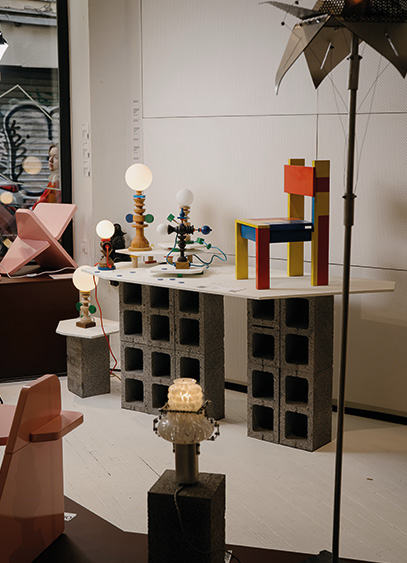
Following an initial event in June, Frgmnt decided to repeat the experience for Paris Design Week by presenting its first exhibition, titled "Edition 01." On view until September 19, the show aims to put "the materials no one looks at" in the spotlight.
For its first participation in Paris Design Week, Frgmnt selected 43 designers and 11 material manufacturers, brought together to showcase a process and pieces imagined from forgotten or discarded industrial materials, scraps, and waste. Initiated by Meryl Benitah, the Frgmnt project began as a creative challenge launched last June. Over 48 hours, groups of designers, paired up for the occasion, imagined pieces using mediums often considered "undesirable". From wood to metal, the project also incorporated new materials, such as the one designed by Etnisi from windshields, or the Tissium developed by the company Maximum. "It was a bit like a hackathon format, but dedicated to design. We started with materials that were either salvaged or upcycled to show that reuse or even a second life can be desirable. Even though the participants didn't know each other, a certain creative synergy quickly emerged, and groups formed rapidly, managing to produce pieces in just two days", says Meryl Benitah.
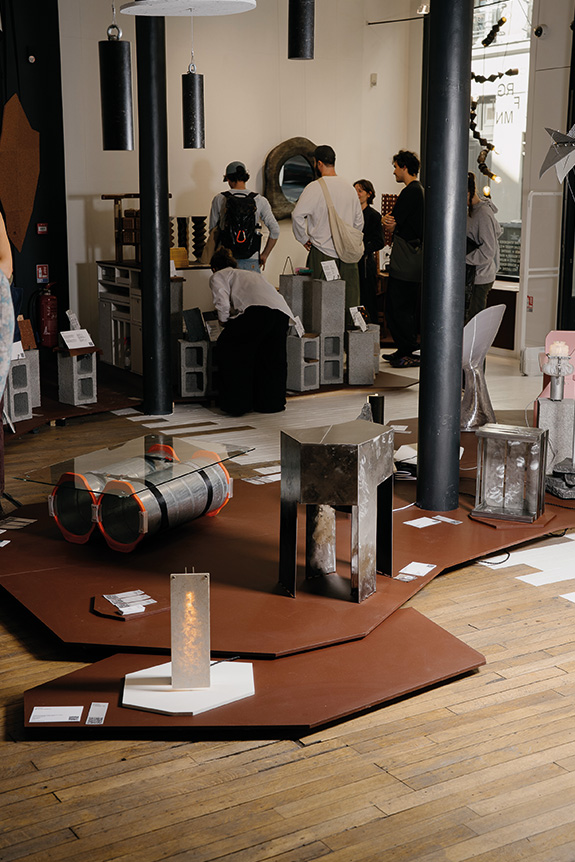
This initiative caught the attention of Sabrina Piperno, manager of the Heureux les Curieux space, who wanted to support the project by inviting Frgmnt to exhibit during Paris Design Week in September. "For this edition, the idea was to invite other material manufacturer partners to create, on one hand, this material library, and on the other, to bring in designers with the same approach. Whether through the material itself or the design manufacturing process", continues Meryl Benitah.
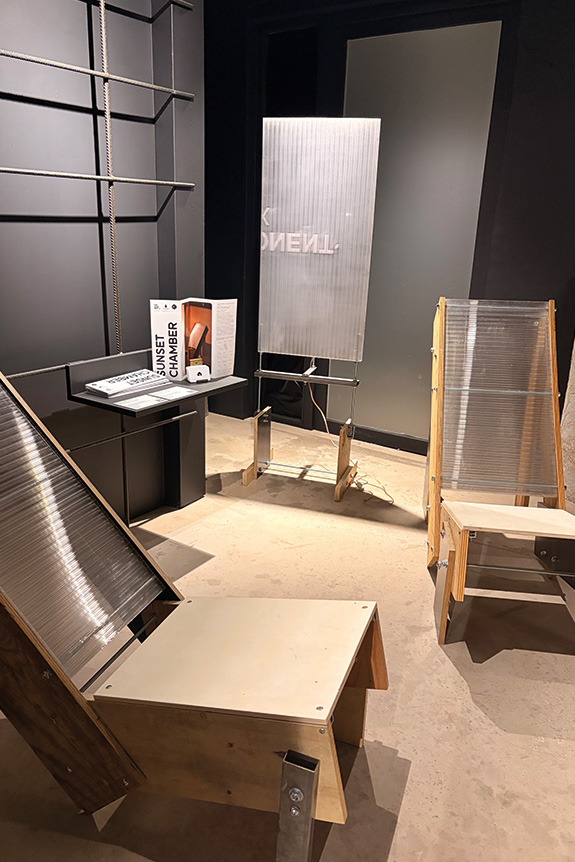
A new way of thinking about material
Spread over two floors, the exhibition presents unique worlds, united by a single ambition: to create from what already exists or to explore the potential of new materials. "There are many ways to make a well-designed object that meets market needs. Some use reuse, others respond through the material, while some do it through function. But they all tell a story through a piece, always asking how to create objects that are desirable in the long term." This inquiry led designers to partner with manufacturers, such as hors-studio, whose Caretta Caretta lamp was made from Celullio, a material developed in collaboration with Matériaux Urbains. The latter is also the creator of Paperio, a new medium that Atelier Alcova used to bring Tecto to life. Meanwhile, other creators are presenting original pieces born from their own unique processes. Notable examples include Atelier Perret, creator of the Séléné pendant light made from coffee grounds; the T65 vase designed from bread by studio Copain; and Emma Batsheva Cohen’s concept focused on optimizing vegetable leather.
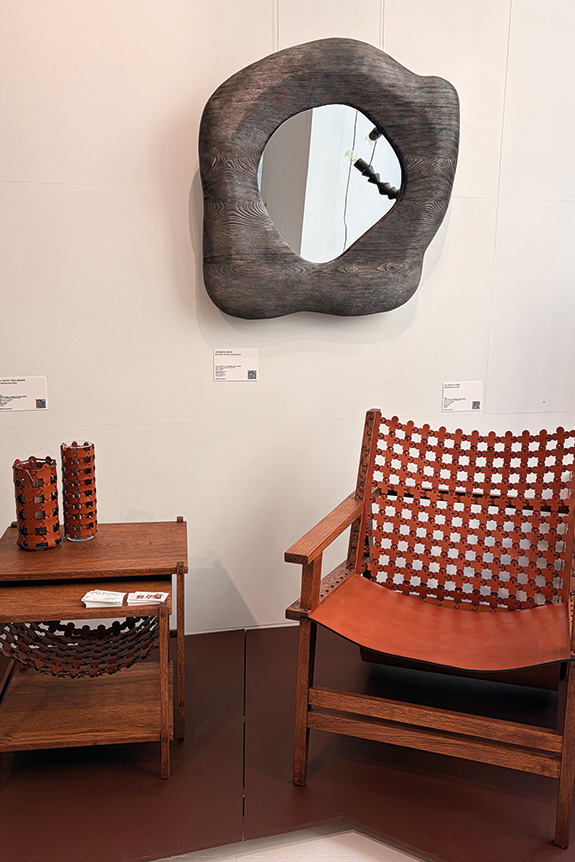
Fostering connections
These diverse profiles and explored avenues aim to demonstrate that materials, initially overlooked, can become desirable once design takes hold of them. "My personal goal is to foster this link between manufacturers, designers, and specifiers by creating a beautiful ecosystem that will encourage them to collaborate and allow these pieces to find their way into hotels, restaurants, and support their development on a larger scale." With this exhibition, Meryl Benitah intends to build new bridges between key sectors of the design industry.

En mettant au point des échantillons de textiles conçus et fabriqués à partir d’un fil issu d’un processus durable de recyclage de textiles usagés mixtes, le collectif de designers Envisions, en collaboration avec un consortium international d’entreprises et d’institutions* ouvre la voie à une industrie textile soutenable, pour de multiples applications (architecture, automobile, mobilier, mode, etc.).
Aujourd’hui, les fils recyclés ne sont produits qu’à partir de déchets triés (laine déchiquetée, bouteilles en PET ou déchets plastiques des océans). Pourtant, selon la fondation Ellen Mac Arthur, l’équivalent en volume d’un camion poubelle de textile est enfoui ou brûlé chaque seconde. Le gisement de ressource est donc énorme. Mais pour le moins hétéroclite : une grande partie des déchets textiles est constituée d’un mélange de fibres (T-Shirt en coton et élasthanne ou polyester, par exemple), très variables en qualité, colorées, etc., impossibles à trier. D’où leur destruction ou leur recyclage, en faible volume, en matériau d’isolation.


Initié en 2013 par un consortium international*, sous la houlette du bureau d’études allemand Imat-Uve, le projet de recherche Fibers Unsorted a permis la mise au point d’une technique mécanique de déconstruction des textiles usagés, sans procédés chimiques de traitement, afin d’en faire des fibres mixtes, suffisamment longues pour être filées, puis d’un fil capable de répondre aux standards industriels les plus exigeants, notamment dans le secteur automobile.Au cours du processus, seules 15 % des fibres sont évacuées (trop courtes ou inadaptées à un traitement mécanique, le carbone notamment).

C’est autour de la création de textiles à partir de ce fil mixte et de la projection d’applications pour ce tissu qu’a été consulté le collectif de designers Envisions. À partir du fil gris brut, les designers ont ainsi développé une série de propositions textiles aux motifs et tissages variés, travaillant les notions de tactilité et de texture, jouant aussi avec d’autres couleurs, en ajoutant, dans la limite de 20 % du fil polyester recyclé coloré. Une installation lors de la Dutch Design Week en 2021 complétait la proposition pour mieux projeter l’industrie du textile dans un futur soutenable. Une approche, qui démontre à nouveau que le mode collaboratif entre design, sciences, organisations et industrie reste un levier puissant du changement. Réjouissant !
*Le consortium, en partie financé par l’Union Européenne, est composé d’Imat-Uve, C2C ExpoLab, FB Basic, Texperium, Trüzschler et Brain of Materials.

.svg)


.svg)